Centre for Cancer Genetic Epidemiology, Department of Public Health and Primary Care, University of Cambridge, Cambridge, UK.
The Netherlands Cancer Institute, Department of Epidemiology (PSOE), Amsterdam, The Netherlands.
Genet Med. 2020 Oct;22(10):1653-1666. doi: 10.1038/s41436-020-0862-x. Epub 2020 Jul 15.
We assessed the associations between population-based polygenic risk scores (PRS) for breast (BC) or epithelial ovarian cancer (EOC) with cancer risks for BRCA1 and BRCA2 pathogenic variant carriers.
Retrospective cohort data on 18,935 BRCA1 and 12,339 BRCA2 female pathogenic variant carriers of European ancestry were available. Three versions of a 313 single-nucleotide polymorphism (SNP) BC PRS were evaluated based on whether they predict overall, estrogen receptor (ER)-negative, or ER-positive BC, and two PRS for overall or high-grade serous EOC. Associations were validated in a prospective cohort.
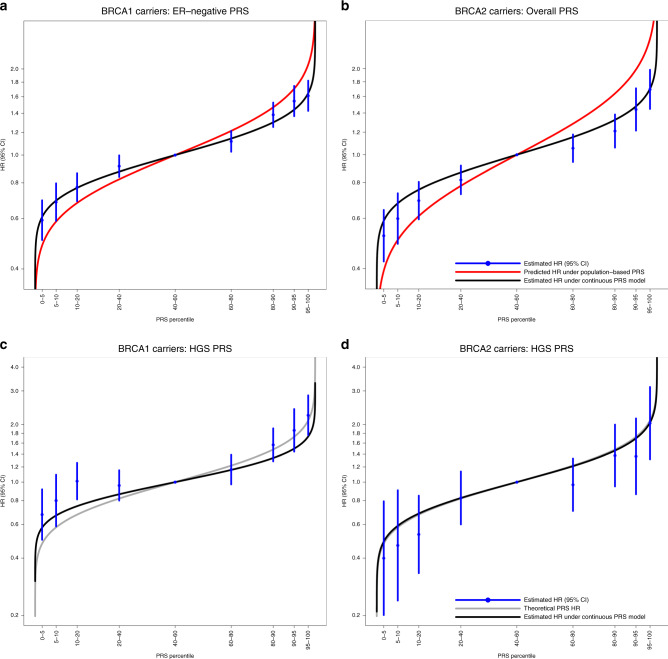
The ER-negative PRS showed the strongest association with BC risk for BRCA1 carriers (hazard ratio [HR] per standard deviation = 1.29 [95% CI 1.25-1.33], P = 3×10). For BRCA2, the strongest association was with overall BC PRS (HR = 1.31 [95% CI 1.27-1.36], P = 7×10). HR estimates decreased significantly with age and there was evidence for differences in associations by predicted variant effects on protein expression. The HR estimates were smaller than general population estimates. The high-grade serous PRS yielded the strongest associations with EOC risk for BRCA1 (HR = 1.32 [95% CI 1.25-1.40], P = 3×10) and BRCA2 (HR = 1.44 [95% CI 1.30-1.60], P = 4×10) carriers. The associations in the prospective cohort were similar.
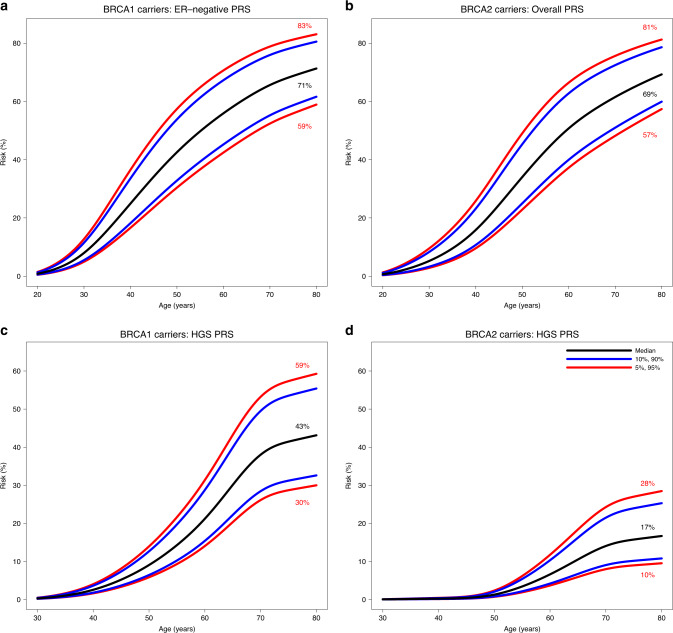
Population-based PRS are strongly associated with BC and EOC risks for BRCA1/2 carriers and predict substantial absolute risk differences for women at PRS distribution extremes.
我们评估了基于人群的多基因风险评分(PRS)与 BRCA1 和 BRCA2 致病性变异携带者乳腺癌(BC)或上皮性卵巢癌(EOC)风险之间的关联。
我们获得了 18935 名欧洲裔 BRCA1 和 12339 名 BRCA2 女性致病性变异携带者的回顾性队列数据。评估了三种基于是否预测总体、雌激素受体(ER)阴性或 ER 阳性 BC 的 313 个单核苷酸多态性(SNP)BC PRS 版本,以及两种用于总体或高级别浆液性 EOC 的 PRS。在一个前瞻性队列中验证了关联。
ER 阴性 PRS 与 BRCA1 携带者的 BC 风险相关性最强(每标准差风险比 [HR] = 1.29 [95% CI 1.25-1.33],P = 3×10)。对于 BRCA2,最强的关联是总体 BC PRS(HR = 1.31 [95% CI 1.27-1.36],P = 7×10)。HR 估计值随年龄显著下降,并且存在预测变异对蛋白质表达影响的关联差异的证据。HR 估计值小于一般人群的估计值。高级别浆液性 PRS 与 BRCA1(HR = 1.32 [95% CI 1.25-1.40],P = 3×10)和 BRCA2(HR = 1.44 [95% CI 1.30-1.60],P = 4×10)携带者的 EOC 风险相关性最强。前瞻性队列中的关联相似。
基于人群的 PRS 与 BRCA1/2 携带者的 BC 和 EOC 风险密切相关,并预测 PRS 分布极端的女性存在实质性的绝对风险差异。