Barnes Daniel R, Silvestri Valentina, Leslie Goska, McGuffog Lesley, Dennis Joe, Yang Xin, Adlard Julian, Agnarsson Bjarni A, Ahmed Munaza, Aittomäki Kristiina, Andrulis Irene L, Arason Adalgeir, Arnold Norbert, Auber Bernd, Azzollini Jacopo, Balmaña Judith, Barkardottir Rosa B, Barrowdale Daniel, Barwell Julian, Belotti Muriel, Benitez Javier, Berthet Pascaline, Boonen Susanne E, Borg Åke, Bozsik Aniko, Brady Angela F, Brennan Paul, Brewer Carole, Brunet Joan, Bucalo Agostino, Buys Saundra S, Caldés Trinidad, Caligo Maria A, Campbell Ian, Cassingham Hayley, Christensen Lise Lotte, Cini Giulia, Claes Kathleen B M, Cook Jackie, Coppa Anna, Cortesi Laura, Damante Giuseppe, Darder Esther, Davidson Rosemarie, de la Hoya Miguel, De Leeneer Kim, de Putter Robin, Del Valle Jesús, Diez Orland, Ding Yuan Chun, Domchek Susan M, Donaldson Alan, Eason Jacqueline, Eeles Ros, Engel Christoph, Evans D Gareth, Feliubadaló Lidia, Fostira Florentia, Frone Megan, Frost Debra, Gallagher David, Gehrig Andrea, Giraud Sophie, Glendon Gord, Godwin Andrew K, Goldgar David E, Greene Mark H, Gregory Helen, Gross Eva, Hahnen Eric, Hamann Ute, Hansen Thomas V O, Hanson Helen, Hentschel Julia, Horvath Judit, Izatt Louise, Izquierdo Angel, James Paul A, Janavicius Ramunas, Jensen Uffe Birk, Johannsson Oskar Th, John Esther M, Kramer Gero, Kroeldrup Lone, Kruse Torben A, Lautrup Charlotte, Lazaro Conxi, Lesueur Fabienne, Lopez-Fernández Adria, Mai Phuong L, Manoukian Siranoush, Matrai Zoltan, Matricardi Laura, Maxwell Kara N, Mebirouk Noura, Meindl Alfons, Montagna Marco, Monteiro Alvaro N, Morrison Patrick J, Muranen Taru A, Murray Alex, Nathanson Katherine L, Neuhausen Susan L, Nevanlinna Heli, Nguyen-Dumont Tu, Niederacher Dieter, Olah Edith, Olopade Olufunmilayo I, Palli Domenico, Parsons Michael T, Pedersen Inge Sokilde, Peissel Bernard, Perez-Segura Pedro, Peterlongo Paolo, Petersen Annabeth H, Pinto Pedro, Porteous Mary E, Pottinger Caroline, Pujana Miquel Angel, Radice Paolo, Ramser Juliane, Rantala Johanna, Robson Mark, Rogers Mark T, Rønlund Karina, Rump Andreas, Sánchez de Abajo Ana María, Shah Payal D, Sharif Saba, Side Lucy E, Singer Christian F, Stadler Zsofia, Steele Linda, Stoppa-Lyonnet Dominique, Sutter Christian, Tan Yen Yen, Teixeira Manuel R, Teulé Alex, Thull Darcy L, Tischkowitz Marc, Toland Amanda E, Tommasi Stefania, Toss Angela, Trainer Alison H, Tripathi Vishakha, Valentini Virginia, van Asperen Christi J, Venturelli Marta, Viel Alessandra, Vijai Joseph, Walker Lisa, Wang-Gohrke Shan, Wappenschmidt Barbara, Whaite Anna, Zanna Ines, Offit Kenneth, Thomassen Mads, Couch Fergus J, Schmutzler Rita K, Simard Jacques, Easton Douglas F, Chenevix-Trench Georgia, Antoniou Antonis C, Ottini Laura
Centre for Cancer Genetic Epidemiology, Department of Public Health and Primary Care, University of Cambridge, Cambridge, UK.
Department of Molecular Medicine, Sapienza University of Rome, Rome, Italy.
J Natl Cancer Inst. 2022 Jan 11;114(1):109-122. doi: 10.1093/jnci/djab147.
Recent population-based female breast cancer and prostate cancer polygenic risk scores (PRS) have been developed. We assessed the associations of these PRS with breast and prostate cancer risks for male BRCA1 and BRCA2 pathogenic variant carriers.
483 BRCA1 and 1318 BRCA2 European ancestry male carriers were available from the Consortium of Investigators of Modifiers of BRCA1/2 (CIMBA). A 147-single nucleotide polymorphism (SNP) prostate cancer PRS (PRSPC) and a 313-SNP breast cancer PRS were evaluated. There were 3 versions of the breast cancer PRS, optimized to predict overall (PRSBC), estrogen receptor (ER)-negative (PRSER-), or ER-positive (PRSER+) breast cancer risk.
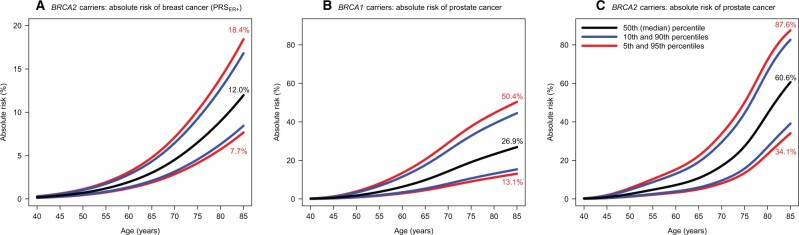
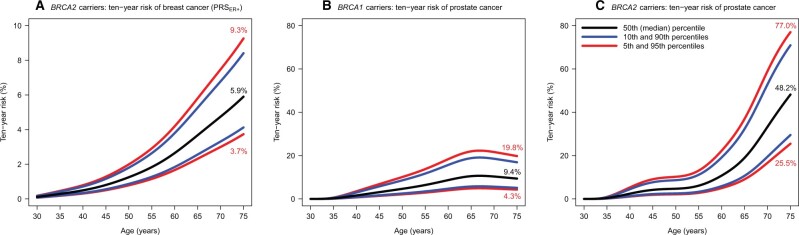
PRSER+ yielded the strongest association with breast cancer risk. The odds ratios (ORs) per PRSER+ standard deviation estimates were 1.40 (95% confidence interval [CI] =1.07 to 1.83) for BRCA1 and 1.33 (95% CI = 1.16 to 1.52) for BRCA2 carriers. PRSPC was associated with prostate cancer risk for BRCA1 (OR = 1.73, 95% CI = 1.28 to 2.33) and BRCA2 (OR = 1.60, 95% CI = 1.34 to 1.91) carriers. The estimated breast cancer odds ratios were larger after adjusting for female relative breast cancer family history. By age 85 years, for BRCA2 carriers, the breast cancer risk varied from 7.7% to 18.4% and prostate cancer risk from 34.1% to 87.6% between the 5th and 95th percentiles of the PRS distributions.
Population-based prostate and female breast cancer PRS are associated with a wide range of absolute breast and prostate cancer risks for male BRCA1 and BRCA2 carriers. These findings warrant further investigation aimed at providing personalized cancer risks for male carriers and informing clinical management.
近期已开发出基于人群的女性乳腺癌和前列腺癌多基因风险评分(PRS)。我们评估了这些PRS与男性BRCA1和BRCA2致病变异携带者的乳腺癌和前列腺癌风险之间的关联。
从BRCA1/2修饰因子研究联盟(CIMBA)获得了483名BRCA1和1318名BRCA2欧洲血统男性携带者。评估了一种147个单核苷酸多态性(SNP)的前列腺癌PRS(PRSPC)和一种313个SNP的乳腺癌PRS。有3个版本的乳腺癌PRS,分别优化用于预测总体(PRSBC)、雌激素受体(ER)阴性(PRSER-)或ER阳性(PRSER+)乳腺癌风险。
PRSER+与乳腺癌风险的关联最强。BRCA1携带者每增加一个PRSER+标准差估计值的比值比(OR)为1.40(95%置信区间[CI]=1.07至1.83),BRCA2携带者为1.33(95%CI=1.16至1.52)。PRSPC与BRCA1(OR=1.73,95%CI=1.28至2.33)和BRCA2(OR=1.60,95%CI=1.34至1.91)携带者的前列腺癌风险相关。在调整女性亲属乳腺癌家族史后,估计的乳腺癌比值比更大。到85岁时,对于BRCA2携带者,在PRS分布的第5百分位数和第95百分位数之间,乳腺癌风险从7.7%到18.4%不等,前列腺癌风险从34.1%到87.6%不等。
基于人群的前列腺癌和女性乳腺癌PRS与男性BRCA1和BRCA2携带者广泛的绝对乳腺癌和前列腺癌风险相关。这些发现值得进一步研究,旨在为男性携带者提供个性化的癌症风险并为临床管理提供信息。