Rangasamy Valluvan, Thampi Susheela Ammu, Mueller Ariel, F H Chang Tracy, Sadhasivam Senthilkumar, Subramaniam Balachundhar
Department of Anesthesia, Critical Care, and Pain Medicine, Beth Israel Deaconess Medical Center, Harvard Medical School, Boston, Massachusetts, 02215, USA.
Department of Labor Studies and Employment Relations (LSER),, Rutgers University, New Brunswick, NJ, USA.
F1000Res. 2019 Mar 26;8:335. doi: 10.12688/f1000research.18446.1. eCollection 2019.
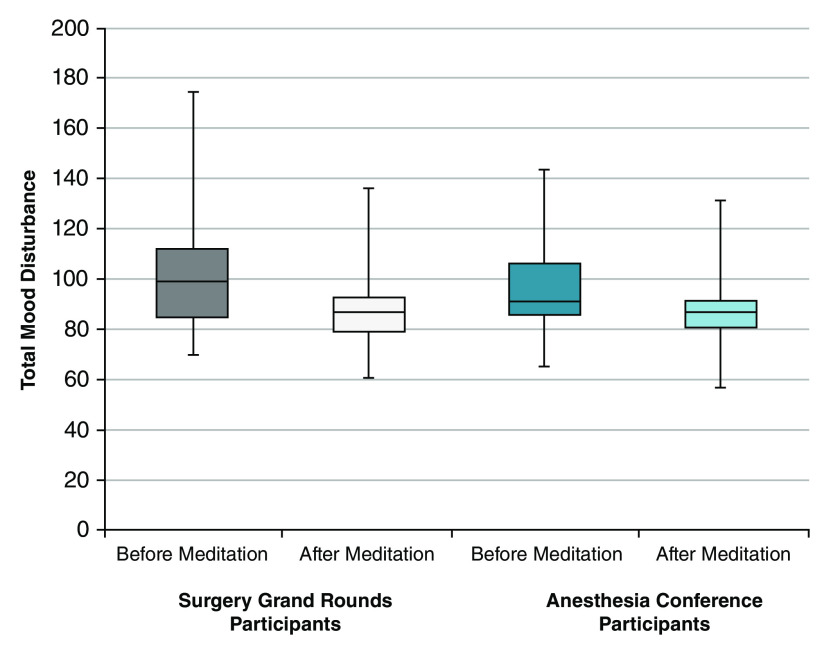
Operating room professionals are exposed to high levels of stress and burnout. Besides affecting the individual, it can compromise patient safety and quality of care as well. Meditation practice is getting recognized for its ability to improve wellness among various populations, including healthcare providers. Baseline stress levels of perioperative healthcare providers were measured via an online survey using a Perceived Stress Scale (PSS) questionnaire. An in-person meditation workshop was demonstrated during surgical grand rounds and an international anesthesia conference using a 15-minute guided Isha Kriya meditation. The participants were then surveyed for mood changes before and after meditation using a Profile of Mood States (POMS) questionnaire. Surgeons and anesthesiologists were found to have higher median (interquartile range) Perceived Stress Scores as compared to nurses respectively (17 [12, 20] and 17 [12, 21] vs 14 [9, 19]; = 0.01). Total mood disturbances were found to be significantly reduced after meditation in both the surgical grand rounds (pre-meditation median [IQR] 99 [85, 112] vs 87 [80, 93] post-meditation; < 0.0001) and anesthesia conference cohorts (pre-meditation 92 [86, 106] vs 87 [81, 92] post-meditation; < 0.0001). Isha Kriya, a guided meditation, is easy to learn and takes less than 15 minutes to complete. This meditation technique improves mood changes and negative emotions among operating room professionals and could be used as a potential tool for improving wellness.
手术室专业人员面临着高度的压力和职业倦怠。这不仅会影响个人,还可能危及患者安全和护理质量。冥想练习因其能够改善包括医疗保健提供者在内的不同人群的健康状况而得到认可。通过使用感知压力量表(PSS)问卷的在线调查来测量围手术期医疗保健提供者的基线压力水平。在外科大查房和一次国际麻醉会议期间,通过15分钟的依霎·克里亚冥想引导,展示了一场面对面的冥想工作坊。然后使用情绪状态剖面图(POMS)问卷对参与者在冥想前后的情绪变化进行调查。结果发现,与护士相比,外科医生和麻醉医生的感知压力得分中位数(四分位间距)分别更高(17 [12, 20] 和17 [12, 21] 对比14 [9, 19];P = 0.01)。在外科大查房(冥想前中位数[IQR] 99 [85, 112] 对比冥想后87 [80, 93];P < 0.0001)和麻醉会议队列中,冥想后总情绪紊乱均显著减少(冥想前92 [86, 106] 对比冥想后87 [81, 92];P < 0.0001)。依霎·克里亚是一种引导式冥想,易于学习,完成时间不到15分钟。这种冥想技巧可改善手术室专业人员的情绪变化和负面情绪,可作为改善健康状况的潜在工具。