Simon Neta, Shallat Jaclyn, Williams Wietzikoski Corey, Harrington Whitney E
Department of Microbiology, University of Washington, Seattle, WA, USA.
Seattle Children's Research Institute, Seattle, WA, USA.
Biol Methods Protoc. 2020 May 2;5(1):bpaa009. doi: 10.1093/biomethods/bpaa009. eCollection 2020.
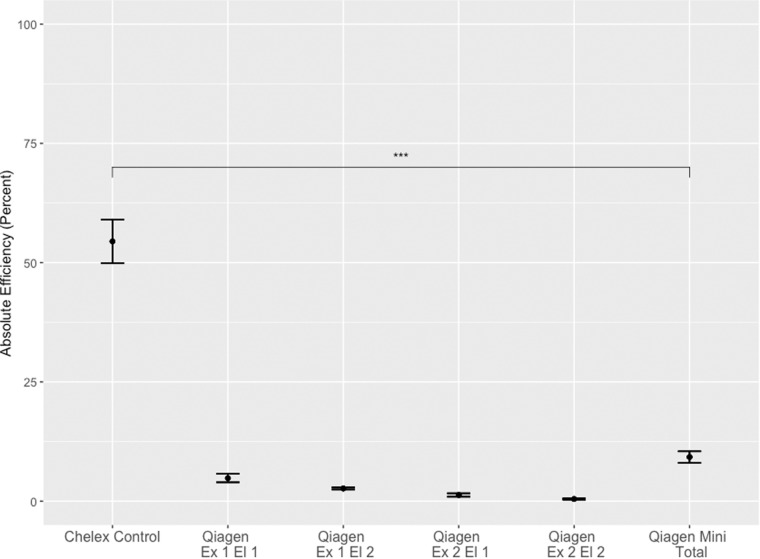
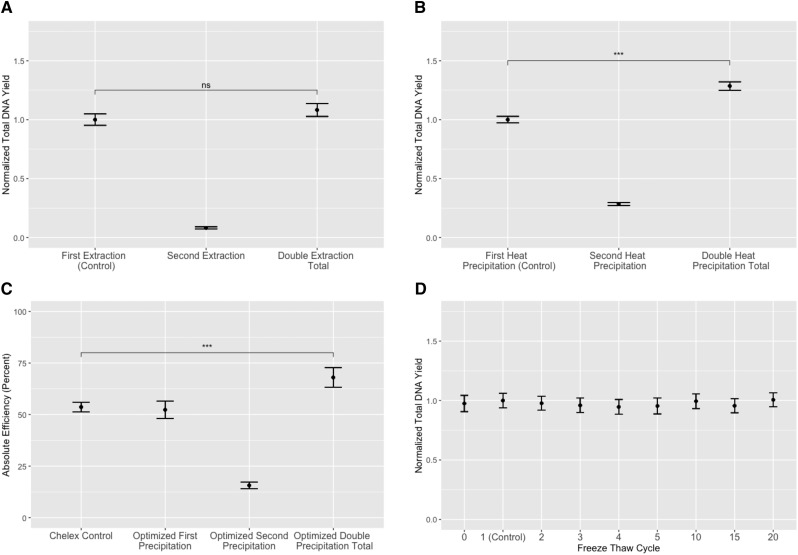
Dried blood spots (DBS) are widely utilized as part of universal newborn screening and as a means of transporting samples from field sites. We use DBS from African field sites to assess for rare maternal-fetal cell exchange during pregnancy known as microchimerism. We aimed to develop a protocol to maximize the quantity of high-quality genomic DNA (gDNA) extracted from DBS. The total gDNA yield obtained from control DBS utilizing a Qiagen-based protocol and a Chelex 100 resin-based protocol was first compared. Variations of the Chelex protocol were subsequently tested to develop an optimized protocol. The gDNA was quantified by qPCR targeting the human beta-globin gene. DNA yield for a given experimental condition was normalized to a Chelex control performed on the same day, and the total yields were compared using a Student's -test. The control Chelex protocol yielded 590% more DNA than the QIAamp DNA Blood Mini Kit . The absolute efficiency of the control Chelex protocol was 54%, compared to an absolute efficiency of 9% for the QIAamp DNA Blood Mini Kit. Modification of the Chelex protocol to include a second heat precipitation from the same DBS increased the gDNA yield by 29% ( < 0.001). Our optimized protocol including this modification increased the absolute efficiency of extraction to 68%. The gDNA extracted using the Chelex protocol was stable through repeated freeze-thaw cycles. In a mock microchimerism experiment, rare donor alleles at a frequency of 10 in 100 000 could be identified in gDNA from DBS extracted using the optimized Chelex protocol. Our findings may be of significance for a diverse range of applications that utilize DBS and require high-quality DNA, including newborn screening programs, pathogen and drug resistance screening from remote field sites, forensics, and rare allele detection.
干血斑(DBS)被广泛用作新生儿普遍筛查的一部分以及从现场采集样本进行运输的一种方式。我们使用来自非洲现场的干血斑来评估孕期罕见的母胎细胞交换,即微嵌合体现象。我们旨在开发一种方案,以最大限度地提高从干血斑中提取的高质量基因组DNA(gDNA)的数量。首先比较了使用基于Qiagen的方案和基于Chelex 100树脂的方案从对照干血斑中获得的总gDNA产量。随后对Chelex方案的变体进行了测试,以开发一种优化方案。通过针对人β-珠蛋白基因的qPCR对gDNA进行定量。将给定实验条件下的DNA产量归一化至同一天进行的Chelex对照,并使用学生t检验比较总产量。对照Chelex方案产生的DNA比QIAamp DNA Blood Mini Kit多590%。对照Chelex方案的绝对效率为54%,而QIAamp DNA Blood Mini Kit的绝对效率为9%。对Chelex方案进行修改,使其包括对同一干血斑进行第二次热沉淀,可使gDNA产量提高29%(P<0.001)。我们包括此修改的优化方案将提取的绝对效率提高到了68%。使用Chelex方案提取的gDNA在反复冻融循环中保持稳定。在模拟微嵌合体实验中,使用优化的Chelex方案从干血斑中提取的gDNA中可以鉴定出频率为十万分之十的罕见供体等位基因。我们的发现可能对多种利用干血斑并需要高质量DNA的应用具有重要意义,包括新生儿筛查项目、来自偏远现场的病原体和耐药性筛查、法医学以及罕见等位基因检测。