Research Department of Pathology, University College London, London, UK.
Department of Histopathology, Royal National Orthopaedic Hospital, Stanmore, UK.
J Pathol. 2020 Oct;252(2):151-164. doi: 10.1002/path.5507. Epub 2020 Sep 1.
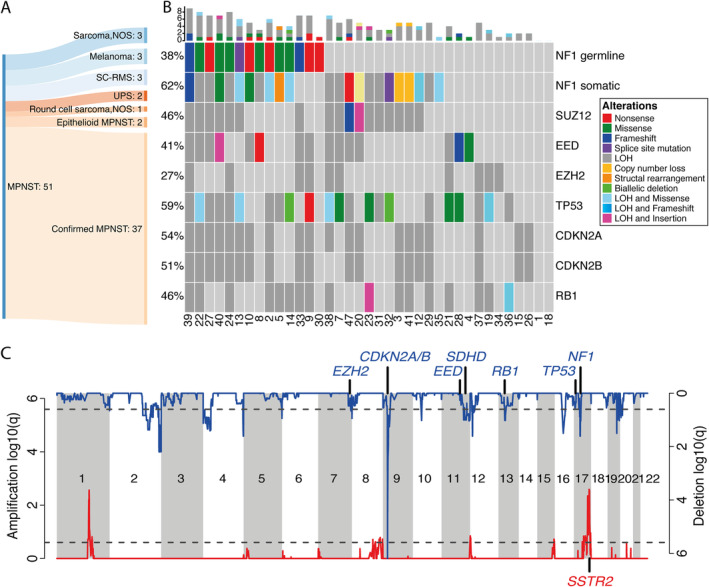
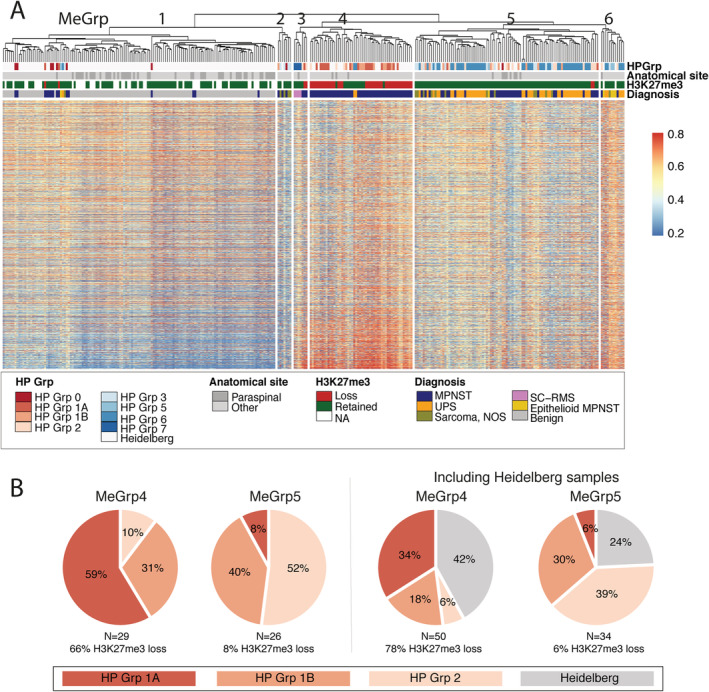
Diagnosing MPNST can be challenging, but genetic alterations recently identified in polycomb repressive complex 2 (PRC2) core component genes, EED and SUZ12, resulting in global loss of the histone 3 lysine 27 trimethylation (H3K27me3) epigenetic mark, represent drivers of malignancy and a valuable diagnostic tool. However, the reported loss of H3K27me3 expression ranges from 35% to 84%. We show that advances in molecular pathology now allow many MPNST mimics to be classified confidently. We confirm that MPNSTs harbouring mutations in PRC2 core components are associated with loss of H3K27me3 expression; whole-genome doubling was detected in 68%, and SSTR2 was amplified in 32% of MPNSTs. We demonstrate that loss of H3K27me3 expression occurs overall in 38% of MPNSTs, but is lost in 76% of histologically classical cases, whereas loss was detected in only 23% cases with heterologous elements and 14% where the diagnosis could not be provided on morphology alone. H3K27me3 loss is rarely seen in other high-grade sarcomas and was not found to be associated with an inferior outcome in MPNST. We show that DNA methylation profiling distinguishes MPNST from its histological mimics, was unrelated to anatomical site, and formed two main clusters, MeGroups 4 and 5. MeGroup 4 represents classical MPNSTs lacking H3K27me3 expression in the majority of cases, whereas MeGroup 5 comprises MPNSTs exhibiting non-classical histology and expressing H3K27me3 and cluster with undifferentiated sarcomas. The two MeGroups are distinguished by differentially methylated PRC2-associated genes, the majority of which are hypermethylated in the promoter regions in MeGroup 4, indicating that the PRC2 target genes are not expressed in these tumours. The methylation profiles of MPNSTs with retention of H3K27me3 in MeGroups 4 and 5 are independent of mutations in PRC2 core components and the driver(s) in these groups remain to be identified. Our results open new avenues of investigation. © 2020 The Authors. The Journal of Pathology published by John Wiley & Sons, Ltd. on behalf of The Pathological Society of Great Britain and Ireland.
诊断 MPNST 具有一定挑战性,但最近在多梳抑制复合物 2(PRC2)核心成分基因 EED 和 SUZ12 中发现的遗传改变导致组蛋白 3 赖氨酸 27 三甲基化(H3K27me3)表观遗传标记的全局缺失,代表了恶性肿瘤的驱动因素和有价值的诊断工具。然而,报道的 H3K27me3 表达缺失范围为 35%至 84%。我们表明,分子病理学的进步现在可以使许多 MPNST 模拟物被准确分类。我们证实,携带 PRC2 核心成分突变的 MPNST 与 H3K27me3 表达缺失相关;在 68%的 MPNST 中检测到全基因组倍增,在 32%的 MPNST 中 SSTR2 扩增。我们证明,38%的 MPNST 总体上存在 H3K27me3 表达缺失,但在 76%的组织学经典病例中缺失,而在具有异源成分的病例中仅检测到 23%,在仅通过形态学无法提供诊断的病例中检测到 14%。H3K27me3 缺失在其他高级别肉瘤中很少见,并且与 MPNST 的不良预后无关。我们表明,DNA 甲基化谱可将 MPNST 与其组织学模拟物区分开来,与解剖部位无关,并形成两个主要簇,MeGroup 4 和 5。MeGroup 4 代表大多数情况下缺乏 H3K27me3 表达的经典 MPNST,而 MeGroup 5 由表现出非经典组织学并表达 H3K27me3 的 MPNST 组成,与未分化肉瘤聚类。这两个 MeGroup 通过差异甲基化的 PRC2 相关基因区分,其中大多数在 MeGroup 4 的启动子区域中呈高甲基化,表明这些肿瘤中 PRC2 靶基因未表达。在 MeGroup 4 和 5 中保留 H3K27me3 的 MPNST 的甲基化谱与 PRC2 核心成分的突变无关,这些组中的驱动因素仍有待确定。我们的结果开辟了新的研究途径。