Department of Emergency Medicine, School of Medicine, University of Colorado Anschutz Medical Campus, Aurora.
Veterans Affairs Eastern Colorado Geriatric Research Education and Clinical Center, Denver.
JAMA Netw Open. 2020 Jul 1;3(7):e207756. doi: 10.1001/jamanetworkopen.2020.7756.
The population of adults with Alzheimer disease and related dementias (ADRD) is increasing, and many people with ADRD have access to firearms. Little is known, however, about how caregivers of people with ADRD think about or address firearm safety.
To assess views on firearm safety risks among caregivers of persons with ADRD, experiences of caregivers with health care professional-delivered counseling, and their preferred sources of information about firearm safety.
DESIGN, SETTING, AND PARTICIPANTS: This survey study used a probability-based online survey (National Firearms Survey, July 30 to August 11, 2019) with weights used to generate nationally representative estimates of adults living in households with firearms to assess firearm safety views of English-speaking adults 35 years or older. Respondents for the National Firearm Survery were drawn from I KnowledgePanel, a frame with approximately 55 000 US adults selected on an ongoing basis using address-based sampling methods.
Caregivers were asked whether the person with ADRD owned or had access to firearms. Additional ADRD-related measures assessed perceptions about the likelihood of types of firearm injuries involving people with ADRD, support for firearm safety counseling by health care professionals with regard to dementia, and history of ever having received such counseling.
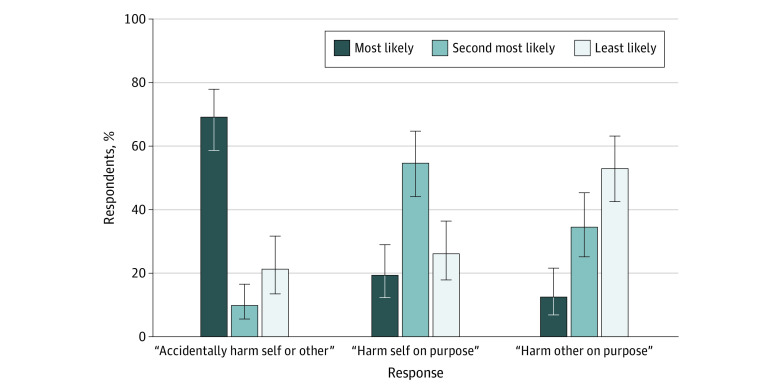
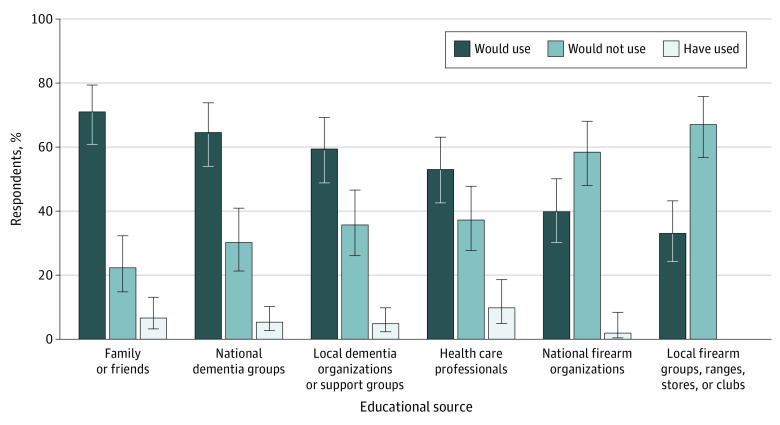
Of 6712 invited panel members, 4030 completed the survey (completion rate, 65%). For this analysis, we excluded the youngest participants (aged 18-34 years; n = 498); among the remaining 3532 participants, 124 reported being caregivers for persons with ADRD. Of the 124 caregivers, 51% were female and the mean (SD) age was 60 (12.5) years. Most participants (71%; 95% CI, 69%-72%) thought that a person with ADRD was more likely to hurt someone else unintentionally than intentionally hurt themselves or someone else. Many participants thought health care professionals should always (45%; 95% CI, 43%-47%) or sometimes (34%; 95% CI, 32%-37%) talk about firearm safety with caregivers or patients with dementia, but only 5% of caregivers (95% CI, 2%-12%) reported that a health care professional had ever spoken to them about firearm safety. Among the 41% (95% CI, 31%-51%) of caregivers who lived with a person with dementia, 31% (95% CI, 18%-49%) said the person with dementia could access firearms in the home.
In this study, few caregivers of adults with ADRD reported having received health care professional counseling about firearm safety, although most thought health care professionals should provide such counseling. These findings raise concerns about home firearm access among adults with ADRD and indicate potential opportunities for enhanced education by health care professionals and community organizations.
患有阿尔茨海默病和相关痴呆症(ADRD)的成年人的数量正在增加,许多患有 ADRD 的人都可以获得枪支。然而,人们对 ADRD 患者的照顾者如何看待或处理枪支安全问题知之甚少。
评估 ADRD 患者照顾者对枪支安全风险的看法、他们与医疗保健专业人员进行咨询的经验,以及他们对枪支安全信息的首选来源。
设计、设置和参与者:这项基于概率的在线调查研究(全国枪支调查,2019 年 7 月 30 日至 8 月 11 日)使用了全国枪支调查,该调查使用了权重,以生成居住在有枪支家庭中的成年人的全国代表性估计数,以评估英语为母语的 35 岁及以上成年人对枪支安全的看法。全国枪支调查的受访者来自 I KnowledgePanel,这是一个大约有 55000 名美国成年人的框架,通过基于地址的抽样方法定期进行选择。
照顾者被问及 ADRD 患者是否拥有或可以获得枪支。其他与 ADRD 相关的措施评估了与 ADRD 患者有关的枪支伤害类型的可能性、医疗保健专业人员就痴呆症提供枪支安全咨询的支持程度,以及他们是否曾经接受过此类咨询。
在 6712 名受邀的小组成员中,有 4030 人完成了调查(完成率为 65%)。在这项分析中,我们排除了最年轻的参与者(18-34 岁;n=498);在剩下的 3532 名参与者中,有 124 人报告说他们是 ADRD 患者的照顾者。在这 124 名照顾者中,有 51%是女性,平均(SD)年龄为 60(12.5)岁。大多数参与者(71%;95%置信区间,69%-72%)认为,ADRD 患者更有可能意外伤害他人,而不是故意伤害自己或他人。许多参与者认为,医疗保健专业人员应该始终(45%;95%置信区间,43%-47%)或有时(34%;95%置信区间,32%-37%)与照顾者或痴呆症患者谈论枪支安全,但只有 5%的照顾者(95%置信区间,2%-12%)报告说有医疗保健专业人员曾就枪支安全与他们交谈过。在 41%(95%置信区间,31%-51%)与痴呆症患者同住的照顾者中,有 31%(95%置信区间,18%-49%)表示,患者可以在家中接触到枪支。
在这项研究中,很少有 ADRD 成年患者的照顾者报告说接受过枪支安全方面的医疗保健专业人员咨询,尽管大多数人认为医疗保健专业人员应该提供这种咨询。这些发现令人担忧 ADRD 成年患者家中的枪支获取问题,并表明医疗保健专业人员和社区组织有机会加强教育。