Mignan Thomas, Targett Mike, Lowrie Mark
Dovecote Veterinary Hospital, Derby, UK.
School of Veterinary Medicine and Science, University of Nottingham, Leicestershire, UK.
J Vet Intern Med. 2020 Sep;34(5):1707-1717. doi: 10.1111/jvim.15855. Epub 2020 Jul 15.
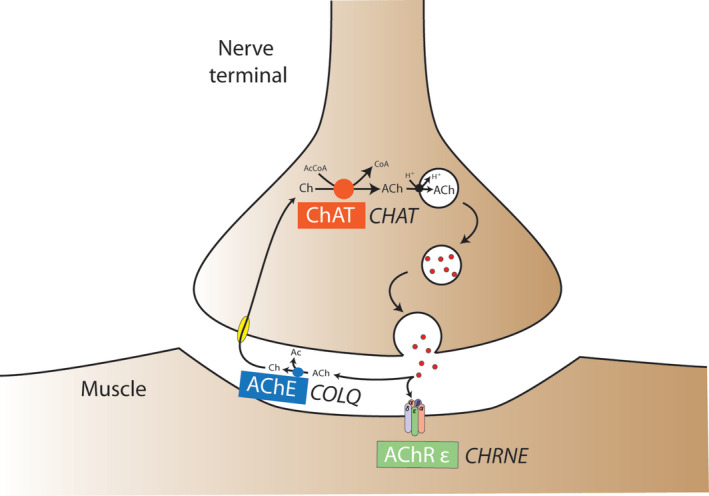
Myasthenia, a syndrome of impaired neuromuscular transmission, occurs as either an acquired or congenital condition. Myasthenia gravis (MG) is an acquired autoimmune disorder with autoantibodies against the neuromuscular junction (NMJ) of skeletal muscle whereas congenital myasthenic syndromes (CMSs) are a clinically heterogeneous group of genetic disorders affecting the NMJ with a young age of onset. Both conditions are diseases for which recognition is important with regard to treatment and outcome. We review the published literature on MG and CMSs in dogs and cats, and by comparison with published classification used in humans, propose a classification system for MG and CMSs in dogs and cats. Myasthenia gravis is first classified based on focal, generalized, or acute fulminating presentation. It then is subclassified according to the autoimmune disease mechanism or seronegativity. Autoimmune disease mechanism relates to the presence or absence of a thymoma, or administration of thiourylene medication in cats. Congenital myasthenic syndromes are classified according to the affected NMJ component, the mechanism of the defect of neuromuscular transmission, the affected protein, and ultimately the mutated gene responsible. In proposing this categorization of MG and CMSs, we hope to aid recognition of the disease groups for both conditions, as well as guide treatment, refine prognosis, and provide a framework for additional studies of these conditions.
肌无力是一种神经肌肉传递受损的综合征,可表现为获得性或先天性疾病。重症肌无力(MG)是一种获得性自身免疫性疾病,存在针对骨骼肌神经肌肉接头(NMJ)的自身抗体,而先天性肌无力综合征(CMSs)是一组临床异质性的遗传性疾病,影响神经肌肉接头,发病年龄较小。这两种疾病在治疗和预后方面,识别都很重要。我们回顾了关于犬猫重症肌无力和先天性肌无力综合征的已发表文献,并通过与人类使用的已发表分类进行比较,提出了犬猫重症肌无力和先天性肌无力综合征的分类系统。重症肌无力首先根据局灶性、全身性或急性暴发性表现进行分类。然后根据自身免疫性疾病机制或血清阴性进行亚分类。自身免疫性疾病机制与胸腺瘤的存在与否,或猫是否使用硫脲类药物有关。先天性肌无力综合征根据受影响的神经肌肉接头成分、神经肌肉传递缺陷的机制、受影响的蛋白质以及最终负责的突变基因进行分类。在提出重症肌无力和先天性肌无力综合征的这种分类时,我们希望有助于识别这两种疾病的类别,以及指导治疗、完善预后,并为这些疾病的进一步研究提供一个框架。