Fu Yu, Xiong Mengyuan, Li Xuehan, Zhou Junying, Xiao Xiao, Fang Fang, Cheng Xiaohuan, Le Yingbang, Li Yirong
Department of Clinical Laboratory, Zhongnan Hospital, Wuhan University, Wuhan, People's Republic of China.
Infect Drug Resist. 2020 Jun 30;13:2063-2072. doi: 10.2147/IDR.S249988. eCollection 2020.
This study aimed to investigate the molecular characteristics, antimicrobial resistance and virulence genes profiles of isolates from Wuhan, central China.
A total of 302 non-duplicate isolates were collected successively during January-December 2018 and subjected to multi-locus sequence typing (MLST), () typing and (PVL) and A, B, C, D, E, G, H and I ( and ) detection. All methicillin-resistant (MRSA) isolates were additionally subjected to staphylococcal chromosomal cassette (SCC) typing.
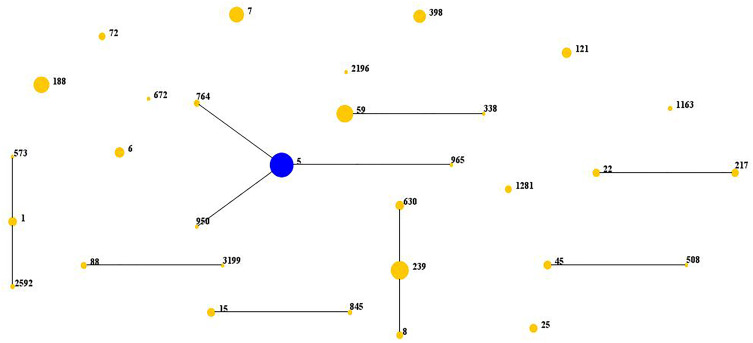
Of the 302 isolates, 131 were categorised as MRSA, yielding a rate 1.4 times the average rate in China during 2018 (43.4% vs 30.9%). Thirty-one sequence types (STs) and 82 types were identified. The most prevalent clones were ST5-t2460 (10.9%), ST239-t030 (9.3%), ST188-t189 (7.9%) and ST59-t437 (6.3%). Notably, the continued prevalence of ST239-t030 in Wuhan differs from other areas in China. SCC types and subtypes I, II, III, IVa and V were present in 0.8%, 36.6%, 26.0%, 20.6% and 8.4% of MRSA isolates. A comprehensive analysis identified ST5-t2460-SCC II (25.2%,), ST239-t030-SCC III (19.8%) and ST59-t437-SCC IVa (7.6%) as the major clones among MRSA isolates. The genes and were detected at respective frequencies of 11.9%, 42.1%, 49.7%, 45.0%, 20.9%, 33.8%, 60.5%, 25.8% and 66.9%.
ST239-t030 remains one of the most prevalent clones in isolates from Wuhan, leading us to conclude that isolates from Wuhan possess unique molecular characteristics. The isolates also exhibit unique antimicrobial resistance profiles and harbour relatively high numbers of enterotoxin virulence genes, compared with other reports from China.
本研究旨在调查中国中部武汉分离株的分子特征、抗菌药物耐药性及毒力基因谱。
于2018年1月至12月连续收集302株非重复分离株,进行多位点序列分型(MLST)、()分型及(PVL)以及A、B、C、D、E、G、H和I(和)检测。所有耐甲氧西林金黄色葡萄球菌(MRSA)分离株还进行葡萄球菌染色体盒(SCC)分型。
在302株金黄色葡萄球菌分离株中,131株被归类为MRSA,其发生率是2018年中国平均发生率的1.4倍(43.4%对30.9%)。鉴定出31种序列类型(STs)和82种()类型。最常见的克隆株为ST5-t2460(10.9%)、ST239-t030(9.3%)、ST188-t189(7.9%)和ST59-t437(6.3%)。值得注意的是,ST239-t030在武汉的持续流行与中国其他地区不同。SCC类型及亚型I、II、III、IVa和V分别存在于0.8%、36.6%、26.0%、20.6%和8.4%的MRSA分离株中。综合分析确定ST5-t2460-SCC II(25.2%,)、ST239-t030-SCC III(19.8%)和ST59-t437-SCC IVa(7.6%)为MRSA分离株中的主要克隆株。基因和的检测频率分别为11.9%、42.1%、49.7%、45.0%、20.9%、33.8%、60.5%、25.8%和66.9%。
ST239-t030仍然是武汉金黄色葡萄球菌分离株中最常见的克隆株之一,这使我们得出结论,武汉的金黄色葡萄球菌分离株具有独特的分子特征。与中国其他报告相比,这些金黄色葡萄球菌分离株还表现出独特抗菌药物耐药性谱,并携带相对较多数量的肠毒素毒力基因。