• 文献检索
  • 文档翻译
  • 深度研究
  • 学术资讯
  • Suppr Zotero 插件Zotero 插件
  • 邀请有礼
  • 套餐&价格
  • 历史记录
应用&插件
Suppr Zotero 插件Zotero 插件浏览器插件Mac 客户端Windows 客户端微信小程序
定价
高级版会员购买积分包购买API积分包
服务
文献检索文档翻译深度研究API 文档MCP 服务
关于我们
关于 Suppr公司介绍联系我们用户协议隐私条款
关注我们

Suppr 超能文献

核心技术专利:CN118964589B侵权必究
粤ICP备2023148730 号-1Suppr @ 2026

文献检索

告别复杂PubMed语法,用中文像聊天一样搜索,搜遍4000万医学文献。AI智能推荐,让科研检索更轻松。

立即免费搜索

文件翻译

保留排版,准确专业,支持PDF/Word/PPT等文件格式,支持 12+语言互译。

免费翻译文档

深度研究

AI帮你快速写综述,25分钟生成高质量综述,智能提取关键信息,辅助科研写作。

立即免费体验

评估分级和评估预测工具框架对临床医生和医疗保健专业人员在选择临床预测工具时决策的影响:随机对照试验。

Evaluating the Impact of the Grading and Assessment of Predictive Tools Framework on Clinicians and Health Care Professionals' Decisions in Selecting Clinical Predictive Tools: Randomized Controlled Trial.

机构信息

Centre for Health Informatics, Australian Institute of Health Innovation, Faculty of Medicine and Health Sciences, Macquarie University, Sydney, Australia.

Centre for Big Data Research in Health, Faculty of Medicine, University of New South Wales, Sydney, Australia.

出版信息

J Med Internet Res. 2020 Jul 9;22(7):e15770. doi: 10.2196/15770.

DOI:10.2196/15770
PMID:32673228
原文链接:https://pmc.ncbi.nlm.nih.gov/articles/PMC7381257/
Abstract

BACKGROUND

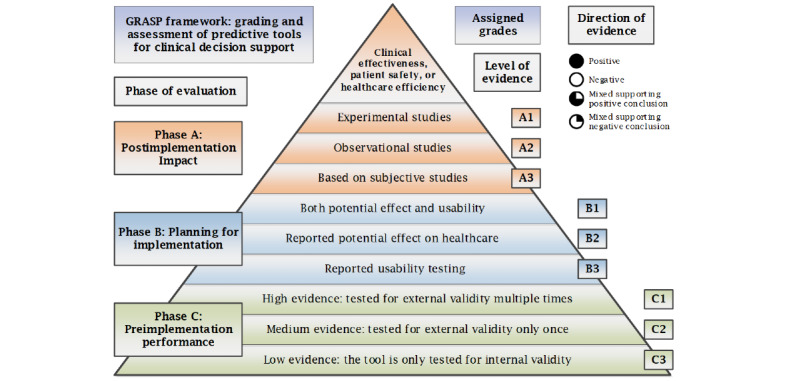
While selecting predictive tools for implementation in clinical practice or for recommendation in clinical guidelines, clinicians and health care professionals are challenged with an overwhelming number of tools. Many of these tools have never been implemented or evaluated for comparative effectiveness. To overcome this challenge, the authors developed and validated an evidence-based framework for grading and assessment of predictive tools (the GRASP framework). This framework was based on the critical appraisal of the published evidence on such tools.

OBJECTIVE

The aim of the study was to examine the impact of using the GRASP framework on clinicians' and health care professionals' decisions in selecting clinical predictive tools.

METHODS

A controlled experiment was conducted through a web-based survey. Participants were randomized to either review the derivation publications, such as studies describing the development of the predictive tools, on common traumatic brain injury predictive tools (control group) or to review an evidence-based summary, where each tool had been graded and assessed using the GRASP framework (intervention group). Participants in both groups were asked to select the best tool based on the greatest validation or implementation. A wide group of international clinicians and health care professionals were invited to participate in the survey. Task completion time, rate of correct decisions, rate of objective versus subjective decisions, and level of decisional conflict were measured.

RESULTS

We received a total of 194 valid responses. In comparison with not using GRASP, using the framework significantly increased correct decisions by 64%, from 53.7% to 88.1% (88.1/53.7=1.64; t=8.53; P<.001); increased objective decision making by 32%, from 62% (3.11/5) to 82% (4.10/5; t=9.24; P<.001); decreased subjective decision making based on guessing by 20%, from 49% (2.48/5) to 39% (1.98/5; t=-5.47; P<.001); and decreased prior knowledge or experience by 8%, from 71% (3.55/5) to 65% (3.27/5; t=-2.99; P=.003). Using GRASP significantly decreased decisional conflict and increased the confidence and satisfaction of participants with their decisions by 11%, from 71% (3.55/5) to 79% (3.96/5; t=4.27; P<.001), and by 13%, from 70% (3.54/5) to 79% (3.99/5; t=4.89; P<.001), respectively. Using GRASP decreased the task completion time, on the 90th percentile, by 52%, from 12.4 to 6.4 min (t=-0.87; P=.38). The average System Usability Scale of the GRASP framework was very good: 72.5% and 88% (108/122) of the participants found the GRASP useful.

CONCLUSIONS

Using GRASP has positively supported and significantly improved evidence-based decision making. It has increased the accuracy and efficiency of selecting predictive tools. GRASP is not meant to be prescriptive; it represents a high-level approach and an effective, evidence-based, and comprehensive yet simple and feasible method to evaluate, compare, and select clinical predictive tools.
https://cdn.ncbi.nlm.nih.gov/pmc/blobs/f9d7/7381257/88c7bc89957e/jmir_v22i7e15770_fig3.jpg
https://cdn.ncbi.nlm.nih.gov/pmc/blobs/f9d7/7381257/2db4628a8cea/jmir_v22i7e15770_fig1.jpg
https://cdn.ncbi.nlm.nih.gov/pmc/blobs/f9d7/7381257/9cc90a6f5e03/jmir_v22i7e15770_fig2.jpg
https://cdn.ncbi.nlm.nih.gov/pmc/blobs/f9d7/7381257/88c7bc89957e/jmir_v22i7e15770_fig3.jpg
https://cdn.ncbi.nlm.nih.gov/pmc/blobs/f9d7/7381257/2db4628a8cea/jmir_v22i7e15770_fig1.jpg
https://cdn.ncbi.nlm.nih.gov/pmc/blobs/f9d7/7381257/9cc90a6f5e03/jmir_v22i7e15770_fig2.jpg
https://cdn.ncbi.nlm.nih.gov/pmc/blobs/f9d7/7381257/88c7bc89957e/jmir_v22i7e15770_fig3.jpg
摘要

背景

在选择用于临床实践实施或临床指南推荐的预测工具时,临床医生和医疗保健专业人员面临着数量庞大的工具。其中许多工具从未被实施或评估过其比较效果。为了克服这一挑战,作者开发并验证了一个用于分级和评估预测工具的基于证据的框架(GRASP 框架)。该框架基于对这些工具的已发表证据的严格评估。

目的

本研究旨在检验使用 GRASP 框架对临床医生和医疗保健专业人员选择临床预测工具决策的影响。

方法

通过基于网络的调查进行了一项对照实验。参与者被随机分配到以下两种情况之一:查看常见创伤性脑损伤预测工具的推导出版物(如描述预测工具开发的研究)(对照组)或查看基于证据的摘要,其中每个工具都使用 GRASP 框架进行了分级和评估(干预组)。要求两组参与者根据最大验证或实施来选择最佳工具。邀请了广泛的国际临床医生和医疗保健专业人员参与调查。测量了任务完成时间、正确决策率、客观决策率与主观决策率以及决策冲突水平。

结果

我们共收到 194 份有效回复。与不使用 GRASP 相比,使用该框架可使正确决策率显著提高 64%,从 53.7%提高到 88.1%(88.1/53.7=1.64;t=8.53;P<.001);客观决策率提高 32%,从 62%(3.11/5)提高到 82%(4.10/5;t=9.24;P<.001);基于猜测的主观决策率降低 20%,从 49%(2.48/5)降低到 39%(1.98/5;t=-5.47;P<.001);基于先验知识或经验的决策率降低 8%,从 71%(3.55/5)降低到 65%(3.27/5;t=-2.99;P=.003)。使用 GRASP 可使决策冲突显著降低 11%,并使参与者对决策的信心和满意度分别提高 13%,从 71%(3.55/5)提高到 79%(3.96/5;t=4.27;P<.001)和从 70%(3.54/5)提高到 79%(3.99/5;t=4.89;P<.001)。使用 GRASP 可将 90 百分位数的任务完成时间缩短 52%,从 12.4 分钟缩短到 6.4 分钟(t=-0.87;P=.38)。GRASP 的平均系统可用性量表非常好:72.5%和 88%(108/122)的参与者认为 GRASP 有用。

结论

使用 GRASP 可以支持并显著改善基于证据的决策。它提高了选择预测工具的准确性和效率。GRASP 并非旨在具有规定性;它代表了一种高级方法,是一种有效、基于证据且全面但简单可行的方法,用于评估、比较和选择临床预测工具。

相似文献

1
Evaluating the Impact of the Grading and Assessment of Predictive Tools Framework on Clinicians and Health Care Professionals' Decisions in Selecting Clinical Predictive Tools: Randomized Controlled Trial.评估分级和评估预测工具框架对临床医生和医疗保健专业人员在选择临床预测工具时决策的影响:随机对照试验。
J Med Internet Res. 2020 Jul 9;22(7):e15770. doi: 10.2196/15770.
2
Developing a framework for evidence-based grading and assessment of predictive tools for clinical decision support.制定基于证据的分级框架和评估临床决策支持预测工具。
BMC Med Inform Decis Mak. 2019 Oct 29;19(1):207. doi: 10.1186/s12911-019-0940-7.
3
Grading and assessment of clinical predictive tools for paediatric head injury: a new evidence-based approach.儿童头部损伤临床预测工具的分级和评估:一种新的基于证据的方法。
BMC Emerg Med. 2019 Jun 14;19(1):35. doi: 10.1186/s12873-019-0249-y.
4
Randomized controlled trial on the effect of an online decision aid for young female cancer patients regarding fertility preservation.随机对照试验研究在线决策辅助工具对年轻女性癌症患者生育力保存的效果。
Hum Reprod. 2019 Sep 29;34(9):1726-1734. doi: 10.1093/humrep/dez136.
5
The effectiveness of internet-based e-learning on clinician behavior and patient outcomes: a systematic review protocol.基于互联网的电子学习对临床医生行为和患者结局的有效性:一项系统评价方案。
JBI Database System Rev Implement Rep. 2015 Jan;13(1):52-64. doi: 10.11124/jbisrir-2015-1919.
6
The Effectiveness of Integrated Care Pathways for Adults and Children in Health Care Settings: A Systematic Review.综合护理路径在医疗环境中对成人和儿童的有效性:一项系统评价。
JBI Libr Syst Rev. 2009;7(3):80-129. doi: 10.11124/01938924-200907030-00001.
7
Comparative Effectiveness of a Web-Based Patient Decision Aid for Therapeutic Options for Sickle Cell Disease: Randomized Controlled Trial.基于网络的镰状细胞病治疗方案患者决策辅助工具的比较效果:随机对照试验
J Med Internet Res. 2019 Dec 4;21(12):e14462. doi: 10.2196/14462.
8
Cost-effectiveness of using prognostic information to select women with breast cancer for adjuvant systemic therapy.利用预后信息为乳腺癌患者选择辅助性全身治疗的成本效益
Health Technol Assess. 2006 Sep;10(34):iii-iv, ix-xi, 1-204. doi: 10.3310/hta10340.
9
Health professionals' experience of teamwork education in acute hospital settings: a systematic review of qualitative literature.医疗专业人员在急症医院环境中团队合作教育的经验:对定性文献的系统综述
JBI Database System Rev Implement Rep. 2016 Apr;14(4):96-137. doi: 10.11124/JBISRIR-2016-1843.
10
Design and Implementation of a Novel Web-Based E-Learning Tool for Education of Health Professionals on the Antibiotic Vancomycin.一种用于卫生专业人员抗生素万古霉素教育的新型基于网络的电子学习工具的设计与实现
J Med Internet Res. 2017 Mar 30;19(3):e93. doi: 10.2196/jmir.6971.

引用本文的文献

1
A scoping review, novel taxonomy and catalogue of implementation frameworks for clinical decision support systems.临床决策支持系统实施框架的范围综述、新分类法和目录。
BMC Med Inform Decis Mak. 2024 Nov 1;24(1):323. doi: 10.1186/s12911-024-02739-1.
2
A Framework for Using Real-World Data and Health Outcomes Modeling to Evaluate Machine Learning-Based Risk Prediction Models.一个利用真实世界数据和健康结果建模来评估基于机器学习的风险预测模型的框架。
Value Health. 2022 Mar;25(3):350-358. doi: 10.1016/j.jval.2021.11.1360. Epub 2021 Dec 22.
3
Predictive nursing helps improve treatment efficacy, treatment compliance, and quality of life in unstable angina pectoris patients.

本文引用的文献

1
Reducing Potentially Inappropriate Prescriptions for Older Patients Using Computerized Decision Support Tools: Systematic Review.使用计算机化决策支持工具减少老年患者潜在不适当处方:系统评价
J Med Internet Res. 2019 Nov 14;21(11):e15385. doi: 10.2196/15385.
2
Developing a framework for evidence-based grading and assessment of predictive tools for clinical decision support.制定基于证据的分级框架和评估临床决策支持预测工具。
BMC Med Inform Decis Mak. 2019 Oct 29;19(1):207. doi: 10.1186/s12911-019-0940-7.
3
Grading and assessment of clinical predictive tools for paediatric head injury: a new evidence-based approach.
预见性护理有助于提高不稳定型心绞痛患者的治疗效果、治疗依从性和生活质量。
Am J Transl Res. 2021 Apr 15;13(4):3473-3479. eCollection 2021.
儿童头部损伤临床预测工具的分级和评估:一种新的基于证据的方法。
BMC Emerg Med. 2019 Jun 14;19(1):35. doi: 10.1186/s12873-019-0249-y.
4
Evaluating the impact of prediction models: lessons learned, challenges, and recommendations.评估预测模型的影响:经验教训、挑战及建议。
Diagn Progn Res. 2018 Jun 12;2:11. doi: 10.1186/s41512-018-0033-6. eCollection 2018.
5
A Human(e) Factor in Clinical Decision Support Systems.临床决策支持系统中的人为因素
J Med Internet Res. 2019 Mar 19;21(3):e11732. doi: 10.2196/11732.
6
What Is the Effectiveness of Patient Decision Aids for Cancer-Related Decisions? A Systematic Review Subanalysis.患者决策辅助工具对癌症相关决策的有效性如何?一项系统评价子分析。
JCO Clin Cancer Inform. 2018 Dec;2:1-13. doi: 10.1200/CCI.17.00148.
7
Quality Improvement in Pediatric Head Trauma with PECARN Rules Implementation as Computerized Decision Support.通过实施PECARN规则作为计算机化决策支持来改善小儿头部创伤的质量
Pediatr Qual Saf. 2017 May 16;2(3):e019. doi: 10.1097/pq9.0000000000000019. eCollection 2017 May-Jun.
8
Clinical Decision Support Systems for Drug Allergy Checking: Systematic Review.用于药物过敏检查的临床决策支持系统:系统评价
J Med Internet Res. 2018 Sep 7;20(9):e258. doi: 10.2196/jmir.8206.
9
Quality of Decision Support in Computerized Provider Order Entry: Systematic Literature Review.计算机化医嘱录入系统中决策支持的质量:系统文献综述
JMIR Med Inform. 2018 Jan 24;6(1):e3. doi: 10.2196/medinform.7170.
10
GRADE Evidence to Decision (EtD) frameworks: a systematic and transparent approach to making well informed healthcare choices. 1: Introduction.GRADE证据到决策(EtD)框架:一种做出明智医疗选择的系统且透明的方法。1:引言。
BMJ. 2016 Jun 28;353:i2016. doi: 10.1136/bmj.i2016.