Department of Biomolecular Sciences, Weizmann Institute of Science, Rehovot 76100, Israel.
Department of Neurobiology, Max Planck Institute of Neurobiology, 82152 Planegg, Germany.
Int J Mol Sci. 2020 Jul 14;21(14):4966. doi: 10.3390/ijms21144966.
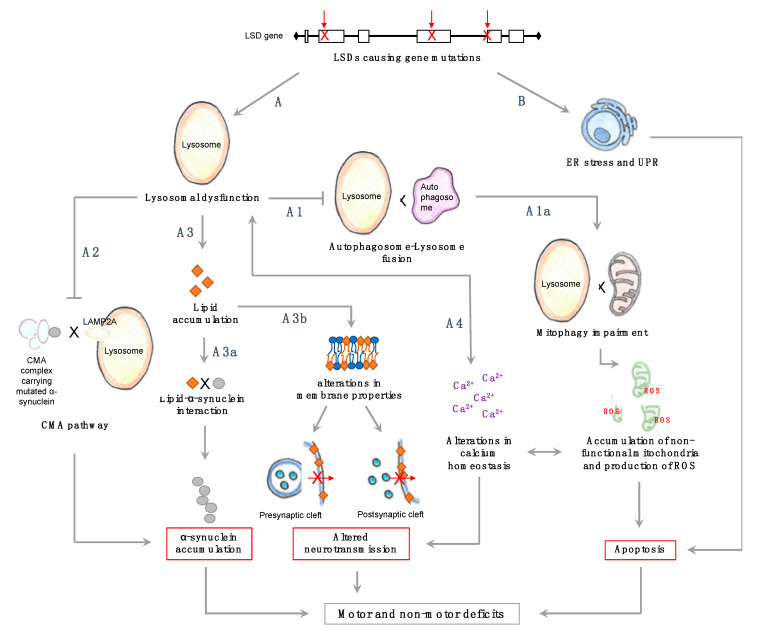
The lysosome is a central player in the cell, acting as a clearing house for macromolecular degradation, but also plays a critical role in a variety of additional metabolic and regulatory processes. The lysosome has recently attracted the attention of neurobiologists and neurologists since a number of neurological diseases involve a lysosomal component. Among these is Parkinson's disease (PD). While heterozygous and homozygous mutations in are the highest genetic risk factor for PD, studies performed over the past decade have suggested that lysosomal loss of function is likely involved in PD pathology, since a significant percent of PD patients have a mutation in one or more genes that cause a lysosomal storage disease (LSD). Although the mechanistic connection between the lysosome and PD remains somewhat enigmatic, significant evidence is accumulating that lysosomal dysfunction plays a central role in PD pathophysiology. Thus, lysosomal dysfunction, resulting from mutations in lysosomal genes, may enhance the accumulation of α-synuclein in the brain, which may result in the earlier development of PD.
溶酶体是细胞中的一个核心角色,充当着大分子降解的“集散中心”,但它在多种其他代谢和调节过程中也起着关键作用。由于一些神经疾病涉及溶酶体成分,溶酶体最近引起了神经生物学家和神经学家的关注。其中包括帕金森病(PD)。虽然 中的杂合和纯合突变是 PD 的最高遗传风险因素,但过去十年的研究表明,溶酶体功能丧失可能与 PD 病理学有关,因为相当一部分 PD 患者的一个或多个基因发生突变,导致溶酶体贮积症(LSD)。虽然溶酶体与 PD 之间的机制联系仍有些神秘,但越来越多的证据表明,溶酶体功能障碍在 PD 病理生理学中起着核心作用。因此,溶酶体基因发生突变导致的溶酶体功能障碍,可能会增强脑内α-突触核蛋白的积累,从而导致 PD 的更早发生。