Department of Pharmacology, University of Oxford, Oxford, OX1 3QT, UK.
Neuroregeneration Institute, McLean Hospital / Harvard Medical School, Belmont, MA, 02478, USA.
Mol Neurodegener. 2019 Nov 8;14(1):40. doi: 10.1186/s13024-019-0339-z.
Haploinsufficiency in the Gaucher disease GBA gene, which encodes the lysosomal glucocerebrosidase GBA, and ageing represent major risk factors for developing Parkinson's disease (PD). Recently, more than fifty other lysosomal storage disorder gene variants have been identified in PD, implicating lysosomal dysfunction more broadly as a key risk factor for PD. Despite the evidence of multiple lysosomal genetic risks, it remains unclear how sphingolipid hydrolase activities, other than GBA, are altered with ageing or in PD. Moreover, it is not fully known if levels of glycosphingolipid substrates for these enzymes change in vulnerable brain regions of PD. Finally, little is known about the levels of complex gangliosides in substantia nigra which may play a significant role in ageing and PD.
To study sphingolipid hydrolase activities and glycosphingolipid expression in ageing and in PD, two independent cohorts of human substantia nigra tissues were obtained. Fluorescent 4-methylumbelliferone assays were used to determine multiple enzyme activities. The lysosomal GBA and non-lysosomal GBA2 activities were distinguished using the inhibitor NB-DGJ. Sensitive and quantitative normal-phase HPLC was performed to study glycosphingolipid levels. In addition, glycosphingolipid levels in cerebrospinal fluid and serum were analysed as possible biomarkers for PD.
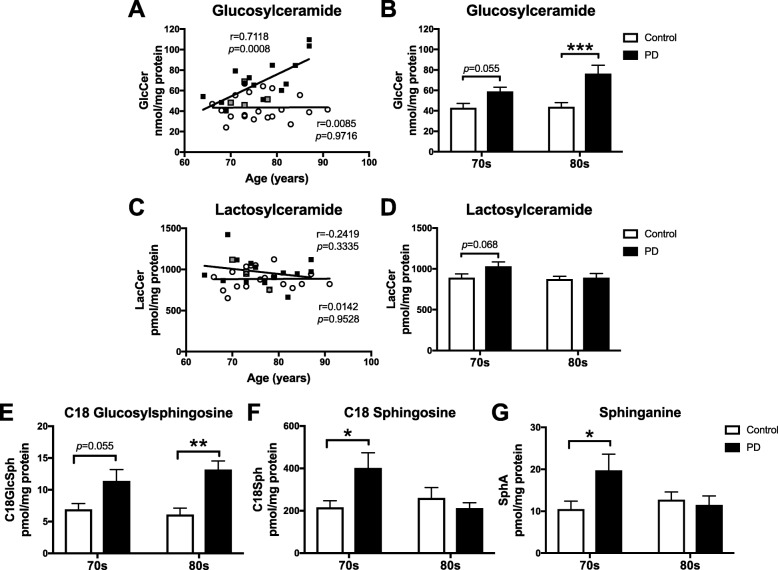
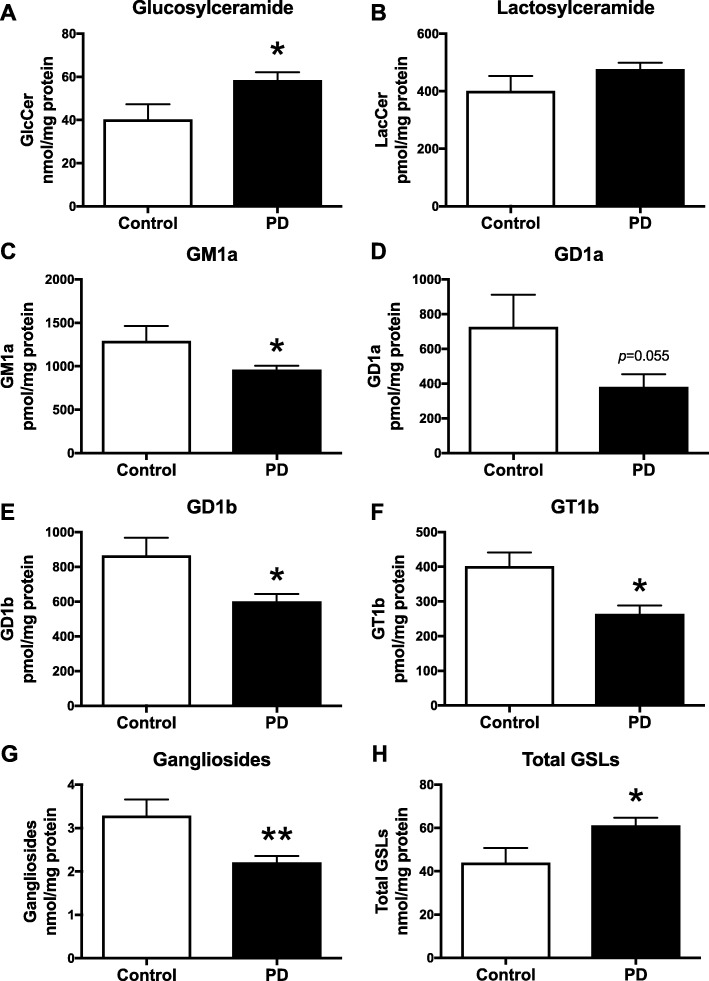
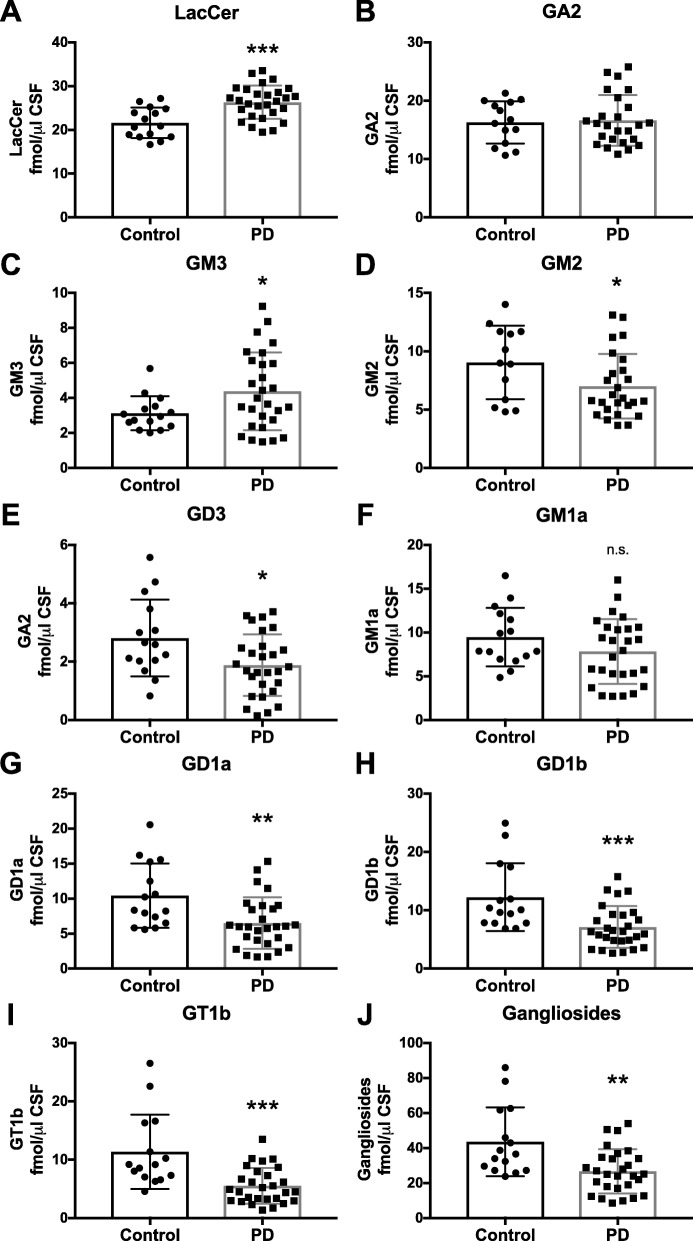
The present study demonstrates, in two independent cohorts of human post-mortem substantia nigra, that sporadic PD is associated with deficiencies in multiple lysosomal hydrolases (e.g. α-galactosidase and β-hexosaminidase), in addition to reduced GBA and GBA2 activities and concomitant glycosphingolipid substrate accumulation. Furthermore, the data show significant reductions in levels of complex gangliosides (e.g. GM1a) in substantia nigra, CSF and serum in ageing, PD, and REM sleep behaviour disorder, which is a strong predictor of PD.
These findings conclusively demonstrate reductions in GBA activity in the parkinsonian midbrain, and for the first time, reductions in the activity of several other sphingolipid hydrolases. Furthermore, significant reductions were seen in complex gangliosides in PD and ageing. The diminished activities of these lysosomal hydrolases, the glycosphingolipid substrate accumulation, and the reduced levels of complex gangliosides are likely major contributors to the primary development of the pathology seen in PD and related disorders with age.
戈谢病 GBA 基因的单倍不足,该基因编码溶酶体葡萄糖脑苷脂酶 GBA,以及衰老,是帕金森病 (PD) 发展的主要危险因素。最近,在 PD 中发现了五十多种其他溶酶体贮积症基因变异,这表明溶酶体功能障碍更广泛地成为 PD 的一个关键风险因素。尽管有多种溶酶体遗传风险的证据,但仍不清楚除 GBA 以外的鞘脂水解酶活性如何随年龄增长或在 PD 中发生变化。此外,尚不清楚这些酶的糖鞘脂底物的水平是否在 PD 易感脑区发生变化。最后,对于可能在衰老和 PD 中起重要作用的黑质中复杂神经节苷脂的水平知之甚少。
为了研究衰老和 PD 中鞘脂水解酶活性和糖鞘脂表达,我们获得了两批独立的人黑质组织。使用荧光 4-甲基伞形酮测定法测定多种酶活性。使用抑制剂 NB-DGJ 区分溶酶体 GBA 和非溶酶体 GBA2 活性。进行灵敏和定量的正相 HPLC 以研究糖鞘脂水平。此外,还分析了脑脊液和血清中的糖鞘脂水平作为 PD 的可能生物标志物。
本研究在两个独立的人尸检黑质队列中证明,散发性 PD 与多种溶酶体水解酶(例如 α-半乳糖苷酶和 β-己糖胺酶)的缺乏以及 GBA 和 GBA2 活性降低以及伴随的糖鞘脂底物积累有关。此外,数据显示在衰老、PD 和快速眼动睡眠行为障碍(PD 的强预测因子)中,黑质、脑脊液和血清中的复杂神经节苷脂(例如 GM1a)水平显着降低。
这些发现明确证明了帕金森中脑 GBA 活性降低,并且首次降低了几种其他鞘脂水解酶的活性。此外,在 PD 和衰老中也观察到复杂神经节苷脂的显着减少。这些溶酶体水解酶活性降低、糖鞘脂底物积累以及复杂神经节苷脂水平降低,可能是 PD 和相关年龄相关疾病中主要病理发展的主要原因。