Nakanishi Tomoko, Forgetta Vincenzo, Handa Tomohiro, Hirai Toyohiro, Mooser Vincent, Lathrop G Mark, Cookson William O C M, Richards J Brent
Dept of Human Genetics, McGill University, Montréal, QC, Canada.
Centre for Clinical Epidemiology, Dept of Medicine, Lady Davis Institute for Medical Research, Jewish General Hospital, McGill University, Montréal, QC, Canada.
Eur Respir J. 2020 Dec 10;56(6). doi: 10.1183/13993003.01441-2020. Print 2020 Dec.
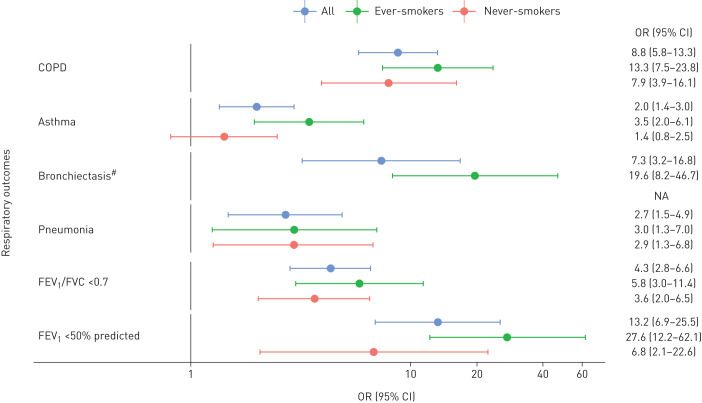
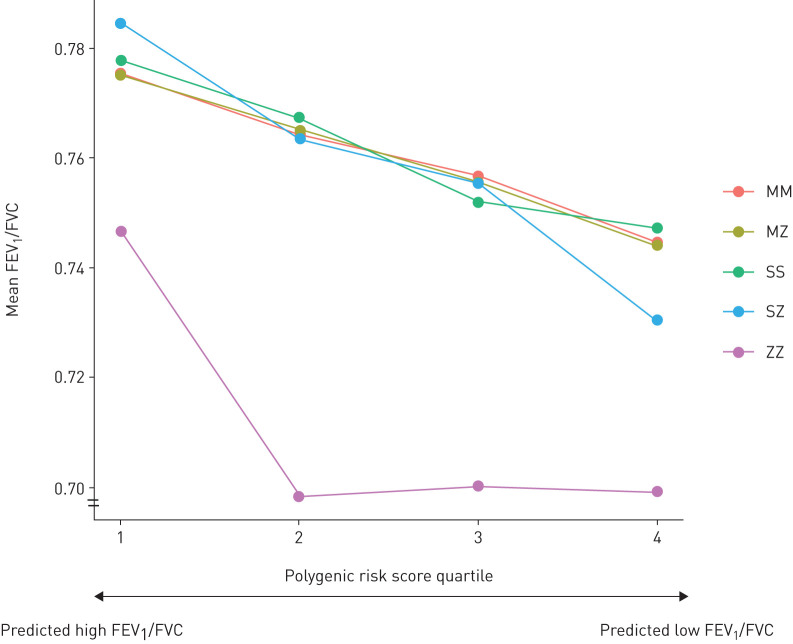
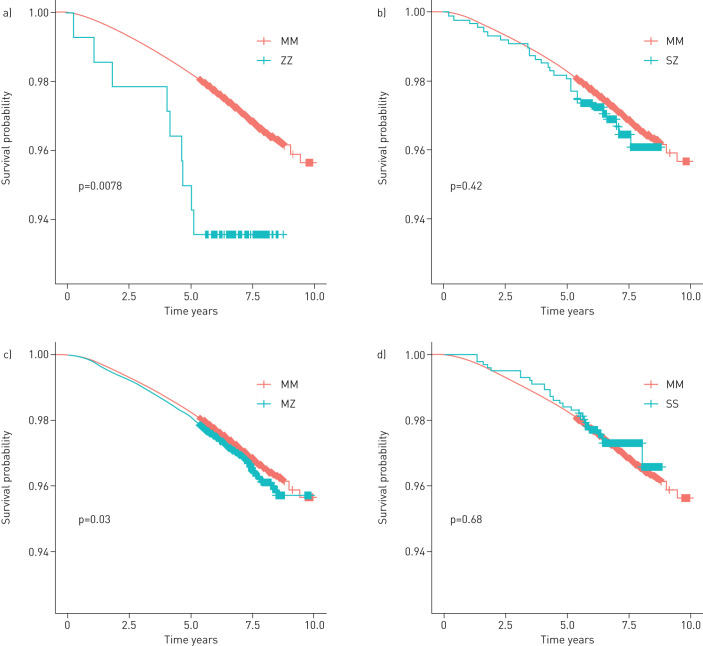
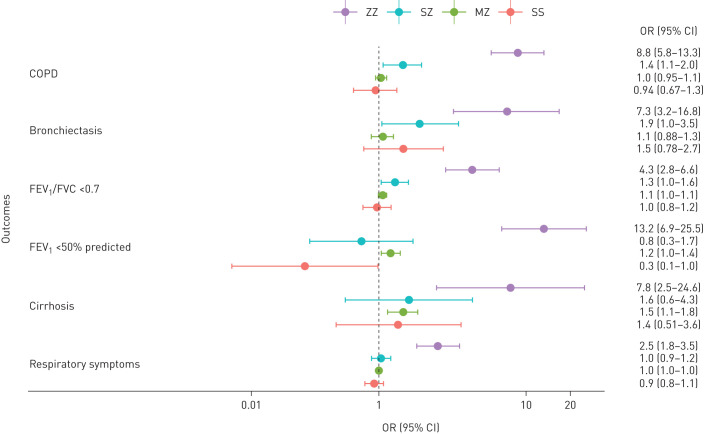
Alpha-1 antitrypsin deficiency (AATD), mainly due to the PIZZ genotype in , is one of the most common inherited diseases. Since it is associated with a high disease burden and partially prevented by smoking cessation, identification of PIZZ individuals through genotyping could improve health outcomes.We examined the frequency of the PIZZ genotype in individuals with and without diagnosed AATD from UK Biobank, and assessed the associations of the genotypes with clinical outcomes and mortality. A phenome-wide association study (PheWAS) was conducted to reveal disease associations with genotypes. A polygenic risk score (PRS) for forced expiratory volume in 1 s (FEV)/forced vital capacity (FVC) ratio was used to evaluate variable penetrance of PIZZ.Among 458 164 European-ancestry participants in UK Biobank, 140 had the PIZZ genotype and only nine (6.4%, 95% CI 3.4-11.7%) of them were diagnosed with AATD. Those with PIZZ had a substantially higher odds of COPD (OR 8.8, 95% CI 5.8-13.3), asthma (OR 2.0, 95% CI 1.4-3.0), bronchiectasis (OR 7.3, 95%CI 3.2-16.8), pneumonia (OR 2.7, 95% CI 1.5-4.9) and cirrhosis (OR 7.8, 95% CI 2.5-24.6) diagnoses and a higher hazard of mortality (2.4, 95% CI 1.2-4.6), compared to PIMM (wildtype) (n=398 424). These associations were stronger among smokers. PheWAS demonstrated associations with increased odds of empyema, pneumothorax, cachexia, polycythaemia, aneurysm and pancreatitis. Polygenic risk score and PIZZ were independently associated with FEV/FVC <0.7 (OR 1.4 per 1-sd change, 95% CI 1.4-1.5 and OR 4.5, 95% CI 3.0-6.9, respectively).The important underdiagnosis of AATD, whose outcomes are partially preventable through smoking cession, could be improved through genotype-guided diagnosis.
α-1抗胰蛋白酶缺乏症(AATD)主要由PIZZ基因型引起,是最常见的遗传性疾病之一。由于它与高疾病负担相关,且戒烟可部分预防,通过基因分型识别PIZZ个体可改善健康结局。我们研究了英国生物银行中已诊断和未诊断AATD个体的PIZZ基因型频率,并评估了这些基因型与临床结局和死亡率的关联。进行了全表型关联研究(PheWAS)以揭示疾病与基因型的关联。使用1秒用力呼气量(FEV)/用力肺活量(FVC)比值的多基因风险评分(PRS)来评估PIZZ的可变外显率。在英国生物银行的458164名欧洲血统参与者中,140人具有PIZZ基因型,其中只有9人(6.4%,95%CI 3.4-11.7%)被诊断为AATD。与PIMM(野生型)(n=398424)相比,PIZZ个体患慢性阻塞性肺疾病(COPD)(OR 8.8,95%CI 5.8-13.3)、哮喘(OR 2.0,95%CI 1.4-3.0)、支气管扩张(OR 7.3,95%CI 3.2-16.8)、肺炎(OR 2.7,95%CI 1.5-4.9)和肝硬化(OR 7.8,95%CI 2.5-24.6)的诊断几率显著更高,且死亡风险更高(2.4,95%CI 1.2-4.6)。这些关联在吸烟者中更强。PheWAS显示与脓胸、气胸、恶病质、红细胞增多症、动脉瘤和胰腺炎的发病几率增加有关。多基因风险评分和PIZZ分别与FEV/FVC<0.7独立相关(每标准差变化的OR为1.4,95%CI 1.4-1.5和OR 4.5,95%CI 3.0-6.9)。AATD的重要漏诊情况可通过基因型指导诊断得到改善,其结局可通过戒烟部分预防。