Fitzgerald Jamie
Bone and Joint Center, Henry Ford Hospital, Integrative Biosciences Center, Detroit, Michigan, USA.
Bone Joint Res. 2020 Jul 13;9(7):351-359. doi: 10.1302/2046-3758.97.BJR-2019-0364.R2. eCollection 2020 Jul.
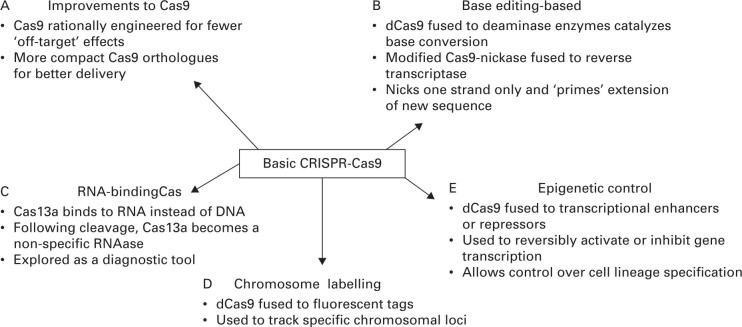
The ability to edit DNA at the nucleotide level using clustered regularly interspaced short palindromic repeats (CRISPR) systems is a relatively new investigative tool that is revolutionizing the analysis of many aspects of human health and disease, including orthopaedic disease. CRISPR, adapted for mammalian cell genome editing from a bacterial defence system, has been shown to be a flexible, programmable, scalable, and easy-to-use gene editing tool. Recent improvements increase the functionality of CRISPR through the engineering of specific elements of CRISPR systems, the discovery of new, naturally occurring CRISPR molecules, and modifications that take CRISPR beyond gene editing to the regulation of gene transcription and the manipulation of RNA. Here, the basics of CRISPR genome editing will be reviewed, including a description of how it has transformed some aspects of molecular musculoskeletal research, and will conclude by speculating what the future holds for the use of CRISPR-related treatments and therapies in clinical orthopaedic practice. Cite this article: 2020;9(7):351-359.
利用成簇规律间隔短回文重复序列(CRISPR)系统在核苷酸水平编辑DNA的能力是一种相对较新的研究工具,它正在彻底改变对人类健康和疾病诸多方面的分析,包括骨科疾病。CRISPR是从细菌防御系统改编而来用于哺乳动物细胞基因组编辑的,已被证明是一种灵活、可编程、可扩展且易于使用的基因编辑工具。最近的改进通过对CRISPR系统特定元件进行工程改造、发现新的天然存在的CRISPR分子以及使CRISPR超越基因编辑扩展到基因转录调控和RNA操纵等修饰,增强了CRISPR的功能。在此,将对CRISPR基因组编辑的基础知识进行综述,包括其如何改变分子肌肉骨骼研究某些方面的描述,并通过推测CRISPR相关治疗和疗法在临床骨科实践中的应用前景来得出结论。引用本文:2020;9(7):351 - 359。