Brockwell Natasha K, Alamgeer Muhammad, Kumar Beena, Rivalland Gareth, John Thomas, Parker Belinda S
Sir Peter MacCallum Department of Oncology, The University of Melbourne, Parkville, Victoria, Australia.
Research Division, Peter MacCallum Cancer Centre, Melbourne, Victoria, Australia.
Transl Lung Cancer Res. 2020 Jun;9(3):639-645. doi: 10.21037/tlcr-19-485.
Malignant pleural mesothelioma (MPM) is well known as an aggressive disease with poor survival. This has sparked trials of alternate immune-based therapies in MPM. While up to a quarter of MPM patients respond to immune checkpoint inhibitors (ICIs), predicting response remains challenging and PD-L1 expression alone has been deemed insufficient. Additionally, patients with sarcomatoid MPM are often excluded from trials utilizing ICIs due to their rapid progression. Here, we analyze the association of T lymphocytes with response to ICI-based immunotherapy to uncover predictive immune markers across subtypes.
Retrospective analysis of immunotherapy treated mesothelioma patient cohorts from two sites were pooled. Patient characteristics, including age, sex, subtype and previous treatment were captured. Multiplex immunohistochemistry was used to assess proportions of CD4, CD8, CD45RO and FOXP3 positive infiltrates in MPM and their association with progression free (PFS) and overall (OS) survival post immunotherapy.
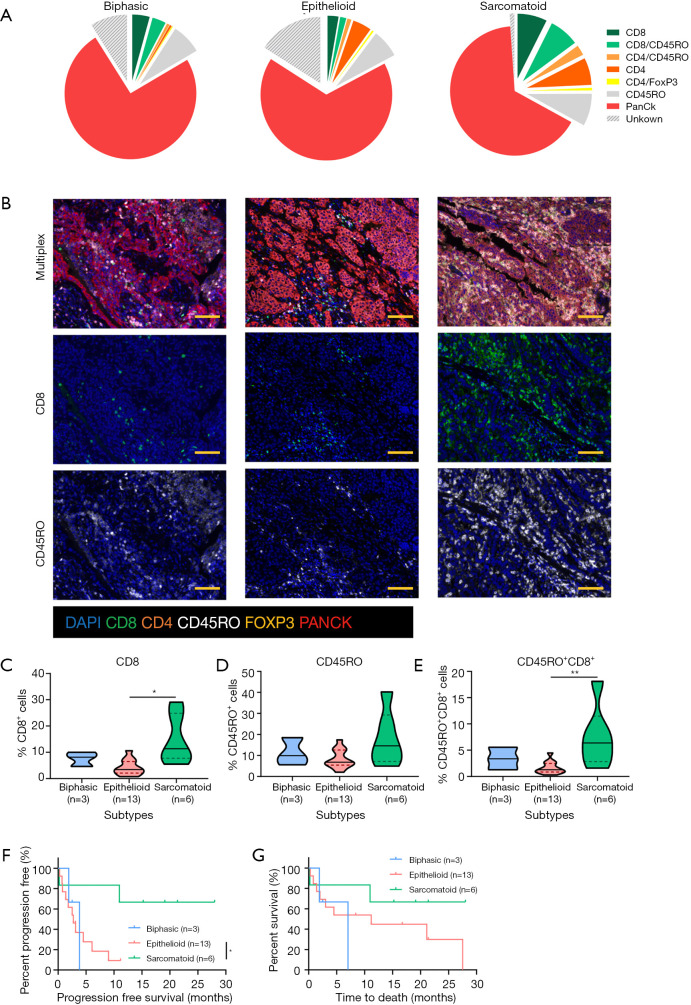
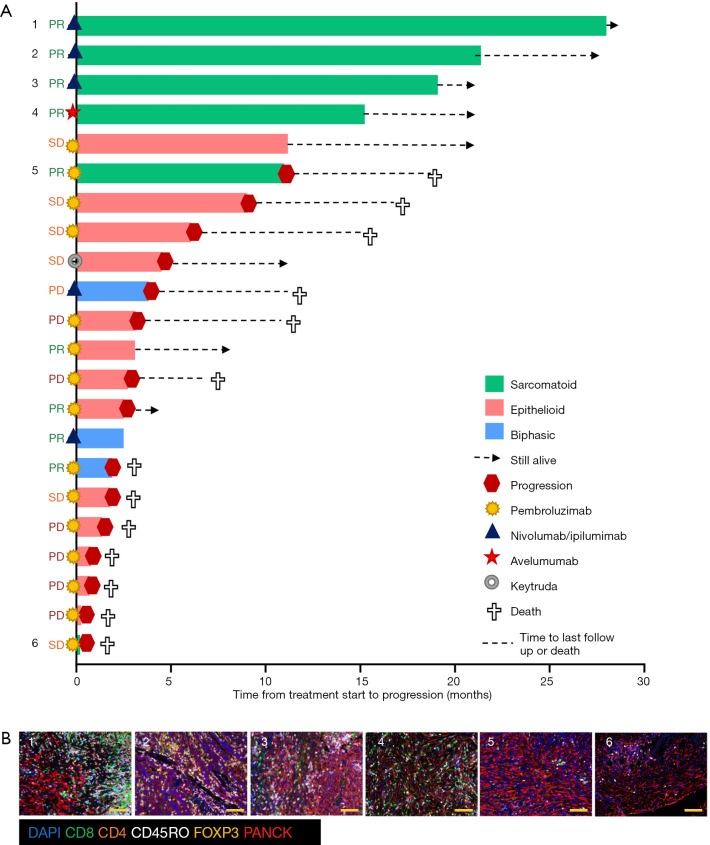
Samples derived from 22 patients were analyzed; 13 (59%) had epithelioid MPM, 6 (27%) sarcomatoid and 3 (14%) biphasic. The overall ICI response rate was 40%, with a median PFS (mPFS) and OS (mOS) of 3.8 and 11.17 months, respectively. Of the subtypes, sarcomatoid patients displayed the greatest median PFS and OS (>28 months) post ICI compared to the epithelioid subtype (3 and 11 months respectively), which correlated with higher proportions of infiltrating CD8, CD45RO and CD8CD45RO cells. Patients who received ICIs as first-line therapy had greater PFS than those who received it as second or third line post-chemotherapy.
High proportions of T lymphocytes and CD45RO cells were associated with prolonged mPFS and mOS in sarcomatoid patients treated with ICI immunotherapy. These data support the expansion of trials utilizing single and combination ICIs as first-line therapy in sarcomatoid MPM and warrants further studies testing the impact or detriment of chemotherapy pre-ICI.
恶性胸膜间皮瘤(MPM)是一种侵袭性疾病,生存率低,这引发了对MPM替代免疫疗法的试验。虽然高达四分之一的MPM患者对免疫检查点抑制剂(ICI)有反应,但预测反应仍然具有挑战性,仅PD-L1表达被认为是不够的。此外,肉瘤样MPM患者由于病情进展迅速,通常被排除在使用ICI的试验之外。在此,我们分析T淋巴细胞与基于ICI的免疫治疗反应之间的关联,以发现各亚型的预测性免疫标志物。
汇总了来自两个地点接受免疫治疗的间皮瘤患者队列的回顾性分析。记录患者特征,包括年龄、性别、亚型和既往治疗情况。采用多重免疫组织化学法评估MPM中CD4、CD8、CD45RO和FOXP3阳性浸润细胞的比例,以及它们与免疫治疗后无进展生存期(PFS)和总生存期(OS)的关联。
分析了22例患者的样本;13例(59%)为上皮样MPM,6例(27%)为肉瘤样,3例(14%)为双向型。ICI总体反应率为40%,中位PFS(mPFS)和OS(mOS)分别为3.8个月和11.17个月。在各亚型中,与上皮样亚型(分别为3个月和11个月)相比,肉瘤样患者在接受ICI治疗后的中位PFS和OS最长(>28个月),这与浸润性CD8、CD45RO和CD8CD45RO细胞比例较高相关。接受ICI作为一线治疗的患者的PFS长于接受ICI作为化疗后二线或三线治疗的患者。
在接受ICI免疫治疗的肉瘤样患者中,高比例的T淋巴细胞和CD45RO细胞与延长的mPFS和mOS相关。这些数据支持扩大在肉瘤样MPM中使用单一和联合ICI作为一线治疗的试验,并需要进一步研究测试ICI前化疗的影响或损害。