Department of medical imaging, Raymond Poincaré University Hospital, AP-HP Paris Saclay University, 92380, Garches, France.
Microbiology laboratory, Raymond Poincaré University Hospital, AP-HP Paris Saclay University, 92380, Garches, France.
BMC Infect Dis. 2020 Jul 16;20(1):512. doi: 10.1186/s12879-020-05223-z.
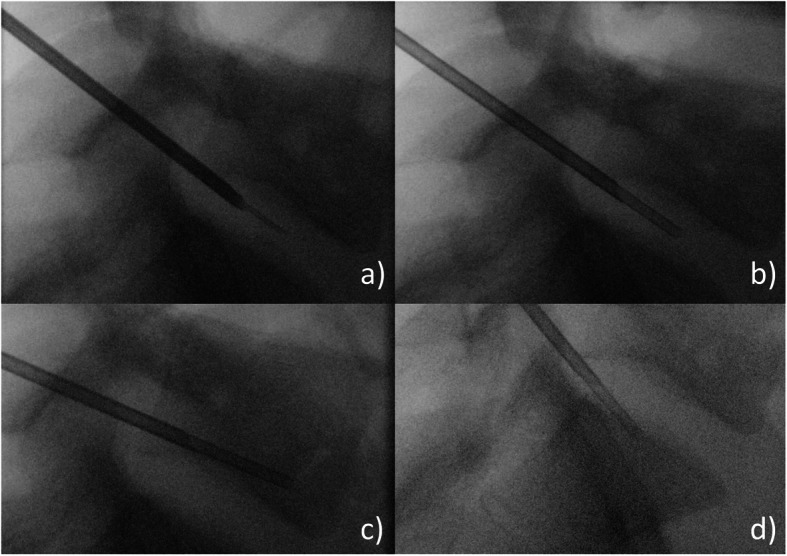
The aims of this study were to identify the predictive factors for microbiological diagnosis through disco-vertebral biopsy (DVB) in patients with pyogenic vertebral osteomyelitis (PVO) and negative blood cultures, and compare the performance of DVB under fluoroscopic versus scanographic guidance.
We performed a cohort study comparing positive and negative DVB among patients with PVO. All cases of PVO undergoing a DVB for microbiological diagnosis in our center were retrospectively reviewed. Infections due to Mycobacterium tuberculosis, infections on foreign device, and non-septic diseases were excluded. Anamnestic, clinical, biological, microbiological, as well as radiological data were collected from medical charts thanks to a standardized data set.
A total of 111 patients were screened; 88 patients were included. Microbiological cultures were positive in 53/88 (60.2%) patients. A thickening of the paravertebral tissue ≥10 mm on magnetic resonance imaging (MRI) in axial MR scans was a predictive factor of DVB microbiological positivity (52.4% vs. 13.3%; p = 0.006; OR = 5.4). Overall, 51 DVB were performed under fluoroscopic guidance and 37 under scanographic guidance. Considering lumbar DVB, 25/36 (69.4%) of cases yielded positive results under fluoroscopic guidance versus 5/15 (33.3%) under scanographic guidance (p = 0.02; OR = 4.4). No adverse event linked to DVB was notified.
Every patient with PVO and negative blood cultures should undergo a DVB. A thickening of the paravertebral tissue ≥10 mm on MRI is associated with a higher rate of positive DVB culture. A lumbar DVB under fluoroscopic guidance is more sensitive than under scanographic guidance to identify the micro-organism involved.
本研究旨在确定经皮椎间盘-椎体骨活检(DVB)对血培养阴性的化脓性脊柱骨髓炎(PVO)患者微生物学诊断的预测因素,并比较透视与扫描引导下 DVB 的性能。
我们对我院接受 DVB 进行微生物学诊断的 PVO 患者进行了队列研究,比较了 DVB 阳性和阴性结果。排除结核分枝杆菌感染、器械相关感染和非感染性疾病。通过标准化数据集从病历中收集病史、临床、生物学、微生物学和影像学数据。
共筛选出 111 例患者,其中 88 例入选。88 例患者中,53/88(60.2%)患者的微生物培养为阳性。轴位磁共振扫描(MRI)中椎旁组织厚度≥10mm是 DVB 微生物学阳性的预测因素(52.4%比 13.3%;p=0.006;OR=5.4)。总体而言,51 例 DVB 在透视引导下进行,37 例在扫描引导下进行。考虑到腰椎 DVB,透视引导下 25/36(69.4%)的病例阳性结果,而扫描引导下 5/15(33.3%)(p=0.02;OR=4.4)。未发现与 DVB 相关的不良事件。
对于血培养阴性的 PVO 患者,均应进行 DVB。MRI 上椎旁组织厚度≥10mm与较高的 DVB 培养阳性率相关。腰椎 DVB 在透视引导下比扫描引导下更能敏感地识别感染微生物。