Department of Medical Diagnostics, Faculty of Allied Health Sciences, Kwame Nkrumah University of Science and Technology, Kumasi, 00233, Ghana.
School of Basic and Biomedical Sciences, University of Health and Allied Sciences, Ho, Ghana.
Malar J. 2020 Jul 16;19(1):256. doi: 10.1186/s12936-020-03328-z.
In the absence of microscopy, Plasmodium falciparum histidine-rich proteins 2 (PfHRP2)-based rapid diagnostic tests (RDTs) are recommended for the diagnosis of falciparum malaria, particularly in endemic regions. However, genetic variability of the pfhrp2 gene threatens the usefulness of the test due to its impact on RDT sensitivity. This study aimed to investigate the diversity of pfhrp2 in malaria cases among children in Ghana.
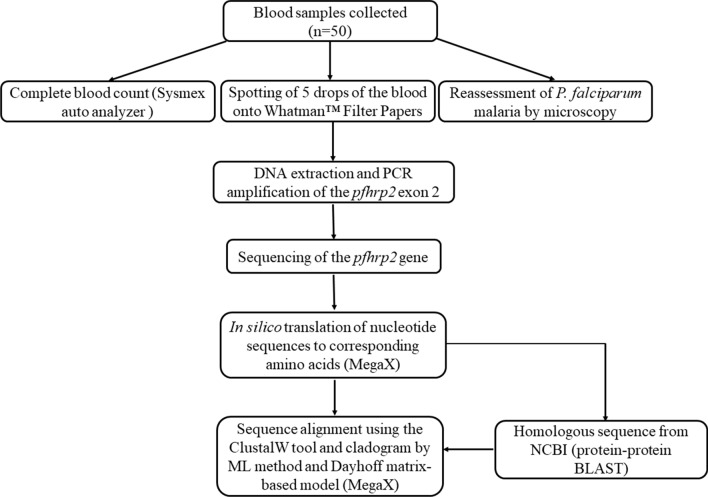
A cross-sectional study was conducted at the Adidome Government Hospital in the Volta Region of Ghana. A total of 50 children with mean age of 6.6 ± 3.5 years and diagnosed falciparum malaria were included. Blood samples were collected for complete blood count, malaria parasite identification and counting using auto analyzer and microscopy, respectively. DNA was isolated from blood-spotted Whatman filters, amplified and sequenced. Nucleotide sequences were translated in silico to corresponding amino acids and the deduced amino acids sequences were analyzed for diversity using Mega X.
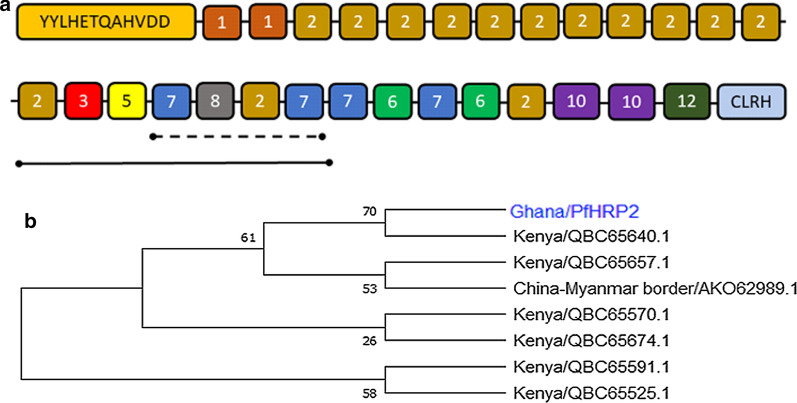
The number of repeats and number of each repeat within PfHRP2 varied between isolates. Twelve rare PfHRP2 repeat types, two of which are previously unreported, were identified in this study. The HRP2 sequence obtained in this study shared high similarities with isolates from Kenya. Using Baker's regression model, Group B was the highest occurring type (58.0%). Screening of all sequences for epitopes recognized by PfHRP2-specific monoclonal antibodies (mAbs), the predominant motif was AHHAADAHH, which is recognized by the C1-13 mAbs.
This study reports diversity of P. falciparum HRP2 in samples from Ghanaian children with symptomatic malaria. The findings of this study highlight the existence of extra amino acid repeat types which adds to the PfHRP2 antigenic variability.
在缺乏显微镜的情况下,推荐使用恶性疟原虫 HRP2(PfHRP2)快速诊断检测(RDT)来诊断恶性疟,尤其是在流行地区。然而,pfhrp2 基因的遗传变异会影响 RDT 的敏感性,从而威胁到该检测的有效性。本研究旨在调查加纳儿童疟疾病例中 pfhrp2 的多样性。
在加纳沃尔特地区的 Adidome 政府医院进行了一项横断面研究。共纳入 50 名年龄为 6.6±3.5 岁的儿童疟疾患者。采集血样进行全血细胞计数,使用自动分析仪和显微镜分别进行疟原虫鉴定和计数。从血斑滤纸中提取 DNA,进行扩增和测序。对核苷酸序列进行计算机翻译,以获得相应的氨基酸,并使用 Mega X 对推导的氨基酸序列进行多样性分析。
PfHRP2 中的重复数和每个重复的数量在分离株之间存在差异。本研究鉴定了 12 种罕见的 PfHRP2 重复类型,其中两种是以前未报道过的。本研究获得的 HRP2 序列与肯尼亚的分离株高度相似。使用 Baker 回归模型,B 组是最常见的类型(58.0%)。对所有序列进行 PfHRP2 特异性单克隆抗体(mAb)识别表位的筛选,主要基序为 AHHAADAHH,被 C1-13 mAb 识别。
本研究报告了加纳有症状疟疾儿童样本中 PfHRP2 的多样性。本研究的发现强调了存在额外的氨基酸重复类型,这增加了 PfHRP2 的抗原变异性。