Xiang Yanhui, Wen Xue, Zhao Jiaxu, Zhang Wenrui, Jiang Yiqi
Cognition and Human Behavior Key Laboratory of Hunan, Department of Psychology, Hunan Normal University, Changsha, China1.
School of Psychology, Hainan Normal University, Hainan, China2.
Adv Cogn Psychol. 2020 May 29;16(2):160-168. doi: 10.5709/acp-0293-9. eCollection 2020.
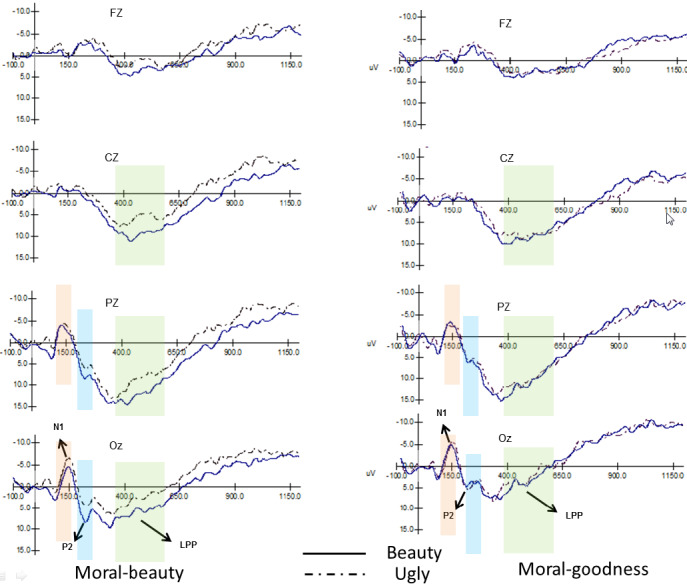
Goodness and beauty have always been important topics of debate in the field of philosophy and aesthetics. The present study used behavior and event-related potentials (ERPs) to investigate whether moral beauty judgments and moral goodness judgments involve different cognitive processes or the same cognitive process under different language labels for the same human act. Behavioral results showed that individuals gave significantly higher scores for a beautiful face than an ugly face when making moral beauty judgments, but there were no significant differences between the two conditions when making moral goodness judgments. The ERP experiment displayed larger P2 amplitudes and the late positive potential (LPP) amplitude was elicited when displaying beautiful faces but not ugly faces during moral beauty judgments. However, during moral goodness judgments, the P2 and LPP showed no significant differences under the two conditions. In general, we conclude that moral beauty judgments and moral goodness judgments involve different cognitive processes, although they objectively refer to the same human act. One of the most important differences between moral beauty judgments and moral goodness judgments was that the former process involved an image, whereas the latter did not. The present conclusion provides important insights into the research in aesthetic perception and moral sense.
善与美一直是哲学和美学领域重要的辩论话题。本研究运用行为学和事件相关电位(ERP)来探究对于同一人类行为,在不同语言标签下,道德美判断和道德善判断是涉及不同的认知过程还是相同的认知过程。行为学结果表明,在进行道德美判断时,个体对美丽面孔给出的分数显著高于丑陋面孔,但在进行道德善判断时,两种面孔条件下无显著差异。ERP实验显示,在道德美判断过程中,呈现美丽面孔时会引发更大的P2波幅和晚期正电位(LPP)波幅,而呈现丑陋面孔时则不会。然而,在道德善判断过程中,两种面孔条件下P2和LPP均无显著差异。总体而言,我们得出结论,道德美判断和道德善判断涉及不同的认知过程,尽管它们在客观上指的是同一人类行为。道德美判断和道德善判断之间最重要的差异之一在于,前者的过程涉及形象,而后者则不涉及。本结论为审美感知和道德感的研究提供了重要见解。