Dabiré Hubert, Dramé Fatou, Cita Nelly, Ghaleh Bijan
U955 - IMRB, Inserm, UPEC, École Nationale Vétérinaire d'Alfort, Créteil, France.
INSERM U955 Équipe 03, Faculté de Médecine, 8 rue du Général Sarrail, 94000 Créteil, France.
Cardiooncology. 2020 Jul 13;6:7. doi: 10.1186/s40959-020-00064-w. eCollection 2020.
Contrasting to the well documented tyrosine kinase inhibitor (TKI)-induced hypertension, little is known on their intrinsic vasomotor effects. We investigated the vasomotor effects of sorafenib, a widely used multikinase inhibitor in the treatment of hepatocellular and renal cell carcinoma and tested the hypothesis that sildenafil, a phosphodiesterase-5 (PDE-5) inhibitor, could represent a pharmacological strategy for the treatment of TKI-induced hypertension.
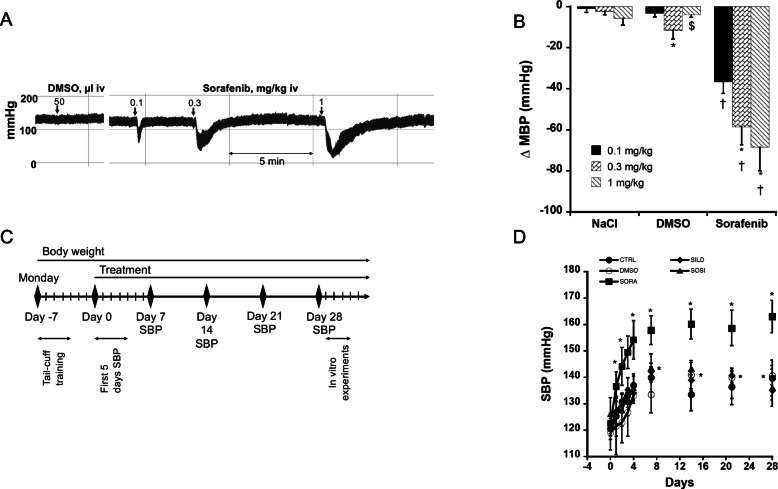
Concentration-response curves of sorafenib were constructed in endothelium-intact or denuded precontracted rat aorta, in the presence or absence of several inhibitors. Acute intravenous effects of sorafenib on arterial blood pressure were also investigated in anaesthetized rats. Finally, rats were chronically treated with sorafenib during 4 weeks in the presence and absence of sildenafil.
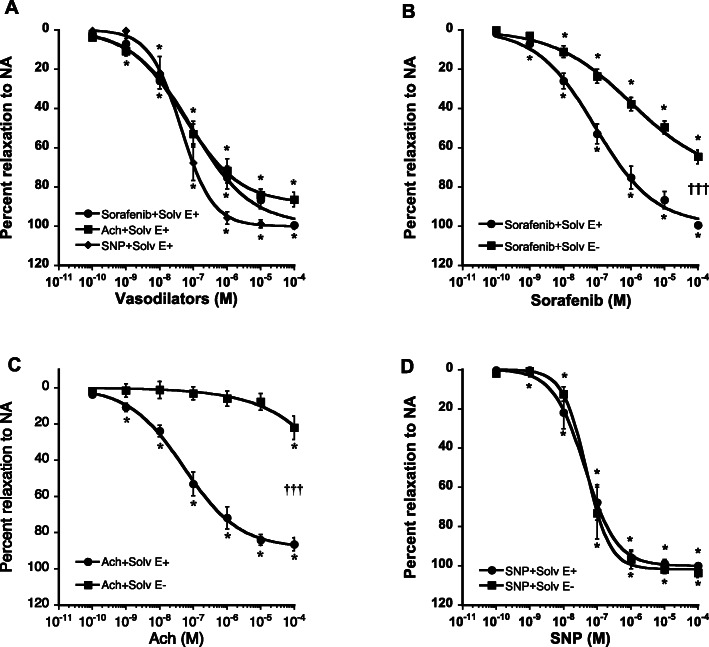
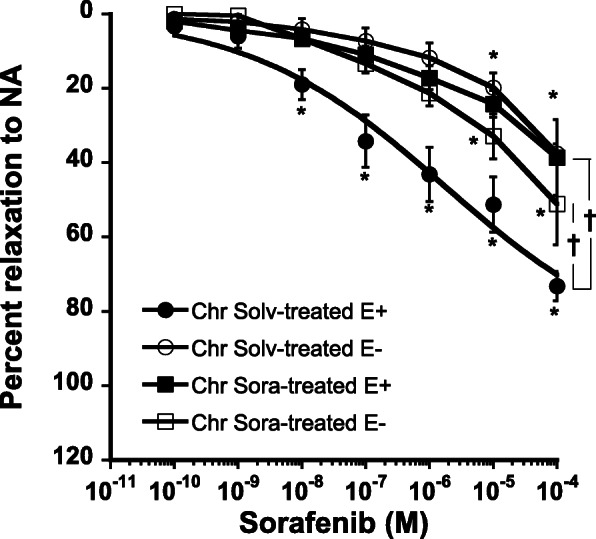
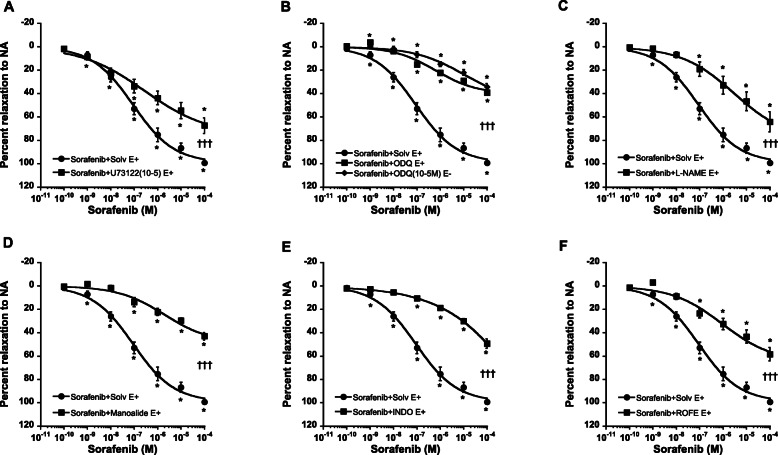
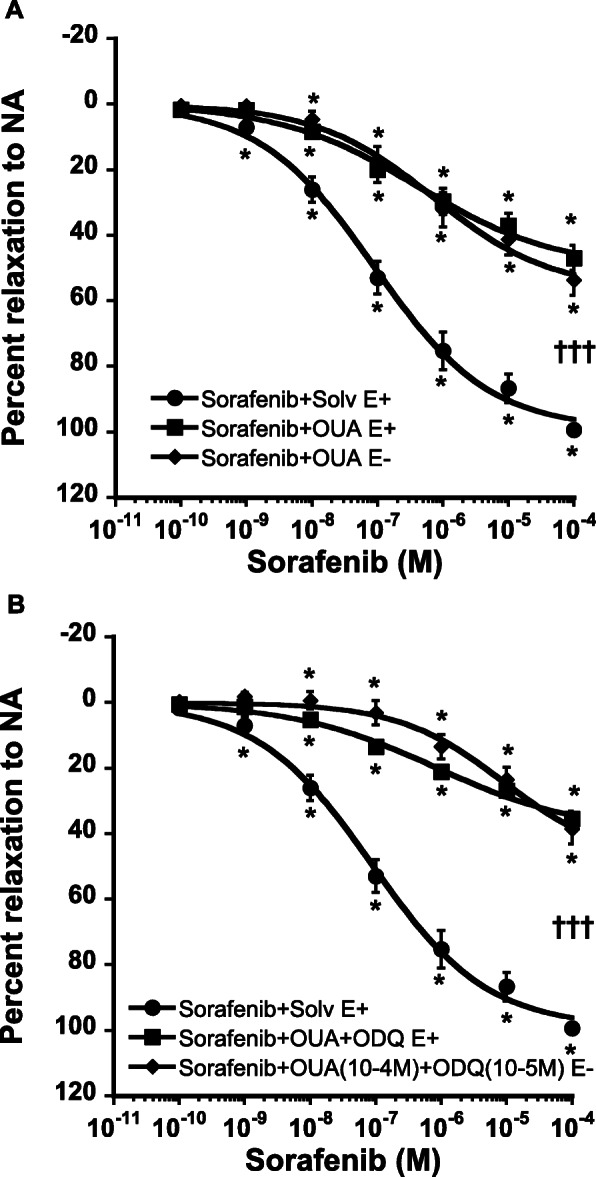
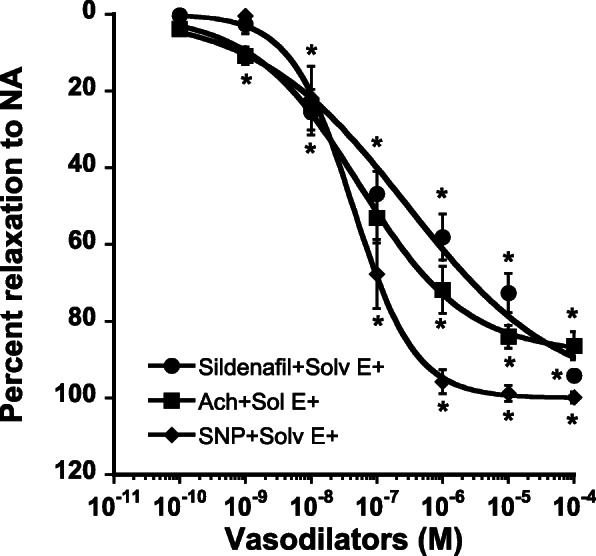
In endothelium intact aortic ring, sorafenib induced a potent concentration-dependent relaxation of precontracted rat aorta. Removal of the endothelium shifted the concentration-response curve of sorafenib to the right and significantly reduced its maximal effects, demonstrating that sorafenib-induced vasorelaxation is endothelium-dependent and endothelium-independent. Inhibition of the different pathways implicated in the endothelium-dependent and independent vasorelaxation revealed that the endothelium-dependent effects of sorafenib result mainly from the activation of prostaglandin and the nitric oxide (NO) pathways. The endothelium-independent vasodilatory effects of sorafenib may result mainly from the activation of Na/K-ATPase and soluble guanylate cyclase. These vasodilatory effects observed in vitro were confirmed by the decrease in arterial blood pressure observed during acute administrations of sorafenib in anesthetized rats. Finally, and most importantly, we report here for the first time that chronic administration of sorafenib in rats induced an increase in SBP that was abolished by sildenafil.
The multikinase inhibitor sorafenib induced in vitro vasorelaxation of large conductance artery, primary by activating soluble guanylate cyclase. Its chronic administration led to arterial blood hypertension that was counteracted by a PDE-5 inhibitor, sildenafil. Our results suggest that targeting the cGMP pathway including NO signalling might be an interesting pharmacological strategy for the treatment of TKI-induced hypertension.
与酪氨酸激酶抑制剂(TKI)引起的高血压已有充分记录形成对比的是,关于它们内在的血管舒缩作用知之甚少。我们研究了索拉非尼(一种广泛用于治疗肝细胞癌和肾细胞癌的多激酶抑制剂)的血管舒缩作用,并检验了磷酸二酯酶-5(PDE-5)抑制剂西地那非可作为治疗TKI引起的高血压的一种药理学策略的假设。
在存在或不存在几种抑制剂的情况下,在内皮完整或去内皮的预收缩大鼠主动脉中构建索拉非尼的浓度-反应曲线。还在麻醉大鼠中研究了索拉非尼对动脉血压的急性静脉作用。最后,在有和没有西地那非的情况下,对大鼠进行为期4周的索拉非尼长期治疗。
在内皮完整的主动脉环中,索拉非尼诱导预收缩的大鼠主动脉产生有效的浓度依赖性舒张。去除内皮使索拉非尼的浓度-反应曲线右移并显著降低其最大效应,表明索拉非尼诱导的血管舒张是内皮依赖性和非内皮依赖性的。对参与内皮依赖性和非内皮依赖性血管舒张的不同途径的抑制表明,索拉非尼的内皮依赖性作用主要源于前列腺素和一氧化氮(NO)途径的激活。索拉非尼的非内皮依赖性血管舒张作用可能主要源于钠钾ATP酶和可溶性鸟苷酸环化酶的激活。在麻醉大鼠中急性给予索拉非尼期间观察到的动脉血压下降证实了体外观察到的这些血管舒张作用。最后,也是最重要的,我们首次在此报告,大鼠长期给予索拉非尼会导致收缩压升高,而西地那非可消除这种升高。
多激酶抑制剂索拉非尼主要通过激活可溶性鸟苷酸环化酶诱导大传导动脉的体外血管舒张。其长期给药导致动脉血压升高,而PDE-5抑制剂西地那非可抵消这种升高。我们的结果表明,靶向包括NO信号传导在内的cGMP途径可能是治疗TKI引起的高血压的一种有趣的药理学策略。