Kidibule Peter Elias, Santos-Moriano Paloma, Plou Francisco Jose, Fernández-Lobato María
Department of Molecular Biology, Centre for Molecular Biology Severo Ochoa (CSIC-UAM), University Autonomous from Madrid. Nicolás Cabrera, 1. Cantoblanco. 28049 Madrid, Spain.
Institute of Catalysis and Petrochemistry, CSIC. Marie Curie, 2. Cantoblanco, 28049 Madrid, Spain.
Biotechnol Rep (Amst). 2020 Jul 4;27:e00500. doi: 10.1016/j.btre.2020.e00500. eCollection 2020 Sep.
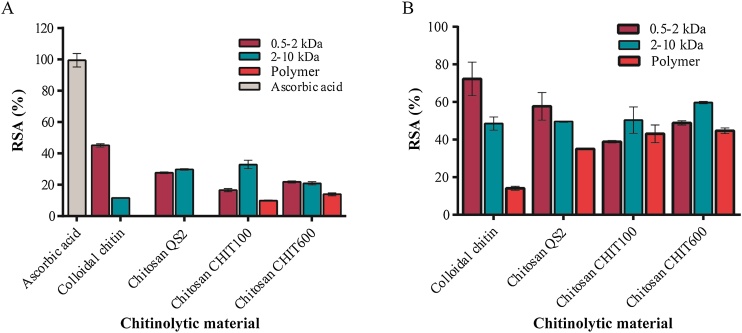
The biological activity of chitooligosaccharides (COS) has made them targets for industrial and medical sectors. In this work, chitinase Chit33 from CECT 2413 was expressed in GS115 to levels never achieved before (630 mg/L; 3.3 U/mL), without its biochemical characteristics being substantially affected. Chit33 produced a mixture of fully and partially acetylated COS from different chitin derivatives. HPAEC-PAD Chromatography and mass spectrometry analyses showed that (GlcNAc) and GlcN-(GlcNAc) were mainly produced from colloidal chitin and chitosan, respectively. COS in reaction mixtures were fragmented according to their size and their antioxidant activity analyzed by reducing power and free radical scavenging activity essays. The highest antioxidant activity was achieved with COS in the range of 0.5-2 and 2-10 kDa produced from colloidal chitin and chitosan, respectively, which gives biotechnological potential to both the chitin derivatives of 0.5-10 kDa and the biocatalyst producing them.
壳寡糖(COS)的生物活性使其成为工业和医疗领域的目标。在这项工作中,来自CECT 2413的几丁质酶Chit33在GS115中表达,达到了前所未有的水平(630mg/L;3.3U/mL),且其生化特性未受到实质性影响。Chit33从不同的几丁质衍生物中产生了完全乙酰化和部分乙酰化的COS混合物。高效阴离子交换色谱-脉冲安培检测(HPAEC-PAD)色谱和质谱分析表明,(GlcNAc)和GlcN-(GlcNAc)分别主要由胶体几丁质和壳聚糖产生。反应混合物中的COS根据其大小进行分离,并通过还原能力和自由基清除活性测定分析其抗氧化活性。分别由胶体几丁质和壳聚糖产生的0.5-2kDa和2-10kDa范围内的COS具有最高的抗氧化活性,这赋予了0.5-10kDa的几丁质衍生物及其生产生物催化剂生物技术潜力。