Arizona State University, Tempe, AZ, 85287, USA.
US Naval Research Laboratory, Washington, DC, 20375, USA.
Sci Rep. 2020 Jul 20;10(1):12009. doi: 10.1038/s41598-020-68655-2.
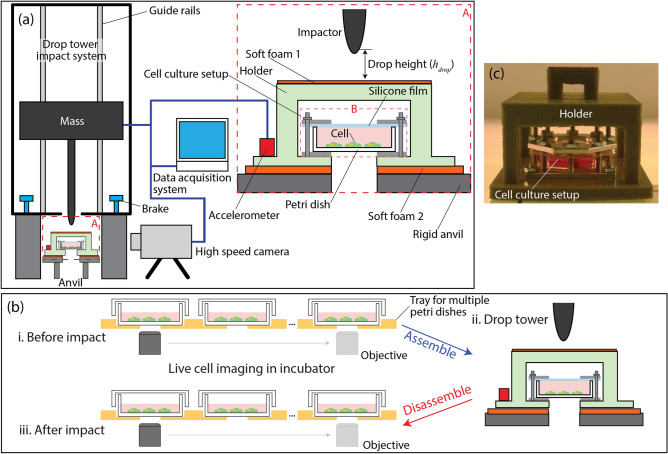
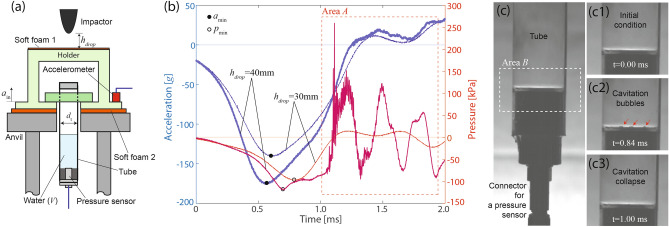
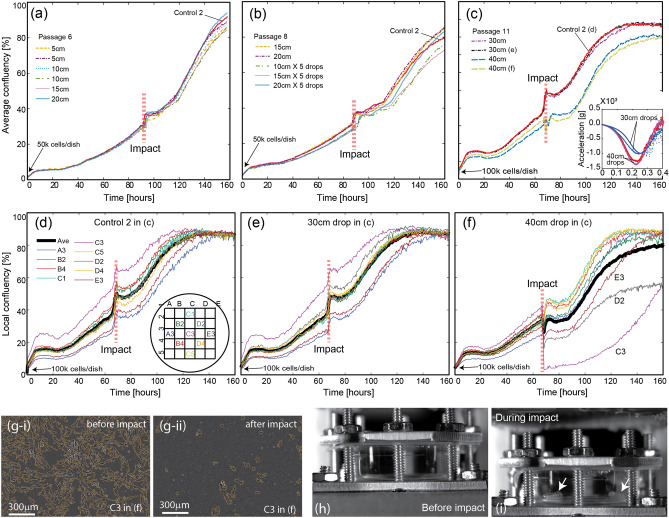
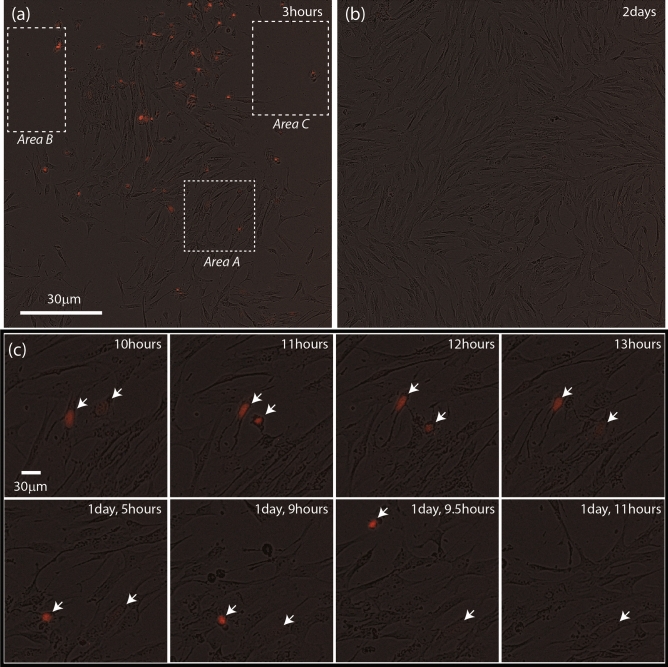
The dynamic response of cells when subjected to mechanical impact has become increasingly relevant for accurate assessment of potential blunt injuries and elucidating underlying injury mechanisms. When exposed to mechanical impact, a biological system such as the human skin, brain, or liver is rapidly accelerated, which could result in blunt injuries. For this reason, an acceleration of greater than > 150 g is the most commonly used criteria for head injury. To understand the main mechanism(s) of blunt injury under such extreme dynamic threats, we have developed an innovative experimental method that applies a well-characterized and -controlled mechanical impact to live cells cultured in a custom-built in vitro setup compatible with live cell microscopy. Our studies using fibroblast cells as a model indicate that input acceleration ([Formula: see text]) alone, even when it is much greater than the typical injury criteria, e.g., [Formula: see text] g, does not result in cell damage. On the contrary, we have observed a material-dependent critical pressure value above which a sudden decrease in cell population and cell membrane damage have been observed. We have unambiguously shown that (1) this critical pressure is associated with the onset of cavitation bubbles in a cell culture chamber and (2) the dynamics of cavitation bubbles in the chamber induces localized compressive/tensile pressure cycles, with an amplitude that is considerably greater than the acceleration-induced pressure, to cells. More importantly, the rate of pressure change with time for cavitation-induced pressure is significantly faster (more than ten times) than acceleration-induced pressure. Our in vitro study on the dynamic response of biological systems due to mechanical impact is a crucial step towards understanding potential mechanism(s) of blunt injury and implementing novel therapeutic strategies post-trauma.
当细胞受到机械冲击时,其动态响应对于准确评估潜在的钝性损伤和阐明潜在的损伤机制变得越来越重要。当暴露于机械冲击时,诸如人体皮肤、大脑或肝脏等生物系统会被迅速加速,这可能导致钝性损伤。因此,超过>150g 的加速度是最常用于头部损伤的标准。为了了解在这种极端动态威胁下钝性损伤的主要机制,我们开发了一种创新的实验方法,该方法将经过良好表征和控制的机械冲击应用于在定制的体外装置中培养的活细胞,该装置与活细胞显微镜兼容。我们使用成纤维细胞作为模型的研究表明,输入加速度([Formula: see text])本身,即使远大于典型的损伤标准,例如[Formula: see text]g,也不会导致细胞损伤。相反,我们观察到了一个依赖于材料的临界压力值,超过该值会观察到细胞群体突然减少和细胞膜损伤。我们明确表明:(1) 这个临界压力与细胞培养室中空化气泡的产生有关;(2) 腔室中空化气泡的动力学导致局部压缩/拉伸压力循环,其幅度远大于加速度引起的压力,对细胞产生影响。更重要的是,空化引起的压力随时间的压力变化率比加速度引起的压力快得多(快十倍以上)。我们对机械冲击引起的生物系统动态响应的体外研究是理解潜在钝性损伤机制和实施创伤后新型治疗策略的重要步骤。