Center for Pediatric and Adolescent Medicine, Division of Pediatric Neurology and Metabolic Medicine, University Hospital Heidelberg, Im Neuenheimer Feld 430, 69120, Heidelberg, Germany.
Children's National Health System, Washington, DC, USA.
Sci Rep. 2020 Jul 20;10(1):11948. doi: 10.1038/s41598-020-67496-3.
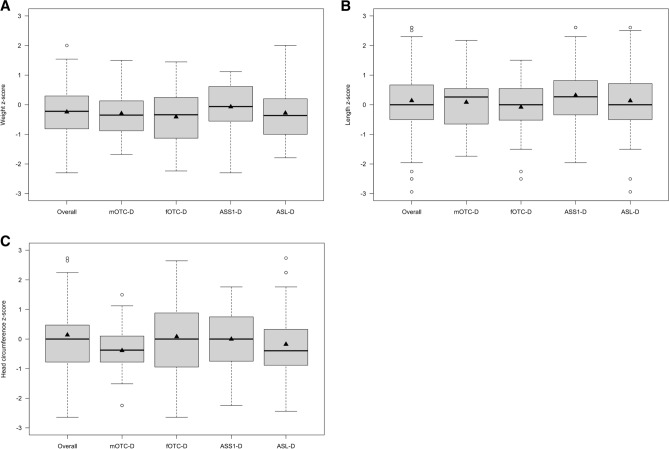
Low protein diet and sodium or glycerol phenylbutyrate, two pillars of recommended long-term therapy of individuals with urea cycle disorders (UCDs), involve the risk of iatrogenic growth failure. Limited evidence-based studies hamper our knowledge on the long-term effects of the proposed medical management in individuals with UCDs. We studied the impact of medical management on growth and weight development in 307 individuals longitudinally followed by the Urea Cycle Disorders Consortium (UCDC) and the European registry and network for Intoxication type Metabolic Diseases (E-IMD). Intrauterine growth of all investigated UCDs and postnatal linear growth of asymptomatic individuals remained unaffected. Symptomatic individuals were at risk of progressive growth retardation independent from the underlying disease and the degree of natural protein restriction. Growth impairment was determined by disease severity and associated with reduced or borderline plasma branched-chain amino acid (BCAA) concentrations. Liver transplantation appeared to have a beneficial effect on growth. Weight development remained unaffected both in asymptomatic and symptomatic individuals. Progressive growth impairment depends on disease severity and plasma BCAA concentrations, but cannot be predicted by the amount of natural protein intake alone. Future clinical trials are necessary to evaluate whether supplementation with BCAAs might improve growth in UCDs.
低蛋白饮食和钠或甘油基苯丁酸钠,是推荐的尿素循环障碍(UCD)患者长期治疗的两个支柱,存在医源性生长失败的风险。有限的基于证据的研究阻碍了我们对 UCD 患者拟议的医学管理的长期效果的了解。我们通过尿素循环障碍联合会(UCDC)和欧洲中毒型代谢疾病登记处和网络(E-IMD)对 307 名个体进行了纵向研究,研究了医学管理对生长和体重发育的影响。所有研究的 UCD 的宫内生长和无症状个体的出生后线性生长不受影响。症状性个体存在进行性生长迟缓的风险,与潜在疾病和天然蛋白质限制的程度无关。生长障碍由疾病严重程度决定,并与降低或边缘血浆支链氨基酸(BCAA)浓度相关。肝移植似乎对生长有有益的影响。无症状和有症状个体的体重发育均不受影响。进行性生长障碍取决于疾病严重程度和血浆 BCAA 浓度,但不能仅通过天然蛋白质摄入量来预测。需要进行未来的临床试验来评估补充 BCAA 是否可以改善 UCD 患者的生长。