Yu Yu, Li Tongxin, Xi Shijun, Li Yilu, Xiao Xi, Yang Min, Ge Xiaoping, Xiao Shuiyuan, Tebes Jacob
Department of Social Medicine and Health Management, Xiangya School of Public Health, Central South University, Changsha, China.
Division of Prevention and Community Research, Department of Psychiatry, Yale School of Medicine, New Haven, CT, United States.
JMIR Res Protoc. 2020 Aug 25;9(8):e18538. doi: 10.2196/18538.
Schizophrenia is a persistent and debilitating mental illness, and its prognosis depends largely on supportive care and systematic treatment. In developing countries like China, families constitute the major caregiving force for schizophrenia and are faced with many challenges, such as lack of knowledge, skills, and resources. The approach to support family caregiving in an accessible, affordable, feasible, and cost-effective way remains unclear. The wide-spread use of WeChat provides a promising and cost-effective medium for support.
We aim to present a protocol for assessing a WeChat-based integrative family intervention (WIFI) to support family caregiving for schizophrenia.
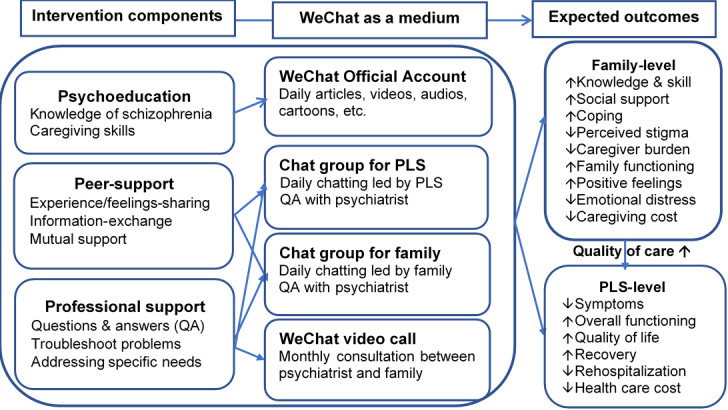
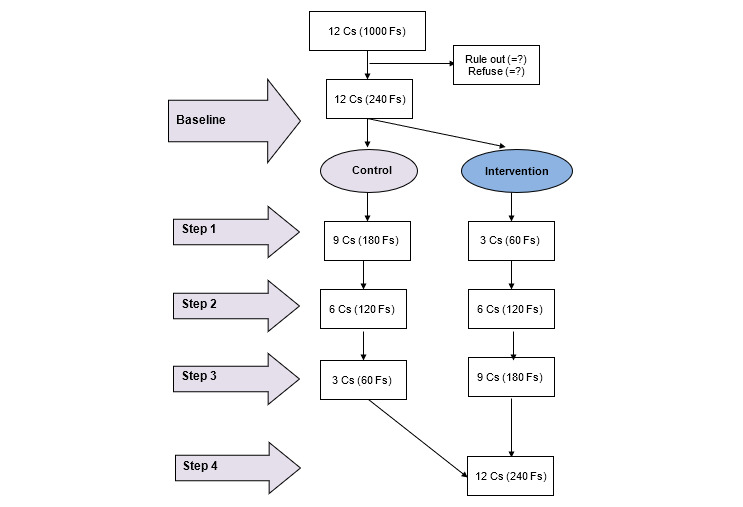
We will develop a WIFI program that includes the following three core components: (1) psychoeducation (WeChat official account), (2) peer support (WeChat chat group), and (3) professional support (WeChat video chat). A rigorous stepped-wedge cluster randomized trial will be used to evaluate the implementation, effectiveness, and cost of the WIFI program. The WIFI program will be implemented in 12 communities affiliated with Changsha Psychiatric Hospital through the free medicine delivery process in the 686 Program. The 12 communities will be randomized to one of four fixed sequences every 2 months during an 8-month intervention period in four clusters of three communities each. Outcomes will be assessed for both family caregivers and people with schizophrenia. Family caregivers will be assessed for their knowledge and skills about caregiving, social support, coping, perceived stigma, caregiver burden, family functioning, positive feelings, and psychological distress. People with schizophrenia will be assessed for their symptoms, functioning, quality of life, recovery, and rehospitalization. Cost data, such as intervention costs, health care utilization costs, and costs associated with lost productivity, will be collected. Moreover, we will collect process data, including fidelity and quality of program implementation, as well as user attitude data. Treatment effects will be estimated using generalized linear maximum likelihood mixed modeling with clusters as a random effect and time as a fixed effect. Cost-effectiveness analysis will be performed from the societal perspective using incremental cost-effectiveness ratios. Qualitative analysis will use the grounded theory approach and immersion-crystallization process.
The study was funded in August 2018 and approved by the institutional review board on January 15, 2019. Preliminary baseline data collection was conducted in May 2019 and completed in September 2019. The WIFI program is expected to start in September 2020.
This is the first study to assess a WeChat-based mHealth intervention to support family caregiving for schizophrenia in China. The innovative study will contribute to the development of a more cost-effective and evidence-based family management model in the community for people with schizophrenia, and the approach could potentially be integrated into national policy and adapted for use in other populations.
ClinicalTrials.gov NCT04393896; https://clinicaltrials.gov/ct2/show/NCT04393896.
INTERNATIONAL REGISTERED REPORT IDENTIFIER (IRRID): PRR1-10.2196/18538.
精神分裂症是一种持续且使人衰弱的精神疾病,其预后很大程度上取决于支持性护理和系统治疗。在中国等发展中国家,家庭是精神分裂症主要的照护力量,面临诸多挑战,如知识、技能和资源匮乏。以可及、可负担、可行且具成本效益的方式支持家庭照护的方法仍不明确。微信的广泛使用提供了一个有前景且具成本效益的支持媒介。
我们旨在提出一项评估基于微信的综合家庭干预(WIFI)以支持精神分裂症家庭照护的方案。
我们将开发一个WIFI项目,包括以下三个核心组成部分:(1)心理教育(微信公众号),(2)同伴支持(微信群聊),以及(3)专业支持(微信视频聊天)。将采用严格的阶梯式楔形整群随机试验来评估WIFI项目的实施情况、有效性和成本。WIFI项目将通过“686项目”中的免费送药流程在长沙市精神病医院附属的12个社区实施。在为期8个月的干预期内,每2个月将12个社区随机分为四个固定序列之一,每个序列为三个社区组成的一组。将对家庭照护者和精神分裂症患者进行结局评估。将评估家庭照护者在照护知识和技能、社会支持、应对方式、感知到的污名、照护者负担、家庭功能、积极情绪和心理困扰方面的情况。将评估精神分裂症患者的症状、功能、生活质量、康复情况和再住院情况。将收集成本数据,如干预成本、医疗保健利用成本以及与生产力损失相关的成本。此外,我们将收集过程数据,包括项目实施的保真度和质量,以及用户态度数据。将使用广义线性最大似然混合模型估计治疗效果,将群组作为随机效应,时间作为固定效应。将从社会角度使用增量成本效益比进行成本效益分析。定性分析将采用扎根理论方法和沉浸 - 结晶过程。
该研究于2018年8月获得资助,并于2019年1月15日获得机构审查委员会批准。2019年5月进行了初步基线数据收集,并于2019年9月完成。WIFI项目预计于2020年9月启动。
这是中国第一项评估基于微信的移动健康干预以支持精神分裂症家庭照护的研究。这项创新性研究将有助于为社区中精神分裂症患者开发更具成本效益且基于证据的家庭管理模式,该方法有可能被纳入国家政策并适用于其他人群。
ClinicalTrials.gov NCT04393896;https://clinicaltrials.gov/ct2/show/NCT04393896。
国际注册报告识别码(IRRID):PRR1 - 10.2196/18538。