Research Centre on Health and Social Care Management (CERGAS), Bocconi University, Via Roentgen 1, 20136, Milan, Italy.
Centre for Health Economics, University of York, York, YO10 5DD, UK.
Orphanet J Rare Dis. 2020 Jul 20;15(1):189. doi: 10.1186/s13023-020-01462-0.
There is increasing recognition that conventional appraisal approaches may be unsuitable for assessing the value rare disease treatments (RDTs). This research examines what supplemental appraisal/reimbursement processes for RDTs are used internationally and how they can be characterised. A qualitative research design was used that included (1) documentation of country appraisal/reimbursement processes for RDTs via questionnaires, desk research and iterative interactions with country experts to produce country vignettes, and (2) a cross-country analysis of these processes to identify and characterise features in supplemental processes for RDTs, and compare them to countries without supplemental processes.
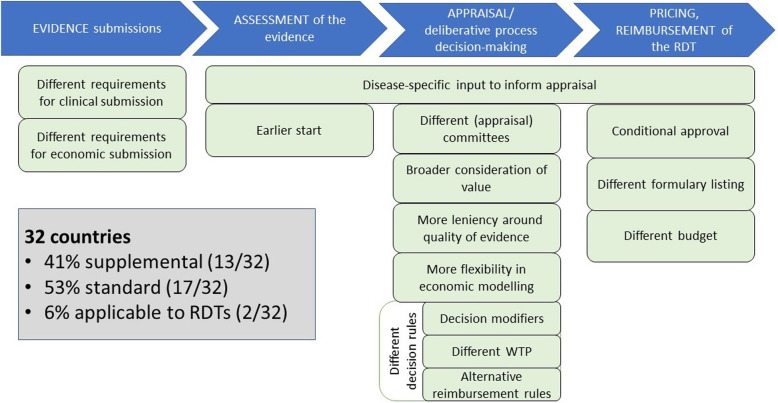
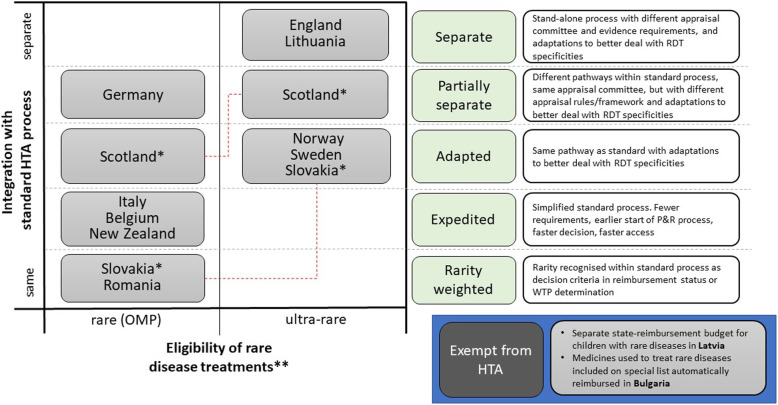
Thirty-two of the 37 invited countries participated in this research. Forty-one percent (13/32) use supplemental processes for RDTs. Their level of integration within standard processes ranged from low to high, characterised by whether they are separate or partially separate from the standard process, adapted or accelerated standard processes, or standard processes that may be applied to RDTs. They are characterised by features implemented throughout the appraisal process. These features are mechanisms that allow application of different standards to assess the value of the medicine, support to the appraisal/decision-making process, overcome the issues of lack of cost-effectiveness, or exempt from part of/the full appraisal/reimbursement process. They increase the likelihood of reimbursement by adjusting and/or foregoing part of the assessment process, or accepting to pay more for the same added benefit as for common conditions. A large proportion of countries with standard processes include one or more of these features (formally or informally) or are discussing potential changes in their systems.
Results suggest revealed preferences to treat RDTs differently than conventional medicines. Some of the challenges around uncertainty and high price remain, but supplemental process features can support decision-making that is more flexible and consistent. Many of these processes are new and countries continue to adjust as they gain experience.
人们越来越认识到,传统的评估方法可能不适合评估罕见病治疗方法(RDT)的价值。本研究考察了国际上使用了哪些补充评估/报销流程来评估 RDT,以及如何对其进行描述。采用了定性研究设计,包括(1)通过问卷、桌面研究和与国家专家的迭代互动来记录 RDT 的国家评估/报销流程,以生成国家案例,以及(2)对这些流程进行跨国分析,以确定和描述 RDT 补充流程的特征,并将其与没有补充流程的国家进行比较。
在 37 个受邀国家中,有 32 个国家参与了这项研究。41%(13/32)对 RDT 使用补充流程。它们在标准流程中的整合程度从低到高不等,其特点是它们是与标准流程分开还是部分分开,是适应还是加速标准流程,或者标准流程是否适用于 RDT。它们的特点是在整个评估过程中实施的特征。这些特征是允许应用不同标准来评估药物价值、支持评估/决策过程、克服缺乏成本效益的问题或免除部分/全部评估/报销过程的机制。它们通过调整和/或放弃评估过程的一部分,或者接受为相同的附加效益支付更多的费用,从而增加了报销的可能性,而附加效益与常见疾病相同。许多有标准流程的国家都包含了其中一个或多个特征(正式或非正式),或者正在讨论其系统的潜在变化。
研究结果表明,人们倾向于对 RDT 采取不同于传统药物的治疗方法。围绕不确定性和高价格的一些挑战仍然存在,但补充流程特征可以支持更灵活和一致的决策。其中许多流程是新的,随着国家获得经验,它们还在不断调整。