Department of Orthopaedic Surgery, Nanjing First Hospital, Nanjing Medical University, Nanjing, 210006, China.
School of Biological Science & Medical Engineering, Southeast University, Nanjing, China.
BMC Musculoskelet Disord. 2020 Jul 21;21(1):478. doi: 10.1186/s12891-020-03509-6.
The aim of this study was to investigate the feasibility of an individual navigation template for the deep pin position on the iliac crest, based on digital design and 3D printing technology.
The preoperative CT images of 8 patients with pelvic fractures were collected. The data were reconstructed using a 3D imaging reconstruction workstation. An individual navigation template for the deep pin position on the iliac crest was designed on a virtual 3D model. The individual drill template and the solid pelvic model were produced using the 3D printing technology. The individual drill template was used for intraoperative deep pin position on the iliac crest after the preoperative simulation was completed.
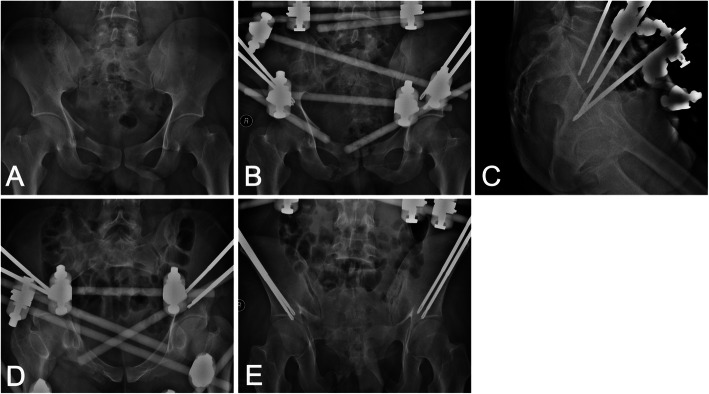
Thirty-two external fixator pins were inserted using the individual drill template. The average depth of pins was 84.82 mm. The trajectories were appropriate based on the postoperative X-ray and CT scan. No significant difference in the entry point, convergence angle, and caudal angle of the pins were noted before and after the operation (all P > 0.05). Finite element analysis indicated that the deep external fixator pin position could more reasonably distribute the stress in the cortical and spongy bones in the pelvis. All patients could perform partial weight-bearing activity 6 weeks postoperatively. No loosening and rupture of the pin, infection, and no damage of blood vessels and nervous tissue were found during the entire follow-up period.
The individual drill template technique is an improvement of the traditional technique, which could increase precision and the depth of pin position. In addition, good mechanical stability and low risk of pin-related complications occurred due to the individual drill template, which makes the external fixation technique a potential alternative.
本研究旨在探讨基于数字设计和 3D 打印技术的个体化髂嵴深部置钉导航模板的可行性。
收集 8 例骨盆骨折患者的术前 CT 图像,采用三维成像重建工作站进行数据重建,在虚拟三维模型上设计个体化髂嵴深部置钉导航模板,采用 3D 打印技术制作个体化导钻模板和实体骨盆模型,完成术前模拟后,在术中使用个体化导钻模板进行髂嵴深部置钉。
使用个体化导钻模板共置入 32 枚外固定架钉,平均钉深 84.82mm,术后 X 线和 CT 扫描提示钉道位置合适。术后入钉点、汇聚角、尾倾角与术前比较,差异均无统计学意义(均 P>0.05)。有限元分析显示,深部外固定架钉位置可使骨盆皮质骨和松质骨的应力更合理分布。所有患者术后 6 周可部分负重活动,整个随访过程中未发现钉松动、断裂、感染,无血管和神经组织损伤。
个体化导钻模板技术是对传统技术的改进,可提高置钉的准确性和深度,同时由于个体化导钻模板的使用,固定具有良好的力学稳定性和较低的钉相关并发症风险,使外固定技术成为一种有潜力的选择。