• 文献检索
  • 文档翻译
  • 深度研究
  • 学术资讯
  • Suppr Zotero 插件Zotero 插件
  • 邀请有礼
  • 套餐&价格
  • 历史记录
应用&插件
Suppr Zotero 插件Zotero 插件浏览器插件Mac 客户端Windows 客户端微信小程序
定价
高级版会员购买积分包购买API积分包
服务
文献检索文档翻译深度研究API 文档MCP 服务
关于我们
关于 Suppr公司介绍联系我们用户协议隐私条款
关注我们

Suppr 超能文献

核心技术专利:CN118964589B侵权必究
粤ICP备2023148730 号-1Suppr @ 2026

文献检索

告别复杂PubMed语法,用中文像聊天一样搜索,搜遍4000万医学文献。AI智能推荐,让科研检索更轻松。

立即免费搜索

文件翻译

保留排版,准确专业,支持PDF/Word/PPT等文件格式,支持 12+语言互译。

免费翻译文档

深度研究

AI帮你快速写综述,25分钟生成高质量综述,智能提取关键信息,辅助科研写作。

立即免费体验

用于 1 型糖尿病管理的人工智能决策支持系统。

An artificial intelligence decision support system for the management of type 1 diabetes.

机构信息

Artificial Intelligence for Medical Systems (AIMS) Lab, Oregon Health & Science University, Portland, OR, USA.

Harold Schnitzer Diabetes Health Center, Oregon Health & Science University, Portland, OR, USA.

出版信息

Nat Metab. 2020 Jul;2(7):612-619. doi: 10.1038/s42255-020-0212-y. Epub 2020 Jun 1.

DOI:10.1038/s42255-020-0212-y
PMID:32694787
原文链接:https://pmc.ncbi.nlm.nih.gov/articles/PMC7384292/
Abstract

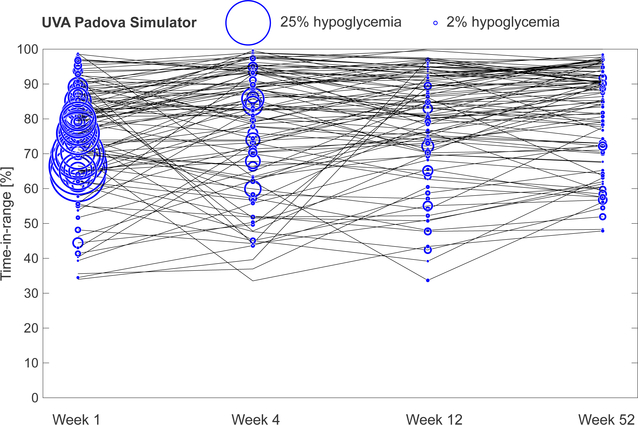
Type 1 diabetes (T1D) is characterized by pancreatic beta cell dysfunction and insulin depletion. Over 40% of people with T1D manage their glucose through multiple injections of long-acting basal and short-acting bolus insulin, so-called multiple daily injections (MDI). Errors in dosing can lead to life-threatening hypoglycaemia events (<70 mg dl) and hyperglycaemia (>180 mg dl), increasing the risk of retinopathy, neuropathy, and nephropathy. Machine learning (artificial intelligence) approaches are being harnessed to incorporate decision support into many medical specialties. Here, we report an algorithm that provides weekly insulin dosage recommendations to adults with T1D using MDI therapy. We employ a unique virtual platform to generate over 50,000 glucose observations to train a k-nearest neighbours decision support system (KNN-DSS) to identify causes of hyperglycaemia or hypoglycaemia and determine necessary insulin adjustments from a set of 12 potential recommendations. The KNN-DSS algorithm achieves an overall agreement with board-certified endocrinologists of 67.9% when validated on real-world human data, and delivers safe recommendations, per endocrinologist review. A comparison of inter-physician-recommended adjustments to insulin pump therapy indicates full agreement of 41.2% among endocrinologists, which is consistent with previous measures of inter-physician agreement (41-45%). In silico benchmarking using a platform accepted by the United States Food and Drug Administration for evaluation of artificial pancreas technologies indicates substantial improvement in glycaemic outcomes after 12 weeks of KNN-DSS use. Our data indicate that the KNN-DSS allows for early identification of dangerous insulin regimens and may be used to improve glycaemic outcomes and prevent life-threatening complications in people with T1D.

摘要

1 型糖尿病(T1D)的特征是胰岛β细胞功能障碍和胰岛素耗竭。超过 40%的 T1D 患者通过多次注射长效基础胰岛素和短效餐时胰岛素来控制血糖,即所谓的多次每日注射(MDI)。剂量错误可能导致危及生命的低血糖事件(<70mg/dl)和高血糖(>180mg/dl),增加视网膜病变、神经病变和肾病的风险。机器学习(人工智能)方法正被用于将决策支持纳入许多医学专业领域。在这里,我们报告了一种算法,该算法使用 MDI 疗法为 T1D 成年患者提供每周胰岛素剂量建议。我们采用独特的虚拟平台生成超过 50000 个血糖观察值,以训练 k-最近邻决策支持系统(KNN-DSS),从而识别高血糖或低血糖的原因,并从 12 种潜在建议中确定必要的胰岛素调整。该 KNN-DSS 算法在对真实世界人类数据进行验证时,与经过董事会认证的内分泌学家的总体一致性为 67.9%,并且根据内分泌学家的审查提供安全的建议。与胰岛素泵治疗的医生间推荐调整的比较表明,内分泌学家之间的完全一致为 41.2%,这与以前的医生间一致性测量结果(41-45%)一致。使用美国食品和药物管理局评估人工胰腺技术的平台进行的模拟基准测试表明,在使用 KNN-DSS 12 周后,血糖控制结果有了实质性的改善。我们的数据表明,KNN-DSS 可以早期识别危险的胰岛素方案,可用于改善血糖控制结果并预防 T1D 患者的危及生命的并发症。
https://cdn.ncbi.nlm.nih.gov/pmc/blobs/4525/7384292/6389070cf845/nihms-1587540-f0002.jpg
https://cdn.ncbi.nlm.nih.gov/pmc/blobs/4525/7384292/17f58772f59a/nihms-1587540-f0003.jpg
https://cdn.ncbi.nlm.nih.gov/pmc/blobs/4525/7384292/0785f621b74a/nihms-1587540-f0004.jpg
https://cdn.ncbi.nlm.nih.gov/pmc/blobs/4525/7384292/5d2cfa1be3af/nihms-1587540-f0005.jpg
https://cdn.ncbi.nlm.nih.gov/pmc/blobs/4525/7384292/06b379a16d51/nihms-1587540-f0006.jpg
https://cdn.ncbi.nlm.nih.gov/pmc/blobs/4525/7384292/0e9ac23e3866/nihms-1587540-f0007.jpg
https://cdn.ncbi.nlm.nih.gov/pmc/blobs/4525/7384292/cd8a54289e39/nihms-1587540-f0008.jpg
https://cdn.ncbi.nlm.nih.gov/pmc/blobs/4525/7384292/d22ccd2706b3/nihms-1587540-f0009.jpg
https://cdn.ncbi.nlm.nih.gov/pmc/blobs/4525/7384292/83ffb0354f2d/nihms-1587540-f0010.jpg
https://cdn.ncbi.nlm.nih.gov/pmc/blobs/4525/7384292/852e60e94898/nihms-1587540-f0011.jpg
https://cdn.ncbi.nlm.nih.gov/pmc/blobs/4525/7384292/0706b8526b1c/nihms-1587540-f0001.jpg
https://cdn.ncbi.nlm.nih.gov/pmc/blobs/4525/7384292/6389070cf845/nihms-1587540-f0002.jpg
https://cdn.ncbi.nlm.nih.gov/pmc/blobs/4525/7384292/17f58772f59a/nihms-1587540-f0003.jpg
https://cdn.ncbi.nlm.nih.gov/pmc/blobs/4525/7384292/0785f621b74a/nihms-1587540-f0004.jpg
https://cdn.ncbi.nlm.nih.gov/pmc/blobs/4525/7384292/5d2cfa1be3af/nihms-1587540-f0005.jpg
https://cdn.ncbi.nlm.nih.gov/pmc/blobs/4525/7384292/06b379a16d51/nihms-1587540-f0006.jpg
https://cdn.ncbi.nlm.nih.gov/pmc/blobs/4525/7384292/0e9ac23e3866/nihms-1587540-f0007.jpg
https://cdn.ncbi.nlm.nih.gov/pmc/blobs/4525/7384292/cd8a54289e39/nihms-1587540-f0008.jpg
https://cdn.ncbi.nlm.nih.gov/pmc/blobs/4525/7384292/d22ccd2706b3/nihms-1587540-f0009.jpg
https://cdn.ncbi.nlm.nih.gov/pmc/blobs/4525/7384292/83ffb0354f2d/nihms-1587540-f0010.jpg
https://cdn.ncbi.nlm.nih.gov/pmc/blobs/4525/7384292/852e60e94898/nihms-1587540-f0011.jpg
https://cdn.ncbi.nlm.nih.gov/pmc/blobs/4525/7384292/0706b8526b1c/nihms-1587540-f0001.jpg
https://cdn.ncbi.nlm.nih.gov/pmc/blobs/4525/7384292/6389070cf845/nihms-1587540-f0002.jpg

相似文献

1
An artificial intelligence decision support system for the management of type 1 diabetes.用于 1 型糖尿病管理的人工智能决策支持系统。
Nat Metab. 2020 Jul;2(7):612-619. doi: 10.1038/s42255-020-0212-y. Epub 2020 Jun 1.
2
Titration of Long-Acting Insulin Using Continuous Glucose Monitoring and Smart Insulin Pens in Type 1 Diabetes: A Model-Based Carbohydrate-Free Approach.1 型糖尿病中使用连续血糖监测和智能胰岛素笔进行长效胰岛素滴定:一种基于模型的无碳水化合物方法。
Front Endocrinol (Lausanne). 2022 Jan 10;12:795895. doi: 10.3389/fendo.2021.795895. eCollection 2021.
3
Artificial Intelligence in Decision Support Systems for Type 1 Diabetes.人工智能在 1 型糖尿病决策支持系统中的应用。
Sensors (Basel). 2020 Jun 5;20(11):3214. doi: 10.3390/s20113214.
4
Classification of Postprandial Glycemic Status with Application to Insulin Dosing in Type 1 Diabetes-An In Silico Proof-of-Concept.基于模拟概念验证的 1 型糖尿病患者餐后血糖状态分类及胰岛素剂量调整
Sensors (Basel). 2019 Jul 18;19(14):3168. doi: 10.3390/s19143168.
5
Diabetes technology and treatments in the paediatric age group.儿科年龄组的糖尿病技术与治疗
Int J Clin Pract Suppl. 2011 Feb(170):76-82. doi: 10.1111/j.1742-1241.2010.02582.x.
6
Insulin dose optimization using an automated artificial intelligence-based decision support system in youths with type 1 diabetes.使用基于人工智能的自动化决策支持系统优化青少年 1 型糖尿病患者的胰岛素剂量。
Nat Med. 2020 Sep;26(9):1380-1384. doi: 10.1038/s41591-020-1045-7. Epub 2020 Sep 9.
7
Minimizing postprandial hypoglycemia in Type 1 diabetes patients using multiple insulin injections and capillary blood glucose self-monitoring with machine learning techniques.使用多次胰岛素注射和基于机器学习技术的毛细血管血糖自我监测来最小化 1 型糖尿病患者的餐后低血糖。
Comput Methods Programs Biomed. 2019 Sep;178:175-180. doi: 10.1016/j.cmpb.2019.06.025. Epub 2019 Jun 27.
8
Automated insulin pump suspension for hypoglycaemia mitigation: development, implementation and implications.用于缓解低血糖的自动胰岛素泵暂停:开发、实施及影响
Diabetes Obes Metab. 2015 Dec;17(12):1126-32. doi: 10.1111/dom.12542. Epub 2015 Oct 5.
9
Insulin-based strategies to prevent hypoglycaemia during and after exercise in adult patients with type 1 diabetes on pump therapy: the DIABRASPORT randomized study.在接受胰岛素泵治疗的 1 型糖尿病成年患者中,采用基于胰岛素的策略预防运动期间及运动后低血糖:DIABRASPORT 随机研究。
Diabetes Obes Metab. 2015 Dec;17(12):1150-7. doi: 10.1111/dom.12552. Epub 2015 Oct 8.
10
Automatic bolus and adaptive basal algorithm for the artificial pancreatic β-cell.人工胰腺β细胞的自动注食和自适应基础算法。
Diabetes Technol Ther. 2010 Nov;12(11):879-87. doi: 10.1089/dia.2010.0029. Epub 2010 Sep 30.

引用本文的文献

1
Effectiveness and safety of AI-driven closed-loop systems in diabetes management: a systematic review and meta-analysis.人工智能驱动的闭环系统在糖尿病管理中的有效性和安全性:一项系统评价和荟萃分析。
Diabetol Metab Syndr. 2025 Jun 23;17(1):238. doi: 10.1186/s13098-025-01819-0.
2
Continual learning across population cohorts with distribution shift: insights from multi-cohort metabolic syndrome identification.跨分布变化的人群队列持续学习:多队列代谢综合征识别的见解
J Am Med Inform Assoc. 2025 Jun 11. doi: 10.1093/jamia/ocaf070.
3
Transforming Healthcare: Intelligent Wearable Sensors Empowered by Smart Materials and Artificial Intelligence.

本文引用的文献

1
Advanced Insulin Bolus Advisor Based on Run-To-Run Control and Case-Based Reasoning.基于运行至运行控制和基于案例推理的高级胰岛素推注量计算器。
IEEE J Biomed Health Inform. 2015 May;19(3):1087-96. doi: 10.1109/JBHI.2014.2331896.
变革医疗保健:由智能材料和人工智能驱动的智能可穿戴传感器
Adv Mater. 2025 May;37(21):e2500412. doi: 10.1002/adma.202500412. Epub 2025 Apr 1.
4
Biomimic models for glycemic index: Scope of sensor integration and artificial intelligence.血糖指数的仿生模型:传感器集成与人工智能的范围
Food Chem X. 2024 Dec 30;25:102132. doi: 10.1016/j.fochx.2024.102132. eCollection 2025 Jan.
5
Methodology for Safe and Secure AI in Diabetes Management.糖尿病管理中安全可靠人工智能的方法学。
J Diabetes Sci Technol. 2025 May;19(3):620-627. doi: 10.1177/19322968241304434. Epub 2024 Dec 26.
6
Harnessing the power of artificial intelligence for human living organoid research.利用人工智能的力量进行人类类器官研究。
Bioact Mater. 2024 Aug 30;42:140-164. doi: 10.1016/j.bioactmat.2024.08.027. eCollection 2024 Dec.
7
Development and validation of nomograms for predicting cardiovascular disease risk in patients with prediabetes and diabetes.开发和验证预测糖尿病前期和糖尿病患者心血管疾病风险的列线图。
Sci Rep. 2024 Sep 8;14(1):20909. doi: 10.1038/s41598-024-71904-3.
8
Use of a decision support tool and quick start onboarding tool in individuals with type 1 diabetes using advanced automated insulin delivery: a single-arm multi-phase intervention study.使用决策支持工具和快速入门引导工具在使用先进自动化胰岛素输送的 1 型糖尿病患者中的应用:一项单臂多阶段干预研究。
BMC Endocr Disord. 2024 Aug 30;24(1):167. doi: 10.1186/s12902-024-01709-y.
9
Need for an Artificial Intelligence-based Diabetes Care Management System in India and the United States.印度和美国对基于人工智能的糖尿病护理管理系统的需求。
Health Serv Res Manag Epidemiol. 2024 Aug 28;11:23333928241275292. doi: 10.1177/23333928241275292. eCollection 2024 Jan-Dec.
10
Enhancing the Capabilities of Continuous Glucose Monitoring With a Predictive App.利用预测型 APP 提升连续血糖监测能力
J Diabetes Sci Technol. 2024 Sep;18(5):1014-1026. doi: 10.1177/19322968241267818. Epub 2024 Aug 19.