Potvin Stéphane, Mahrouche Louiza, Assaf Roxane, Chicoine Marjolaine, Giguère Charles-Édouard, Furtos Alexandra, Godbout Roger
Department of Psychiatry, Centre de recherche de l'Institut Universitaire en Santé Mentale de Montréal, Montreal, QC, Canada.
Department of Psychiatry, University of Montreal, Montreal, QC, Canada.
Front Psychiatry. 2020 Jun 30;11:628. doi: 10.3389/fpsyt.2020.00628. eCollection 2020.
The endogenous cannabinoid system mediates the psychoactive effects of cannabis in the brain. It has been argued that this system may play a key role in the pathophysiology of schizophrenia. While some studies have consistently shown that the levels of anandamide, an endogenous cannabinoid ligand, are increased in the cerebrospinal fluid of schizophrenia patients, inconsistent results have been observed in studies measuring anandamide levels in the periphery. Here, we sought to determine if the assessment of peripheral anandamide levels in patients evaluated in a psychiatric emergency setting would show robust increases.
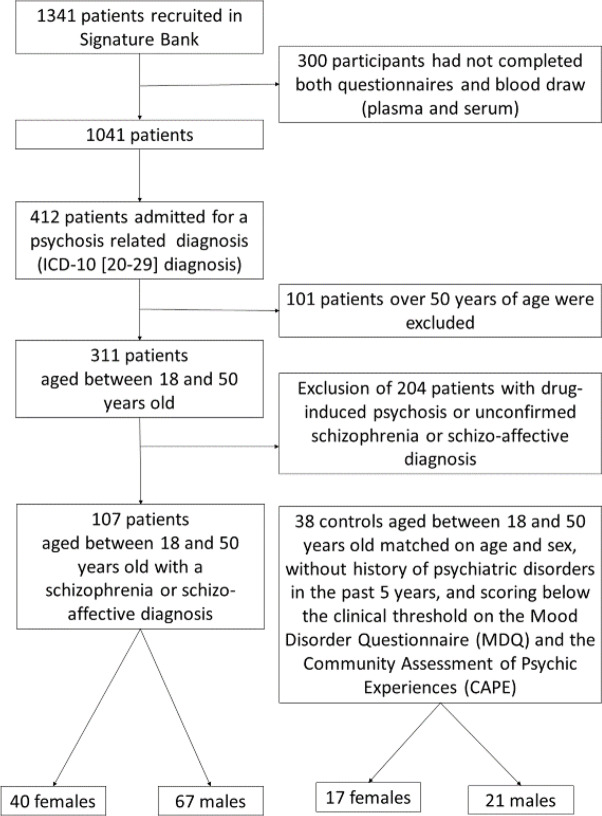
One hundred seven patients with a schizophrenia-spectrum disorder from the psychiatric emergency settings of the and 36 healthy volunteers were included in the study. A subsample of thirty patients were assessed at two time points: at the emergency and at their discharge from the hospital. Anxious and depressive symptoms, sleep and substance use were assessed using self-report questionnaires. In addition to anandamide, the levels of oleoylethanolamide (OEA), an anorexigenic fatty-acid ethanolamide, were also measured, since the prevalence of the metabolic syndrome is increased in schizophrenia. Plasma levels of anandamide and OEA were measured using liquid chromatography and mass spectrometry.
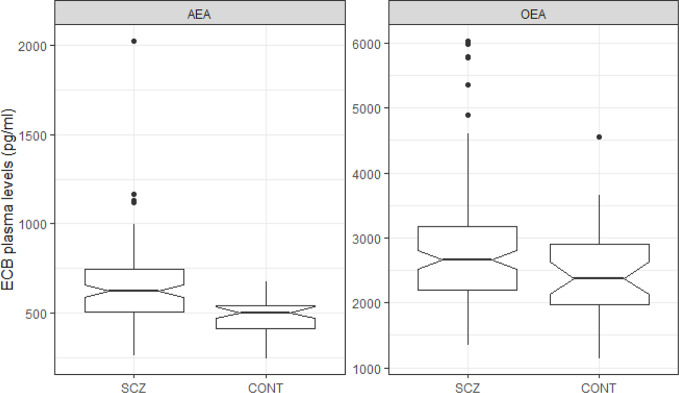
Plasma anandamide and OEA levels were significantly increased in schizophrenia patients, relative to controls (Cohen's d=1.0 and 0.5, respectively). Between-group differences remained significant after controlling for metabolic measures. No differences were observed between schizophrenia patients with and without a comorbid substance use disorder at baseline. Importantly, the levels of both endocannabinoids significantly decreased after discharge from the emergency setting.
The current results add to the growing body of evidence of endocannabinoid alterations in schizophrenia. The strong elevation of plasma anandamide levels in schizophrenia patients assessed in the psychiatric emergency setting suggests that anandamide and OEA area potential biomarkers of the psychological turmoil associated with this context.
内源性大麻素系统介导大麻在大脑中的精神活性作用。有人认为该系统可能在精神分裂症的病理生理学中起关键作用。虽然一些研究一直表明,内源性大麻素配体花生四烯乙醇胺(anandamide)的水平在精神分裂症患者的脑脊液中升高,但在测量外周血中花生四烯乙醇胺水平的研究中观察到了不一致的结果。在此,我们试图确定在精神科急诊环境中接受评估的患者外周血花生四烯乙醇胺水平的评估是否会显示出显著升高。
本研究纳入了来自[具体医院名称1]和[具体医院名称2]精神科急诊的107例精神分裂症谱系障碍患者及36名健康志愿者。对30例患者的子样本在两个时间点进行评估:急诊时和出院时。使用自我报告问卷评估焦虑和抑郁症状、睡眠及物质使用情况。除了花生四烯乙醇胺,还测量了一种厌食性脂肪酸乙醇酰胺油酰乙醇胺(OEA)的水平,因为精神分裂症患者中代谢综合征的患病率增加。使用液相色谱和质谱法测量血浆中花生四烯乙醇胺和OEA的水平。
与对照组相比,精神分裂症患者血浆中花生四烯乙醇胺和OEA水平显著升高(Cohen's d分别为1.0和0.5)。在控制代谢指标后,组间差异仍然显著。在基线时,有和没有合并物质使用障碍的精神分裂症患者之间未观察到差异。重要的是,从急诊环境出院后,两种内源性大麻素的水平均显著下降。
目前的结果增加了精神分裂症中内源性大麻素改变的越来越多的证据。在精神科急诊环境中评估的精神分裂症患者血浆花生四烯乙醇胺水平的强烈升高表明,花生四烯乙醇胺和OEA是与这种情况相关的心理紊乱的潜在生物标志物。