Zheng Jianli, Lu Haiyan, Li Min, Guan Yongjuan, Yang Fangfang, Xu Mengjun, Dong Jingjing, Zhang Qinge, An Ning, Zhou Yun
Department of Prenatal Diagnosis, Center of Medical Genetics, Yancheng Maternity and Child Health Care Hospital, Yancheng, China.
Front Genet. 2020 Jun 30;11:624. doi: 10.3389/fgene.2020.00624. eCollection 2020.
Our aim was to evaluate the clinical utility of non-invasive prenatal testing for pregnant women with different diagnostic indications.
In eight counties and districts of Yancheng, we studied 13,149 pregnant women with different indications who were offered NIPT for fetal screening, including for sex chromosomal aneuploidies (SCAs), rare autosomal trisomies (RATs), and subchromosomal copy number variations (CNVs). The purpose was to compare the detection of positive predictive values (PPVs) of different indications with the use of NIPT. The results were validated by karyotyping, chromosomal microarray analysis (CMA), or follow-up of pregnancy outcomes.
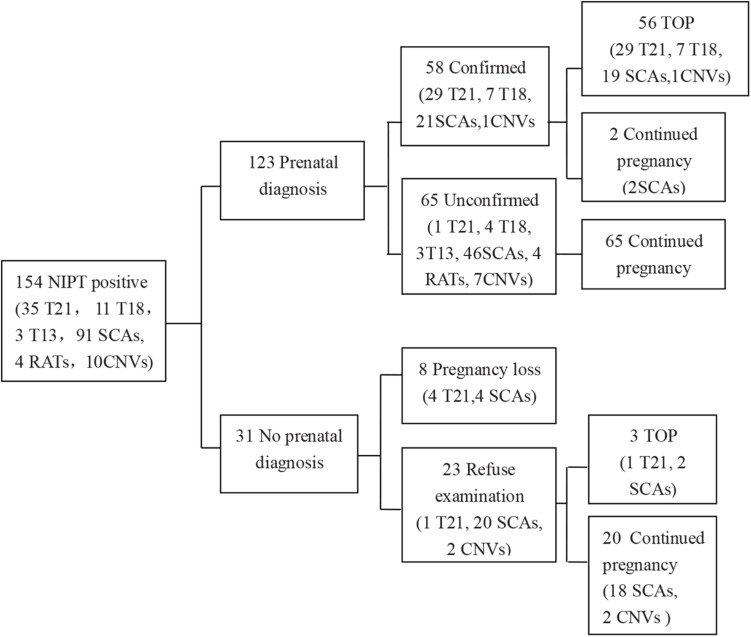
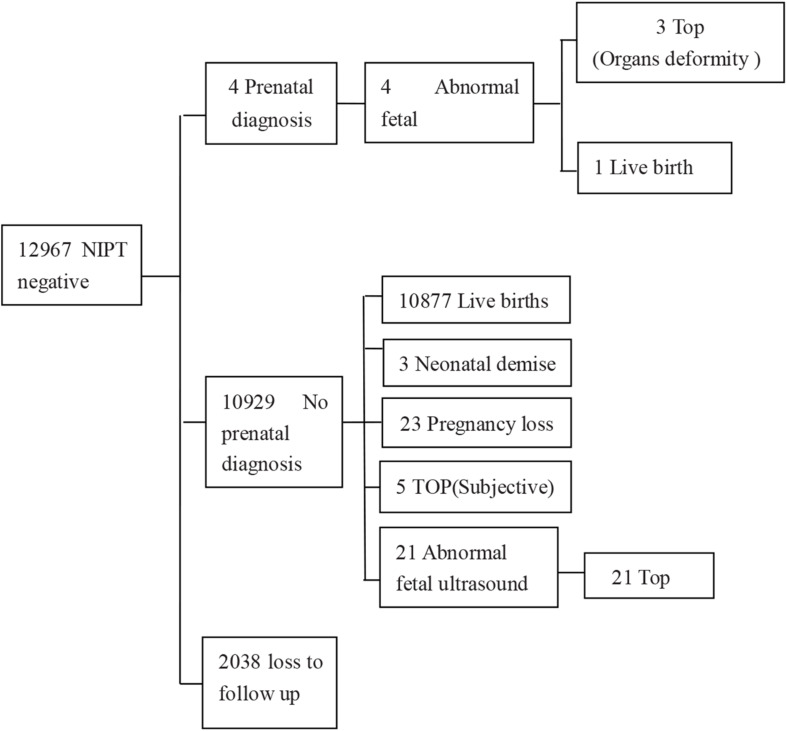
13,149 maternal plasma samples were sequenced, among which 28 samples (0.2%) failed the sequencing quality control. The remaining 13,121 samples were analyzed, and birth follow-up missed 2,192 samples (16.7%). The PPVs of NIPT results for trisomy 21 (T21) and trisomy 18 (T18) and SCAs were 96.67, 63.64, and 31.34%, respectively. Among the advanced maternal age (AMA), serum screening high risk (SSHR), serum screening intermediate risk (SSIR), and voluntary screening (VS) groups, the PPVs for the common trisomies were 81.25, 85.71, 100, and 70%, respectively; the PPVs for total chromosomal abnormalities were 55.82, 65.22, 23.08, and 36.59%, respectively.
NIPT for T21 and T18 and SCAs screening were ideal, and the PPVs for trisomy 13 (T13), RATs, and CNVs were low. For the AMA and VS groups, NIPT could be used as a first-line screening program; for SSHR and SSIR groups, NIPT could be used as a second-line supplementary screening program.
我们的目的是评估不同诊断指征的孕妇进行无创产前检测的临床效用。
在盐城的八个县区,我们研究了13149名有不同指征的孕妇,她们接受了无创产前检测以进行胎儿筛查,包括性染色体非整倍体(SCA)、罕见常染色体三体(RAT)和亚染色体拷贝数变异(CNV)。目的是比较使用无创产前检测对不同指征的阳性预测值(PPV)的检测情况。结果通过核型分析、染色体微阵列分析(CMA)或妊娠结局随访进行验证。
对13149份母血样本进行了测序,其中28份样本(0.2%)测序质量控制不合格。对其余13121份样本进行了分析,出生随访遗漏了2192份样本(16.7%)。无创产前检测结果对21三体(T21)、18三体(T18)和性染色体非整倍体的阳性预测值分别为96.67%、63.64%和31.34%。在高龄产妇(AMA)、血清筛查高风险(SSHR)、血清筛查中度风险(SSIR)和自愿筛查(VS)组中,常见三体的阳性预测值分别为81.25%、85.71%、100%和70%;总染色体异常的阳性预测值分别为55.82%、65.22%、23.08%和36.59%。
无创产前检测用于21三体、18三体和性染色体非整倍体筛查效果理想,13三体、罕见常染色体三体和亚染色体拷贝数变异的阳性预测值较低。对于高龄产妇和自愿筛查组,无创产前检测可作为一线筛查方案;对于血清筛查高风险和血清筛查中度风险组,无创产前检测可作为二线补充筛查方案。