Mohajer Ansari Javad, Ramhormozi Parisa, Shabani Ronak, Pazoki-Toroudi Hamidreza, Yari Abazar, Barati Mahmood, Dahmardehei Mostafa, Babakhani Azar, Nobakht Maliheh
Department of Anatomical Sciences, School of Medicine, Iran University of Medical Sciences, Tehran, Iran.
Physiology Research Center and Department of Physiology, Faculty of Medicine, Iran University of Medical Sciences, Tehran, Iran.
Iran J Basic Med Sci. 2020 Jun;23(6):751-759. doi: 10.22038/ijbms.2020.39782.9465.
Chemokines are wound mediators that promote angiogenesis during wound healing. We hypothesized that Simvastatin in combination with the bone marrow mesenchymal stromal cells (BMSCs) improve burn wound healing by ameliorating angiogenesis via SDF-1α/CXCR4 pathway.
Under general anesthesia, deep partial-thickness burns were created on the inter-scapular area of 48 male rats. Study groups were administrated with petroleum jelly (Simvastatin Vehicle), a single dose of intradermal BMSCs (1×10), topical Simvastatin (0.5 mg/kg) daily and combination of BMSCs and Simvastatin for 14 days. In this study, we used MTT assay, and wound closure, H&E and Trichorome staining, immunohistochemistry (IHC), real- time PCR, Western blot and tube formation assay.
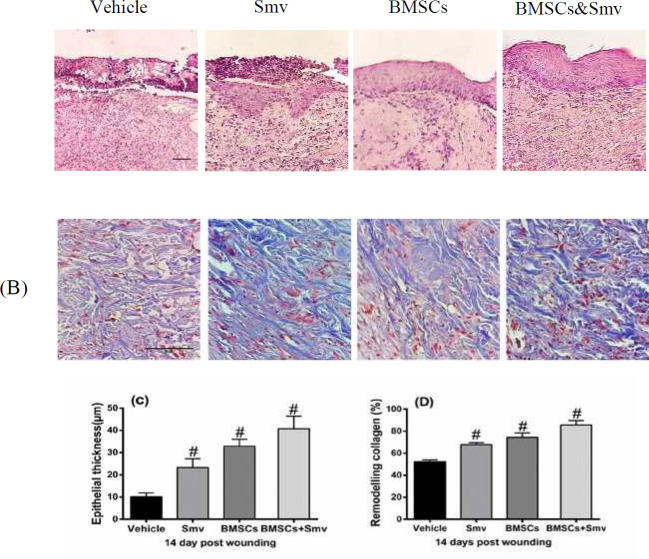
A significant improvement in wound closure percentage, epithelial thickness, collagen remodeling, and up-regulation of stromal cell-derived factor 1 alpha (SDF1α), C-X-C chemokine receptor type 4 (CXCR4), protein kinase B (AKT), and phosphatidylinositol 3- kinase (PI3K), as well as CD31 and vascular endothelial growth factor (VEGF) expression were observed after treatment with simvastatin, BMSCs and combination of them compared to the vehicle group. However, the co-treatment group revealed considerable superiority in examined factors. BMSCs treated with Simvastatin showed the highest viability in the concentration of 0.5 and 1 Nanomolar (nM). Increment in proliferation and capillary vessels formation of BMSCs was observed in the 0.5 nM and 1 nM concentrations of Simvastatin .
Treatment of deep partial-thickness of burns with co-treatment of BMSCs and Simvastatin resulted in improved burn wound healing through up-regulating of SDF-1α/CXCR4 pathway.
趋化因子是伤口介质,在伤口愈合过程中促进血管生成。我们假设辛伐他汀与骨髓间充质基质细胞(BMSCs)联合使用可通过SDF-1α/CXCR4途径改善血管生成,从而促进烧伤创面愈合。
在全身麻醉下,对48只雄性大鼠的肩胛间区域造成深Ⅱ度烧伤。研究组分别给予凡士林(辛伐他汀赋形剂)、单剂量皮内注射BMSCs(1×10)、每日局部应用辛伐他汀(0.5mg/kg)以及BMSCs与辛伐他汀联合应用,持续14天。在本研究中,我们使用了MTT法、伤口闭合情况、苏木精-伊红(H&E)和三色染色、免疫组织化学(IHC)、实时聚合酶链反应(PCR)、蛋白质免疫印迹法(Western blot)和管腔形成试验。
与赋形剂组相比,用辛伐他汀、BMSCs及其联合治疗后,观察到伤口闭合百分比、上皮厚度、胶原重塑有显著改善,基质细胞衍生因子1α(SDF1α)、C-X-C趋化因子受体4(CXCR4)、蛋白激酶B(AKT)和磷脂酰肌醇3激酶(PI3K)上调,以及CD31和血管内皮生长因子(VEGF)表达增加。然而,联合治疗组在检测因素方面显示出相当大的优势。用辛伐他汀处理的BMSCs在浓度为0.5和1纳摩尔(nM)时显示出最高的活力。在0.5 nM和1 nM浓度的辛伐他汀中观察到BMSCs的增殖和毛细血管形成增加。
BMSCs与辛伐他汀联合治疗深Ⅱ度烧伤可通过上调SDF-1α/CXCR4途径改善烧伤创面愈合。