Ferastraoaru D, Bax H J, Bergmann C, Capron M, Castells M, Dombrowicz D, Fiebiger E, Gould H J, Hartmann K, Jappe U, Jordakieva G, Josephs D H, Levi-Schaffer F, Mahler V, Poli A, Rosenstreich D, Roth-Walter F, Shamji M, Steveling-Klein E H, Turner M C, Untersmayr E, Karagiannis S N, Jensen-Jarolim E
Department of Internal Medicine/Allergy and Immunology, Albert Einstein College of Medicine, Montefiore Medical Center, Bronx, NY USA.
St. John's Institute of Dermatology, School of Basic & Medical Biosciences, King's College London, Guy's Hospital, 9th Floor, Guy's Tower, London, SE1 9RT UK.
Clin Transl Allergy. 2020 Jul 17;10:32. doi: 10.1186/s13601-020-00335-w. eCollection 2020.
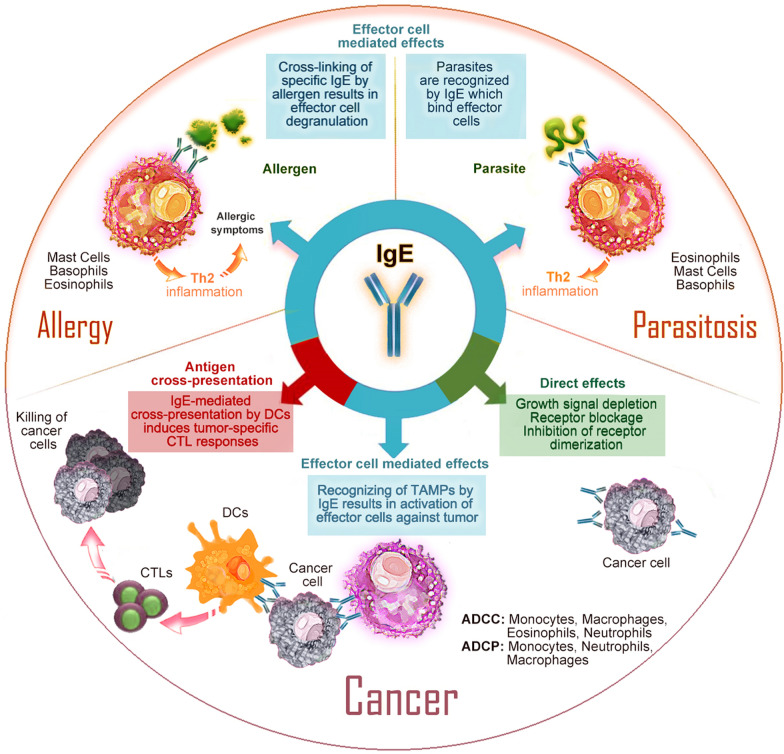
Elevated serum IgE levels are associated with allergic disorders, parasitosis and specific immunologic abnormalities. In addition, epidemiological and mechanistic evidence indicates an association between IgE-mediated immune surveillance and protection from tumour growth. Intriguingly, recent studies reveal a correlation between IgE deficiency and increased malignancy risk. This is the first review discussing IgE levels and links to pathological conditions, with special focus on the potential clinical significance of ultra-low serum IgE levels and risk of malignancy. In this Position Paper we discuss: (a) the utility of measuring total IgE levels in the management of allergies, parasitosis, and immunodeficiencies, (b) factors that may influence serum IgE levels, (c) IgE as a marker of different disorders, and d) the relationship between ultra-low IgE levels and malignancy susceptibility. While elevated serum IgE is generally associated with allergic/atopic conditions, very low or absent IgE may hamper anti-tumour surveillance, indicating the importance of a balanced IgE-mediated immune function. Ultra-low IgE may prove to be an unexpected biomarker for cancer risk. Nevertheless, given the early stage of investigations conducted mostly in patients with diseases that influence IgE levels, in-depth mechanistic studies and stratification of malignancy risk based on associated demographic, immunological and clinical co-factors are warranted.
血清IgE水平升高与过敏性疾病、寄生虫病及特定免疫异常有关。此外,流行病学和机制证据表明IgE介导的免疫监视与预防肿瘤生长之间存在关联。有趣的是,最近的研究揭示了IgE缺乏与恶性肿瘤风险增加之间的相关性。这是第一篇讨论IgE水平及其与病理状况联系的综述,特别关注超低血清IgE水平的潜在临床意义及恶性肿瘤风险。在本立场文件中,我们讨论:(a)测量总IgE水平在过敏、寄生虫病和免疫缺陷管理中的效用;(b)可能影响血清IgE水平的因素;(c)IgE作为不同疾病的标志物;以及(d)超低IgE水平与恶性肿瘤易感性之间的关系。虽然血清IgE升高通常与过敏性/特应性疾病相关,但极低或缺乏IgE可能会妨碍抗肿瘤监视,这表明平衡的IgE介导的免疫功能很重要。超低IgE可能被证明是癌症风险的一个意想不到的生物标志物。然而,鉴于大多数研究是在影响IgE水平的疾病患者中进行的早期阶段,有必要进行深入的机制研究,并根据相关的人口统计学、免疫学和临床共因素对恶性肿瘤风险进行分层。