Park Jin-Young, Kim Hyo Jung, Pathak Chinar, Yoon Hye-Jin, Kim Do-Hee, Park Sung Jean, Lee Bong-Jin
Research Institute of Pharmaceutical Sciences, College of Pharmacy, Seoul National University, Seoul 08826, Republic of Korea.
College of Pharmacy, Woosuk University, Wanju 55338, Republic of Korea.
IUCrJ. 2020 Jun 26;7(Pt 4):748-760. doi: 10.1107/S2052252520006466. eCollection 2020 Jul 1.
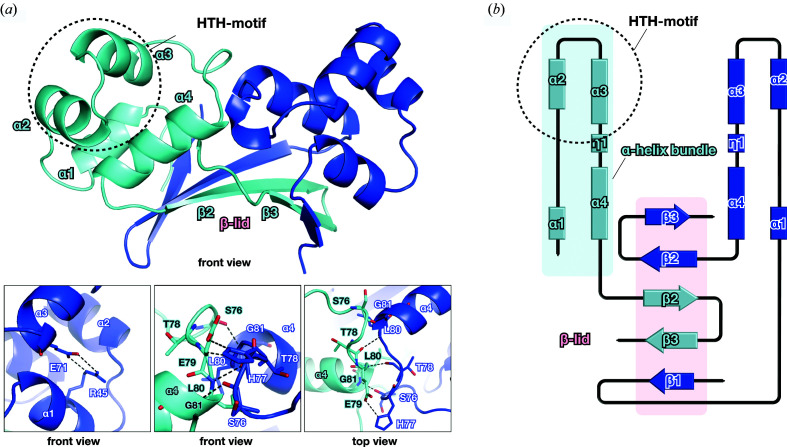
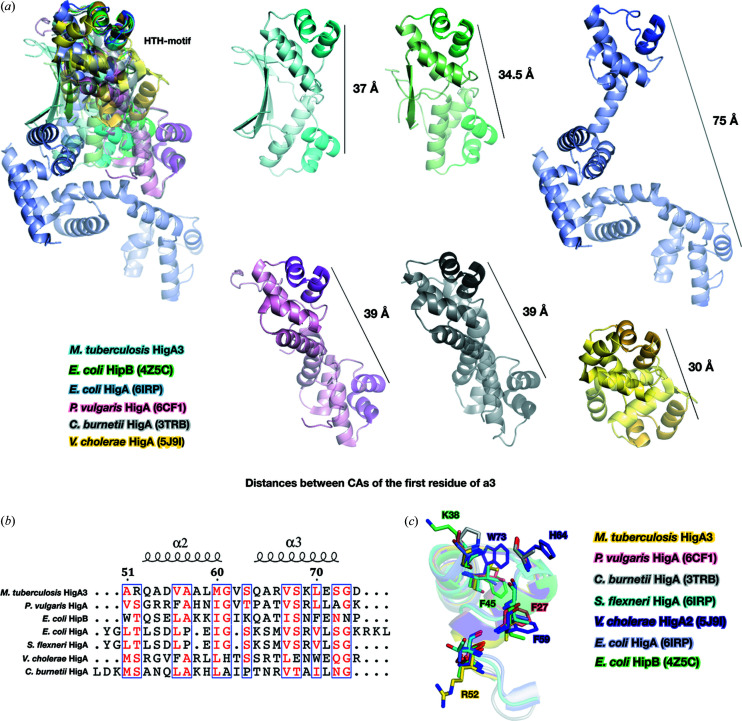
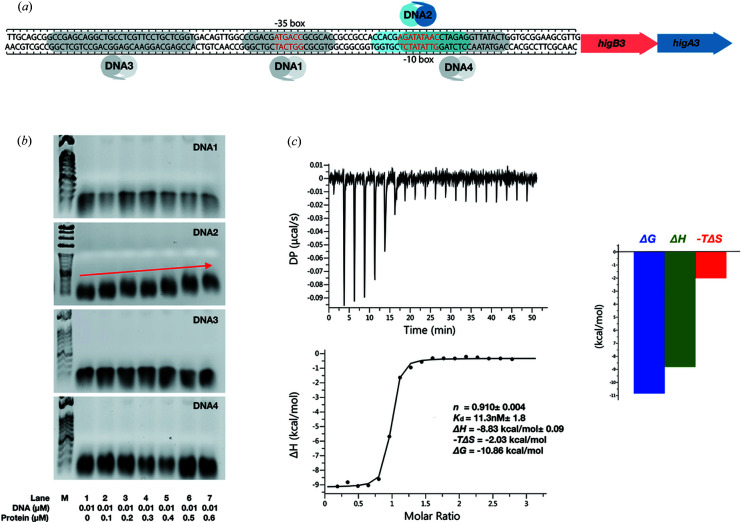
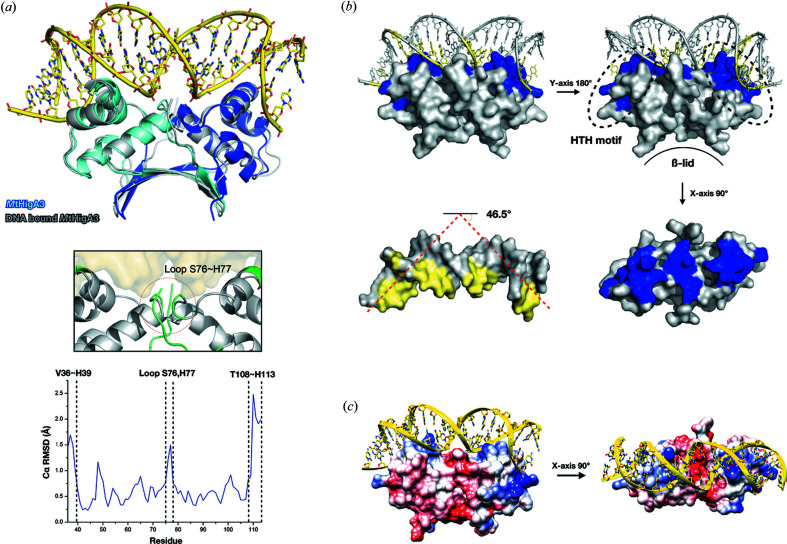
The bacterial toxin-antitoxin (TA) system regulates cell growth under various environmental stresses. , the causative pathogen of tuberculosis (TB), has three HigBA type II TA systems with reverse gene organization, consisting of the toxin protein HigB and labile antitoxin protein HigA. Most type II TA modules are transcriptionally autoregulated by the antitoxin itself. In this report, we first present the crystal structure of the HigA3 antitoxin (HigA3) and HigA3 bound to its operator DNA complex. We also investigated the interaction between HigA3 and DNA using NMR spectroscopy. The HigA3 antitoxin structure is a homodimer that contains a structurally well conserved DNA-binding domain at the N-terminus and a dimerization domain at the C-terminus. Upon comparing the HigA homologue structures, a distinct difference was found in the C-terminal region that possesses the β-lid, and diverse orientations of two helix-turn-helix (HTH) motifs from HigA homologue dimers were observed. The structure of HigA3 bound to DNA reveals that the promoter DNA is bound to two HTH motifs of the HigA3 dimer presenting 46.5° bending, and the distance between the two HTH motifs of each HigA3 monomer was increased in HigA3 bound to DNA. The β-lid, which is found only in the tertiary structure of HigA3 among the HigA homologues, causes the formation of a tight dimerization network and leads to a unique arrangement for dimer formation that is related to the curvature of the bound DNA. This work could contribute to the understanding of the HigBA system of at the atomic level and may contribute to the development of new antibiotics for TB treatment.
细菌毒素-抗毒素(TA)系统在各种环境压力下调节细胞生长。结核分枝杆菌(TB)的病原体结核杆菌有三个具有反向基因组织的HigBA II型TA系统,由毒素蛋白HigB和不稳定的抗毒素蛋白HigA组成。大多数II型TA模块由抗毒素本身进行转录自调控。在本报告中,我们首先展示了HigA3抗毒素(HigA3)及其与操纵子DNA复合物结合的晶体结构。我们还使用核磁共振光谱研究了HigA3与DNA之间的相互作用。HigA3抗毒素结构是一个同型二聚体,在N端含有一个结构上高度保守的DNA结合结构域,在C端含有一个二聚化结构域。在比较HigA同源物结构时,发现具有β-盖的C端区域存在明显差异,并且观察到来自HigA同源物二聚体的两个螺旋-转角-螺旋(HTH)基序有不同的取向。与DNA结合的HigA3结构表明,启动子DNA与呈现46.5°弯曲的HigA3二聚体的两个HTH基序结合,并且在与DNA结合的HigA3中每个HigA3单体的两个HTH基序之间的距离增加。β-盖仅在HigA同源物中HigA3的三级结构中发现,它导致形成紧密的二聚化网络,并导致与结合DNA的曲率相关的独特二聚体形成排列。这项工作有助于在原子水平上理解结核杆菌的HigBA系统,并可能有助于开发用于治疗结核病的新型抗生素。