Department of Experimental Psychology, University of Oxford, Oxford, United Kingdom.
Department of Psychology, University of Bath, Bath, United Kingdom.
Cancer. 2020 Oct 1;126(19):4414-4422. doi: 10.1002/cncr.33098. Epub 2020 Jul 22.
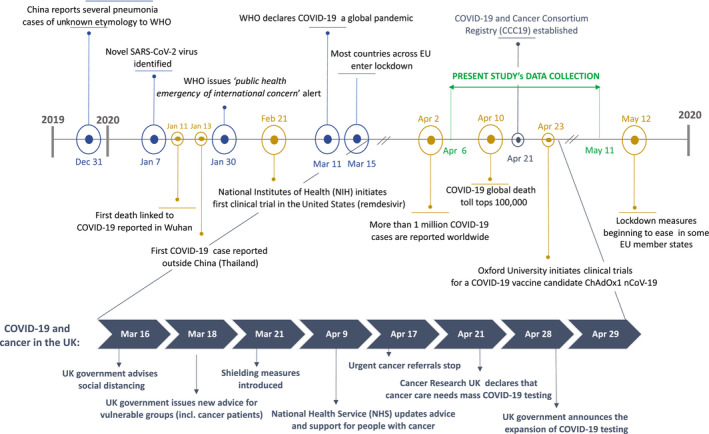
Because of the global spread of coronavirus disease 2019 (COVID-19), oncology departments across the world have rapidly adapted their cancer care protocols to balance the risk of delaying cancer treatments and the risk of COVID-19 exposure. COVID-19 and associated changes may have an impact on the psychosocial functioning of patients with cancer and survivors. This study was designed to determine the impact of the COVID-19 pandemic on young people living with and beyond cancer.
In this cross-sectional study, 177 individuals, aged 18 to 39 years, were surveyed about the impact of COVID-19 on their cancer care and psychological well-being. Participants also reported their information needs with respect to COVID-19. Responses were summarized with a content analysis approach.
This was the first study to examine the psychological functioning of young patients and survivors during the first weeks of the COVID-19 pandemic. A third of the respondents reported increased levels of psychological distress, and as many as 60% reported feeling more anxious than they did before COVID-19. More than half also wanted more information tailored to them as young patients with cancer.
The COVID-19 pandemic is rapidly evolving and changing the landscape of cancer care. Young people living with cancer are a unique population and might be more vulnerable during this time in comparison with their healthy peers. There is a need to screen for psychological distress and attend to young people whose cancer care has been delayed. As the lockdown begins to ease, the guidelines about cancer care should be updated according to this population's needs.
由于 2019 年冠状病毒病(COVID-19)在全球范围内的传播,世界各地的肿瘤学部门迅速调整了癌症治疗方案,以平衡延迟癌症治疗的风险和 COVID-19 暴露的风险。COVID-19 及其相关变化可能会对癌症患者和幸存者的社会心理功能产生影响。本研究旨在确定 COVID-19 大流行对癌症患者和癌症幸存者的影响。
在这项横断面研究中,对 177 名年龄在 18 至 39 岁之间的个体进行了调查,了解 COVID-19 对其癌症治疗和心理健康的影响。参与者还报告了他们对 COVID-19 的信息需求。使用内容分析法对结果进行了总结。
这是第一项研究,在 COVID-19 大流行的最初几周内,研究了年轻患者和幸存者的心理功能。三分之一的受访者报告说心理困扰水平增加,多达 60%的人报告说他们比 COVID-19 之前感到更焦虑。超过一半的人还希望获得更多针对他们作为年轻癌症患者的信息。
COVID-19 大流行正在迅速发展并改变癌症治疗的格局。患有癌症的年轻人是一个独特的群体,与他们的健康同龄人相比,他们在这个时期可能更加脆弱。需要对心理困扰进行筛查,并关注癌症治疗被延迟的年轻人。随着封锁的开始放松,应根据这一人群的需求更新有关癌症治疗的指南。