Fussey Jonathan M, Beaumont Robin N, Wood Andrew R, Vaidya Bijay, Smith Joel, Tyrrell Jessica
Head and Neck Surgery, Royal Devon and Exeter Hospital, Exeter, UK.
Genetics of Complex Traits, Institute of Biomedical and Clinical Science, University of Exeter Medical School, Exeter, UK.
Endocr Relat Cancer. 2020 Oct;27(10):551-559. doi: 10.1530/ERC-20-0067.
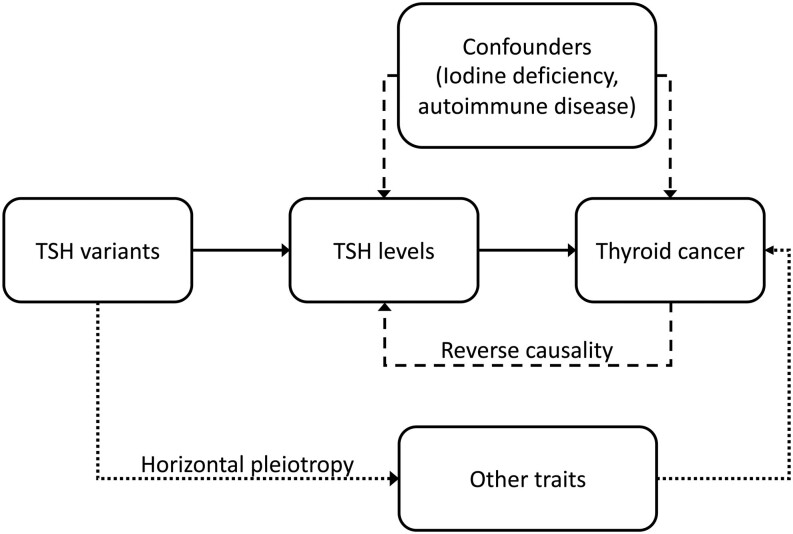
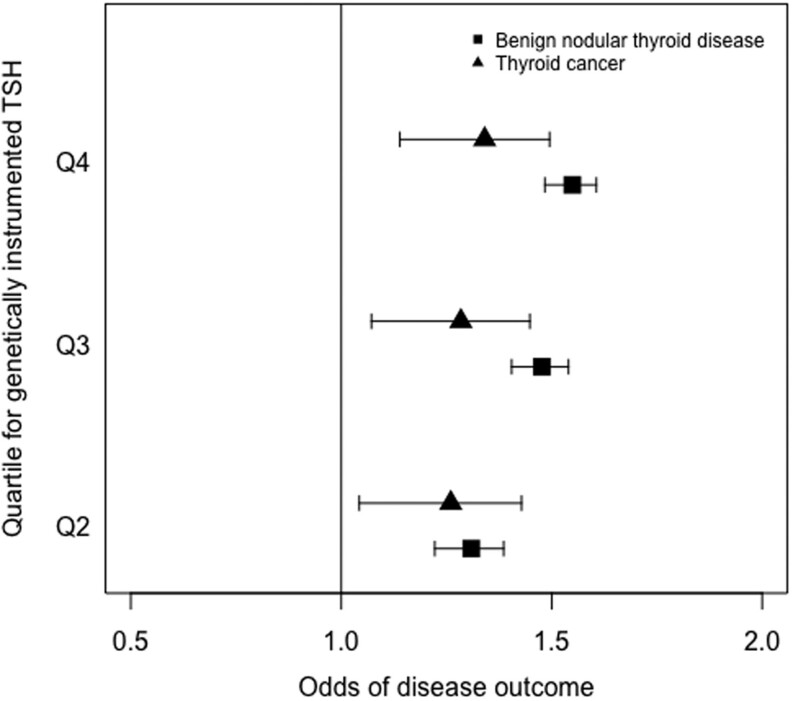
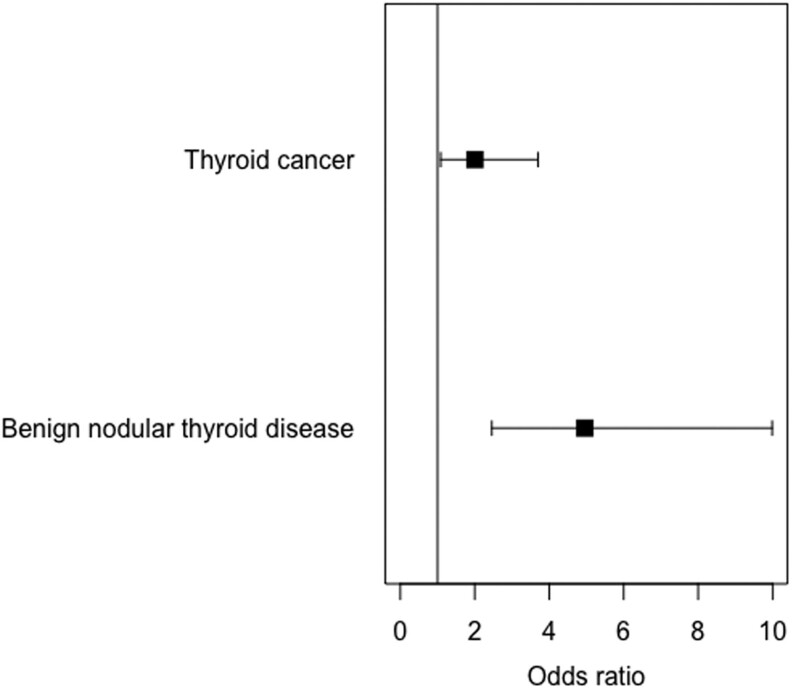
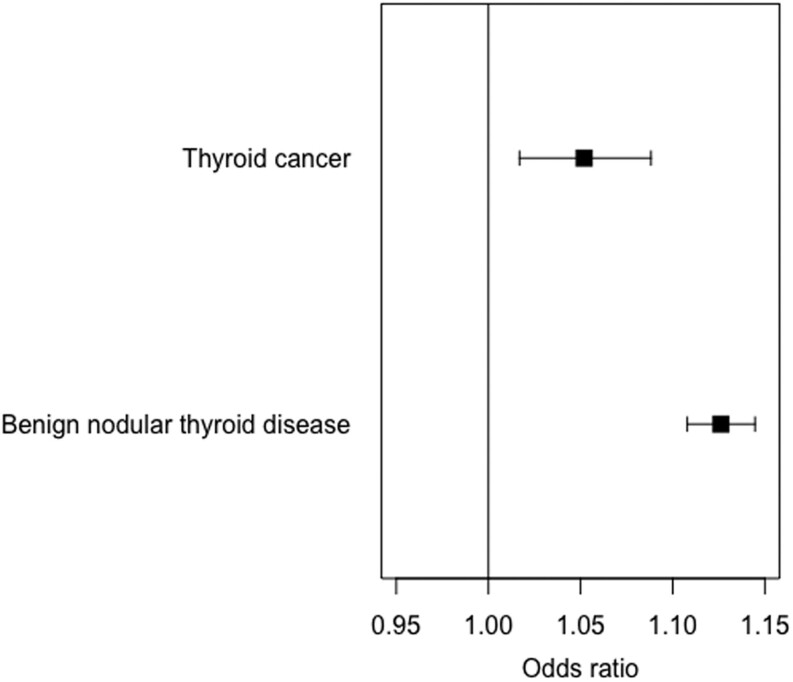
Evidence from observational studies suggest a positive association between serum thyroid-stimulating hormone (TSH) levels and differentiated thyroid carcinoma. However, the cause-effect relationship is poorly understood and these studies are susceptible to bias and confounding. This study aimed to investigate the causal role of TSH in both benign thyroid nodules and thyroid cancer in up to 451,025 UK Biobank participants, using a genetic technique, known as Mendelian randomization (MR). Hospital Episode Statistics and Cancer Registry databases were used to identify 462 patients with differentiated thyroid carcinoma and 2031 patients with benign nodular thyroid disease. MR methods using genetic variants associated with serum TSH were used to test causal relationships between TSH and the two disease outcomes. Mendelian randomization provided evidence of a causal link between TSH and both thyroid cancer and benign nodular thyroid disease. Two-sample MR suggested that a 1 s.d. higher genetically instrumented TSH (approximately 0.8 mIU/L) resulted in 4.96-fold higher odds of benign nodular disease (95% CI 2.46-9.99) and 2.00-fold higher odds of thyroid cancer (95% CI 1.09-3.70). Our results thus support a causal role for TSH in both benign nodular thyroid disease and thyroid cancer.
观察性研究的证据表明,血清促甲状腺激素(TSH)水平与分化型甲状腺癌之间存在正相关。然而,因果关系尚不清楚,并且这些研究容易受到偏倚和混杂因素的影响。本研究旨在利用一种称为孟德尔随机化(MR)的基因技术,调查在多达451,025名英国生物银行参与者中TSH在良性甲状腺结节和甲状腺癌中的因果作用。利用医院病历统计数据和癌症登记数据库识别出462例分化型甲状腺癌患者和2031例良性结节性甲状腺疾病患者。使用与血清TSH相关的基因变异的MR方法来测试TSH与这两种疾病结局之间的因果关系。孟德尔随机化提供了TSH与甲状腺癌和良性结节性甲状腺疾病之间因果联系的证据。两样本MR表明,遗传工具化的TSH每升高1个标准差(约0.8 mIU/L),良性结节性疾病的患病几率就会高出4.96倍(95%置信区间2.46 - 9.99),甲状腺癌的患病几率则高出2.00倍(95%置信区间1.09 - 3.70)。因此,我们的结果支持TSH在良性结节性甲状腺疾病和甲状腺癌中均具有因果作用。