Sprung Victoria S, Kemp Graham J, Wilding John Ph, Adams Valerie, Murphy Kieran, Burgess Malcolm, Emegbo Stephen, Thomas Matthew, Needham Alexander J, Weimken Andrew, Schwab Richard J, Manuel Ari, Craig Sonya E, Cuthbertson Daniel J
Research Institute for Sport & Exercise Sciences, Liverpool John Moores University, Liverpool, UK
Department of Cardiovascular & Metabolic Medicine, University of Liverpool, Liverpool, UK.
BMJ Open. 2020 Jul 22;10(7):e038856. doi: 10.1136/bmjopen-2020-038856.
Obstructive sleep apnoea (OSA) and type 2 diabetes mellitus (T2DM) often occur concurrently, and untreated OSA may potentially amplify the high risk of cardiovascular disease in T2DM. Compliance with continuous positive airway pressure (CPAP), the conventional treatment for OSA, can be poor and considering weight loss is the most effective treatment for OSA. This trial examines whether the glucagon-like peptide-1 receptor agonist liraglutide, a glucose-lowering therapy associated with significant weight loss used in T2DM, can improve the severity and symptoms of OSA.
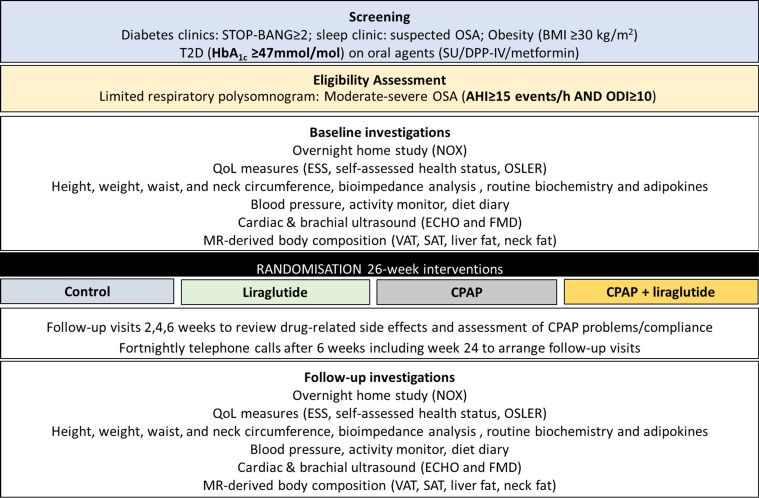
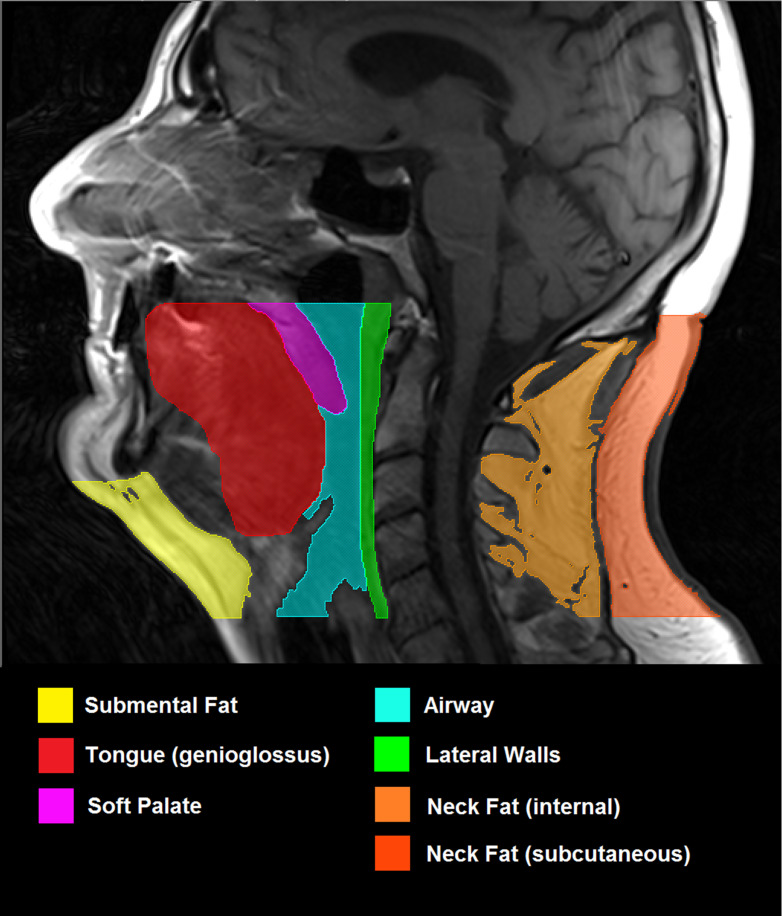
This is an outpatient, single-centred, open-labelled, prospective, phase IV randomised controlled trial in a two-by-two factorial design. One hundred and thirty-two patients with newly diagnosed OSA (apnoea-hypopnoea index (AHI) ≥15 events/hour), and existing obesity and T2DM (glycated haemoglobin (HbA) ≥47 mmol/mol), will be recruited from diabetes and sleep medicine outpatient clinics in primary and secondary care settings across Liverpool. Patients will be allocated equally, using computer-generated random, permuted blocks of unequal sizes, to each of the four treatment arms for 26 weeks: (i) liraglutide (1.8 mg once per day) alone, (ii) liraglutide 1.8 mg once per day with CPAP, (iii) CPAP alone (conventional care) or (iv) no treatment (control). The primary outcome measure is change in OSA severity, determined by AHI. Secondary outcome measures include effects on glycaemic control (glycated haemoglobin (HbA1c)), body weight and quality of life measures. Exploratory measures include measures of physical activity, MRI-derived measures of regional body composition including fat mass (abdominal subcutaneous, visceral, neck and liver fat) and skeletal muscle mass (cross-sectional analysis of thigh), indices of cardiac function (using transthoracic echocardiography) and endothelial function.
The study has been approved by the North West Liverpool Central Research Ethics Committee (14/NW/1019) and it is being conducted in accordance with the Declaration of Helsinki and Good Clinical Practice.
ISRCTN16250774. EUDRACT No. 2014-000988-41. UTN U1111-1139-0677.
阻塞性睡眠呼吸暂停(OSA)与2型糖尿病(T2DM)常同时发生,未经治疗的OSA可能会增加T2DM患者患心血管疾病的高风险。持续气道正压通气(CPAP)是OSA的传统治疗方法,但患者的依从性可能较差,而减肥是治疗OSA最有效的方法。本试验旨在研究胰高血糖素样肽-1受体激动剂利拉鲁肽(一种用于T2DM且与显著体重减轻相关的降糖疗法)是否能改善OSA的严重程度和症状。
这是一项门诊、单中心、开放标签、前瞻性的IV期随机对照试验,采用二乘二析因设计。将从利物浦初级和二级医疗保健机构的糖尿病和睡眠医学门诊招募132例新诊断的OSA患者(呼吸暂停低通气指数(AHI)≥15次/小时),且伴有肥胖和T2DM(糖化血红蛋白(HbA)≥47 mmol/mol)。患者将使用计算机生成的大小不等的随机排列分组,平均分配到四个治疗组,为期26周:(i)单独使用利拉鲁肽(每天1.8 mg),(ii)利拉鲁肽1.8 mg每天一次联合CPAP,(iii)单独使用CPAP(传统治疗)或(iv)不治疗(对照组)。主要结局指标是由AHI确定的OSA严重程度的变化。次要结局指标包括对血糖控制(糖化血红蛋白(HbA1c))、体重和生活质量指标的影响。探索性指标包括身体活动指标、MRI得出的局部身体成分指标,包括脂肪量(腹部皮下、内脏、颈部和肝脏脂肪)和骨骼肌量(大腿横断面分析)、心脏功能指标(使用经胸超声心动图)和内皮功能指标。
该研究已获得利物浦中心西北部研究伦理委员会批准(14/NW/1019),并按照《赫尔辛基宣言》和《良好临床实践规范》进行。
ISRCTN16250774。欧盟临床试验编号2014-000988-41。UTN U1111-1139-0677。