Huang Xiaopeng, Wang Feifu, Lin Zhiyi, He Yifan, Wen Shuyun, Zhou Ling, Lu Fan, Jiang Jun
School of Ophthalmology and Optometry, Wenzhou Medical University, 270 Xueyuan West Road, Wenzhou, 325027 Zhejiang People's Republic of China.
Eye Vis (Lond). 2020 Jul 19;7:41. doi: 10.1186/s40662-020-00204-4. eCollection 2020.
It is unclear whether multifocal soft contact lenses (MFSCLs) affect visual quality when they are used for myopia control in juvenile myopes. The aim of this study was, therefore, to investigate the effect of MFSCLs on visual quality among juvenile myopia subjects.
In a prospective, intervention study, thirty-three juvenile myopes were enrolled. Visual perception was assessed by a quality of vision (QoV) questionnaire with spectacles at baseline and after 1 month of MFSCL wear. At the one-month visit, the high (96%) contrast distance visual acuity (distance HCVA) and low (10%) contrast distance visual acuity (distance LCVA) were measured with single vision spectacle lenses, single vision soft contact lenses (SVSCLs) and MFSCLs in a random order. Wavefront aberrations were measured with SVSCLs, with MFSCLs, and without any correction.
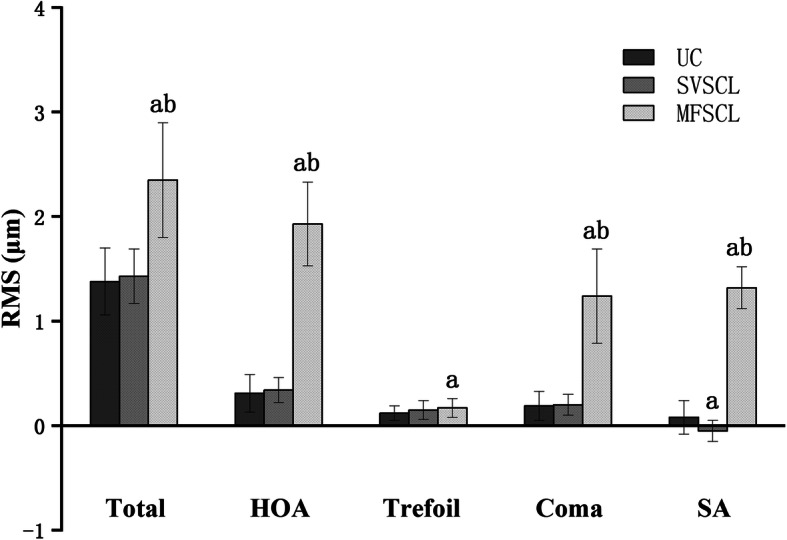
Neither distance HCVA ( > 0.05) nor distance LCVA ( > 0.05) revealed any significant difference between MFSCLs, SVSCLs and single vision spectacle lenses. The overall score (the sum of ten symptoms) of the QoV questionnaire did not show a statistically significant difference between spectacles at baseline and after 1 month of MFSCL wear ( = 0.357). The results showed that the frequency ( < 0.001), severity ( = 0.001) and bothersome degree ( = 0.016) of halos were significantly worse when wearing MFSCLs than when wearing single vision spectacle lenses. In contrast, the bothersome degree caused by focusing difficulty ( = 0.046) and the frequency of difficulty in judging distance or depth perception ( = 0.046) were better when wearing MFSCLs than when wearing single vision spectacle lenses. Compared with the naked eye, MFSCLs increased the total aberrations ( < 0.001), higher-order aberrations ( < 0.001), trefoil ( = 0.023), coma aberrations ( < 0.001) and spherical aberrations (SA) ( < 0.001). Compared with the SVSCLs, MFSCLs increased the total aberrations ( < 0.001), higher-order aberrations ( < 0.001), coma aberrations ( < 0.001) and SA ( < 0.001). The direction of SA was more positive ( < 0.001) with the MFSCLs and more negative ( = 0.001) with the SVSCLs compared with the naked eye.
Wearing MFSCLs can provide satisfactory corrected visual acuity (both distance HCVA and distance LCVA). Although the lenses increased the aberrations, such as total aberrations and higher-order aberrations, there were few adverse effects on the distance HCVA, distance LCVA and visual perception after 1 month of MFSCL use.
Chinese Clinical Trial Registry: ChiCTR-OOC-17012103. Registered 23 July 2017, http://www.chictr.org.cn/usercenter.aspx.
对于青少年近视患者使用多焦点软性接触镜(MFSCL)进行近视控制时是否会影响视觉质量尚不清楚。因此,本研究旨在探讨MFSCL对青少年近视患者视觉质量的影响。
在一项前瞻性干预研究中,招募了33名青少年近视患者。在基线时以及佩戴MFSCL 1个月后,通过视力质量(QoV)问卷评估戴眼镜时的视觉感知。在1个月的随访中,使用单光眼镜镜片、单光软性接触镜(SVSCL)和MFSCL以随机顺序测量高对比度(96%)远视力(远距高对比度视力,distance HCVA)和低对比度(10%)远视力(远距低对比度视力,distance LCVA)。使用SVSCL、MFSCL以及无任何矫正时测量波前像差。
MFSCL、SVSCL和单光眼镜镜片之间的远距高对比度视力(P>0.05)和远距低对比度视力(P>0.05)均未显示出任何显著差异。QoV问卷的总分(十个症状的总和)在基线时戴眼镜与佩戴MFSCL 1个月后之间未显示出统计学上的显著差异(P=0.357)。结果显示,佩戴MFSCL时光晕的频率(P<0.001)、严重程度(P=0.001)和困扰程度(P=0.016)比佩戴单光眼镜镜片时明显更差。相比之下,佩戴MFSCL时聚焦困难引起的困扰程度(P=0.046)以及判断距离或深度感知困难的频率(P=0.046)比佩戴单光眼镜镜片时更好。与裸眼相比,MFSCL增加了总像差(P<0.001)、高阶像差(P<0.001)、三叶草像差(P=0.023)、彗差(P<0.001)和球差(SA)(P<0.001)。与SVSCL相比,MFSCL增加了总像差(P<0.001)、高阶像差(P<0.