China Center for Health Development Studies, Peking University, Beijing, China.
School of Management, Beijing University of Chinese Medicine, Beijing, China.
Int J Health Policy Manag. 2022 Mar 1;11(3):277-286. doi: 10.34172/ijhpm.2020.111.
Understanding the treatment costs of stroke can guide health policies and interventions. However, few studies have analyzed the treatment costs of stroke in China. The aim of this study is to assess stroke-related medical service utilization, direct costs of stroke and associated stroke predictors, and, second, to understand the structure of medical resource use.
This study used a 5% random sample of claim data from China's Urban Basic Medical Insurance between January 2013 to December 2016. The sampling design assigned a sample weight to each beneficiary. Weighted descriptive analyses, Poisson regression and generalized linear model were used to analyze the medical service utilization, costs and their associations with patient characteristics.
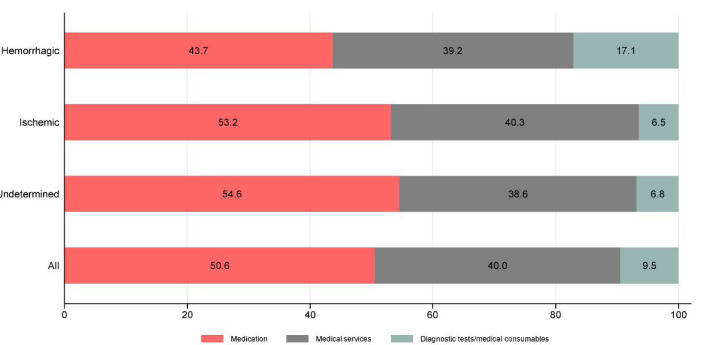
In urban China, the annual prevalence of stroke was 730.43 (95% CI = 730.10-730.76) cases per 100 000 people, and nearly 2% of total health expenditures of urban residents was spent on stroke-related medical costs. Weighted average annual total medical cost of stroke was RMB10 637 [95% CI = 10 435-10 840] (US$1682, 95% CI = 1650-1714), with annual out-of-pocket (OOP) cost of RMB3093 [95% CI = 3026-3161] (US$489, 95% CI = 478-500). The average yearly number of stroke-related outpatient visit was 1.67 [SD = 3.39] and inpatient admission was 0.79 [SD = 0.83], with an average cost of RMB440 [SD = 739] (US$70, SD = 117) for outpatients and RMB12 702 [SD = 21 424] (US$2008, SD = 3387) for inpatients. Inpatient costs accounted for 94% (RMB10 034 or US$ 1586) of medical costs, and tertiary hospitals were the main provider of stroke care. Stroke-related medical care utilization and direct costs were associated with gender, age, pathological stroke types and insurance status. Medication costs contributed to 50.6% (RMB5382 or US$ 851) of the average stroke-related medical costs.
China's health system bares a large economic burden from stroke. Specific policies are needed to strengthen the capacity of secondary hospitals, alter the structure of medical resource allocation, and target specific sections of the stroke population.
了解中风的治疗费用可以指导卫生政策和干预措施。然而,很少有研究分析中国中风的治疗费用。本研究旨在评估中风相关医疗服务的利用情况、中风的直接成本及其相关的中风预测因素,并了解医疗资源利用的结构。
本研究使用了中国城镇基本医疗保险 2013 年 1 月至 2016 年 12 月期间索赔数据的 5%随机样本。抽样设计为每位受益人体重。使用加权描述性分析、泊松回归和广义线性模型分析医疗服务利用、成本及其与患者特征的关系。
在中国城市,中风的年患病率为 730.43(95%置信区间为 730.10-730.76)/100000 人,城镇居民总卫生支出的近 2%用于中风相关医疗费用。中风加权平均年总医疗费用为人民币 10637 元(95%置信区间为 10435-10840)(1682 美元,95%置信区间为 1650-1714),年自付费用为人民币 3093 元(95%置信区间为 3026-3161)(489 美元,95%置信区间为 478-500)。中风相关门诊就诊次数平均为 1.67 次(SD=3.39),住院人次为 0.79 次(SD=0.83),门诊费用平均为人民币 440 元(SD=739)(70 美元,SD=117),住院费用平均为人民币 12702 元(SD=21424)(2008 美元,SD=3387)。住院费用占医疗费用的 94%(人民币 10034 元或 1586 美元),三级医院是中风治疗的主要提供者。中风相关医疗服务的利用和直接成本与性别、年龄、病理类型和保险状况有关。药物治疗费用占中风相关医疗费用的 50.6%(人民币 5382 元或 851 美元)。
中国的卫生系统承担了中风带来的巨大经济负担。需要制定具体政策,加强二级医院的能力,改变医疗资源配置结构,并针对特定的中风人群。