Department of Health and Human Physiology and Department of Epidemiology, University of Iowa, E116 Field House, Iowa City, IA, 52242, USA.
Department of Health Sciences, Saginaw Valley State University, University Center, MI, USA.
BMC Pregnancy Childbirth. 2020 Jul 23;20(1):417. doi: 10.1186/s12884-020-03107-3.
Little is known about patient-provider communication on gestational weight gain among women pregnant with twins, a growing population at high risk for adverse maternal and neonatal outcomes. We examined if women's report of provider advice on gestational weight gain was consistent with the Institute of Medicine (IOM) weight gain guidelines for twin pregnancies, and the association of provider advice on weight gain with women's weight gain during their twin pregnancy.
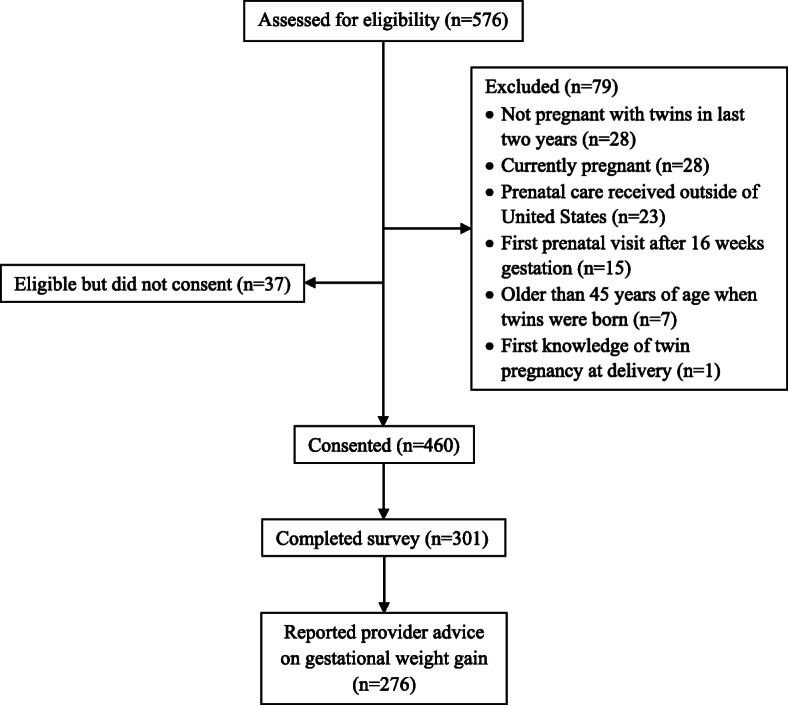
We conducted a cross-sectional survey of 276 women who delivered twins and received prenatal care in the United States. The 2009 IOM provisional weight gain guidelines for twin pregnancies defined whether provider advice on weight gain and women's weight gain were below, within, or above guidelines. Multinomial logistic regression examined associations between provider advice on weight gain with women's weight gain, after adjustment for maternal age, gestational age at delivery, education, parity, twin type, use of assisted reproductive technologies and pre-pregnancy BMI category.
Approximately 30% of women described provider advice on weight gain below the IOM guidelines, 60% within, and 10% above guidelines. Compared to women who reported weight gain advice within guidelines, women who reported advice below guidelines or who reported no advice were 7.1 (95% CI: 3.2, 16.0) and 2.7 (95% CI: 1.3, 5.6) times more likely to gain less than recommended, respectively. Women who reported provider advice above guidelines were 4.6 (95% CI: 1.5, 14.2) times more likely to exceed guidelines.
Provider advice on gestational weight gain may be an important predictor of women's weight gain during twin pregnancies, highlighting the critical need for accurate provider counseling to optimize health outcomes.
对于怀有双胞胎的女性,其与提供者关于妊娠期体重增加的沟通情况鲜为人知,而这一人群是母婴不良结局的高危人群。我们研究了女性报告的关于妊娠期体重增加的提供者建议是否与双胎妊娠的医学研究所(IOM)体重增加指南一致,以及体重增加建议与女性在双胞胎怀孕期间体重增加的关系。
我们对在美国接受产前护理并分娩双胞胎的 276 名女性进行了横断面调查。2009 年 IOM 双胎妊娠临时体重增加指南定义了体重增加建议和女性体重增加是否低于、等于或高于指南。多变量逻辑回归分析了体重增加建议与女性体重增加之间的关联,调整了母亲年龄、分娩时的孕龄、教育程度、产次、双胞胎类型、辅助生殖技术的使用和孕前 BMI 类别等因素。
大约 30%的女性描述了体重增加建议低于 IOM 指南,60%的女性描述了体重增加建议在指南范围内,10%的女性描述了体重增加建议高于指南。与报告体重增加建议符合指南的女性相比,报告体重增加建议低于指南或报告没有建议的女性体重增加不足的可能性分别为 7.1 倍(95%CI:3.2,16.0)和 2.7 倍(95%CI:1.3,5.6)。报告体重增加建议高于指南的女性体重增加超过指南的可能性为 4.6 倍(95%CI:1.5,14.2)。
关于妊娠期体重增加的提供者建议可能是女性在双胞胎怀孕期间体重增加的一个重要预测因素,这突出表明需要准确的提供者咨询以优化健康结果。