Institute for Translational Epidemiology and Department of Population Health Science and Policy, Icahn School of Medicine at Mount Sinai, New York, New York; Center for Disaster Health, Trauma, and Resilience, New York, New York.
Institute for Translational Epidemiology and Department of Population Health Science and Policy, Icahn School of Medicine at Mount Sinai, New York, New York; Department of Epidemiology and Population Health, NYU School of Medicine, New York, New York.
Am J Prev Med. 2020 Sep;59(3):326-332. doi: 10.1016/j.amepre.2020.06.005. Epub 2020 Jun 25.
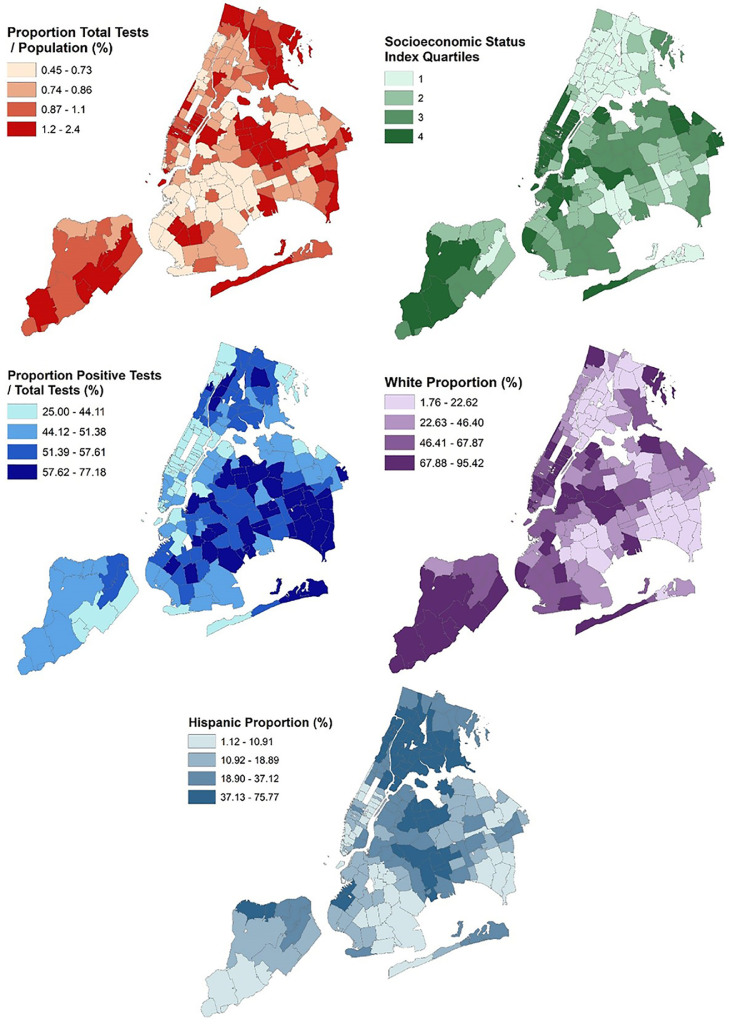
Existing socioeconomic and racial disparities in healthcare access in New York City have likely impacted the public health response to COVID-19. An ecological study was performed to determine the spatial distribution of COVID-19 testing by ZIP code Tabulation Area and investigate if testing was associated with race or SES.
Data were obtained from the New York City coronavirus data repository and 2018 American Community Survey 5-year estimates. A combined index of SES was created using principal component analysis and incorporated household income, gross rent, poverty, education, working class status, unemployment, and occupants per room. Multivariable Poisson regressions were performed to predict the number of total tests and the ratio of positive tests to total tests performed, using the SES index, racial composition, and Hispanic composition as predictors.
The number of total tests significantly increased with the increasing proportion of white residents (β=0.004, SE=0.001, p=0.0032) but not with increasing Hispanic composition or SES index score. The ratio of positive tests to total tests significantly decreased with the increasing proportion of white residents in the ZIP code Tabulation Area (β= -0.003, SE=0.000 6, p<0.001) and with increasing SES index score (β= -0.001 6, SE=0.0007, p=0.0159).
In New York City, COVID-19 testing has not been proportional to need; existing socioeconomic and racial disparities in healthcare access have likely impacted public health response. There is urgent need for widespread testing and public health outreach for the most vulnerable communities in New York City.
在纽约市,现有的社会经济和种族差异可能影响了对 COVID-19 的公共卫生应对。本生态研究旨在确定邮政编码普查区的 COVID-19 检测的空间分布,并调查检测是否与种族或 SES 相关。
数据来自纽约市冠状病毒数据存储库和 2018 年美国社区调查 5 年估计数。使用主成分分析创建 SES 综合指数,并纳入家庭收入、总租金、贫困、教育、工人阶级地位、失业和每个房间的居住人数。使用 SES 指数、种族构成和西班牙裔构成作为预测因子,进行多变量泊松回归,以预测总检测数量和阳性检测与总检测数量的比值。
总检测数量随着白人居民比例的增加而显著增加(β=0.004,SE=0.001,p=0.0032),但与西班牙裔构成或 SES 指数分数的增加无关。阳性检测与总检测数量的比值随着邮政编码普查区白人居民比例的增加而显著降低(β= -0.003,SE=0.0006,p<0.001),并随着 SES 指数分数的增加而降低(β= -0.0016,SE=0.0007,p=0.0159)。
在纽约市,COVID-19 检测并未按需求进行分配;现有的医疗保健获得方面的社会经济和种族差异可能影响了公共卫生应对。纽约市最脆弱社区迫切需要广泛的检测和公共卫生宣传。