Department of Infectious Disease Epidemiology, Imperial College, London, UK.
Department of Respiratory Sciences, University of Leicester, University Road, Leicester, UK.
J Sex Med. 2020 Sep;17(9):1629-1642. doi: 10.1016/j.jsxm.2020.06.007. Epub 2020 Jul 20.
Condomless anal intercourse (AI) confers a far greater likelihood of HIV transmission than condomless vaginal intercourse (VI). However, little is known about AI practice over the life course of women, to what extent AI practice is condom-protected, and whether it is associated with other HIV risk behaviors. We aim to describe longitudinal AI practice among HIV-seronegative women and to identify subgroups with distinct trajectories of AI practice.
Using data from the Women's Interagency HIV Study, an observational cohort of US women with or at risk for HIV, we described AI practice among HIV-seronegative participants. Group-based trajectory modeling was used to identify distinct AI trajectories. We used multinomial regression to examine associations between baseline characteristics and trajectory group membership.
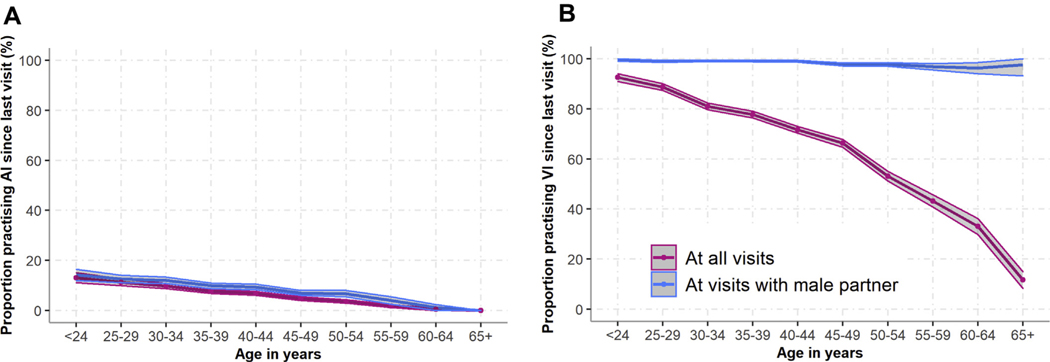
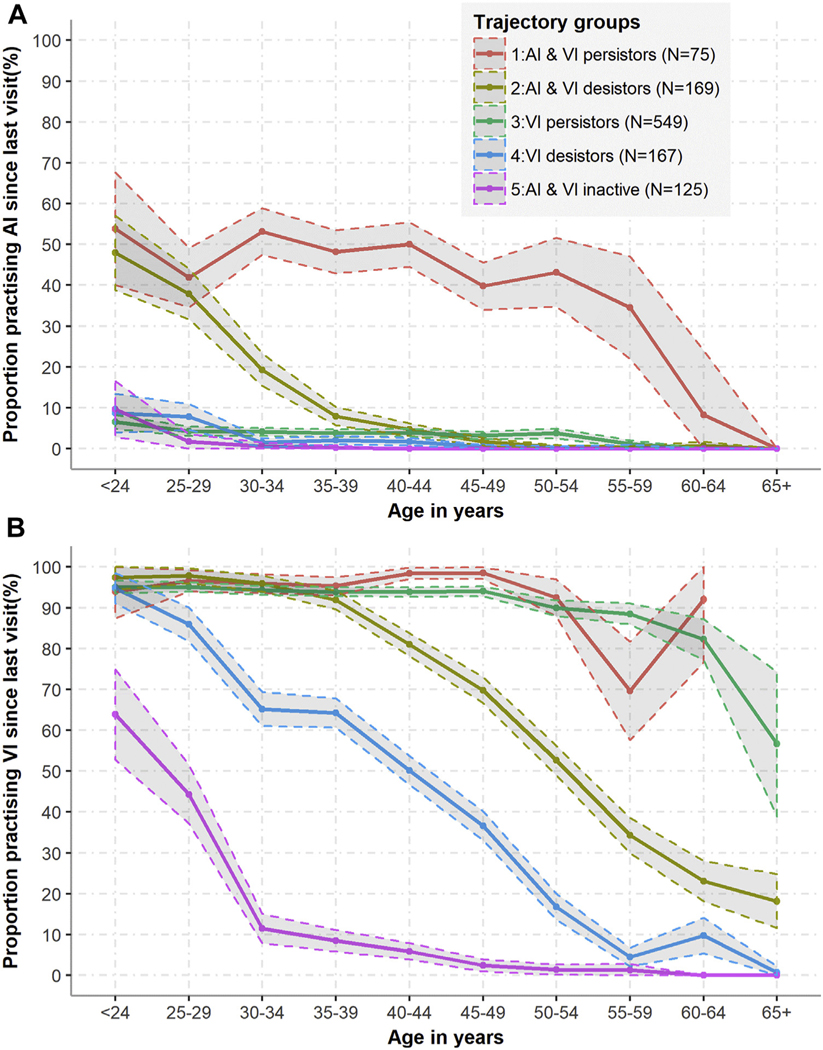
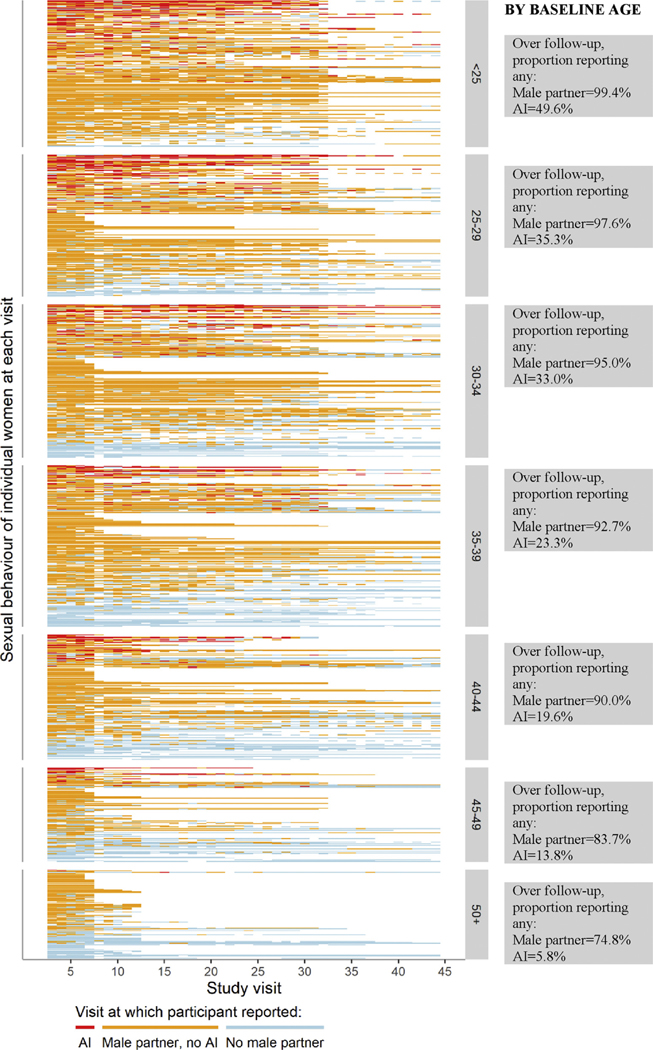
A third of the 1,085 women in our sample reported any AI over follow-up (median follow-up = 14 years). AI decreased more sharply with age compared to VI. Consistent condom use during AI was low: twice the proportion of women never reported using condoms consistently during AI compared to during VI. 5 trajectory groups were identified: AI & VI persistors (N = 75) practiced AI and VI consistently over follow-up (AI & VI desistors (N = 169) tended to practice AI and VI when young only, while VI persistors (N = 549), VI desistors (N = 167), and AI & VI inactives (N = 125) reported varying levels of VI practice, but little AI. AI & VI persistors reported multiple male partners and exchange sex at more visits than other groups. Women who identified as bisexual/lesbian (vs heterosexual), who had ever experienced physical and sexual violence (vs never), and/or who reported above the median number of lifetime male sex partners (vs median or below) had approximately twice the odds of being AI & VI persistors than being VI persistors.
We identified a small subgroup of women who practice AI and report inconsistent condom use along with other risk behaviors throughout the life course; they may therefore particularly benefit from ongoing access to HIV prevention services including pre-exposure prophylaxis. Owen BN, Baggaley RF, Maheu-Giroux M, et al. Patterns and Trajectories of Anal Intercourse Practice Over the Life Course Among US Women at Risk of HIV. J Sex Med 2020;17:1629-1642.
无保护肛交(AI)比无保护阴道交(VI)更有可能传播 HIV。然而,人们对女性一生中 AI 实践的了解甚少,AI 实践在多大程度上受到保护,以及它是否与其他 HIV 风险行为有关。我们旨在描述 HIV 阴性女性的纵向 AI 实践,并确定具有不同 AI 实践轨迹的亚组。
使用来自妇女机构间艾滋病毒研究(一项针对美国有或有感染 HIV 风险的妇女的观察性队列)的数据,我们描述了 HIV 阴性参与者的 AI 实践。使用基于群组的轨迹建模来确定不同的 AI 轨迹。我们使用多项回归来检查基线特征与轨迹组归属之间的关联。
我们样本中的 1085 名女性中有三分之一在随访期间报告了任何 AI(中位随访时间为 14 年)。与 VI 相比,AI 随年龄的下降更为陡峭。AI 时持续使用 condom 的比例较低:两倍的女性报告在 AI 时从未持续使用 condom,而在 VI 时报告持续使用 condom。确定了 5 个轨迹组:AI & VI 持续者(N=75)在随访期间始终如一的进行 AI 和 VI(AI & VI 放弃者(N=169)在年轻时仅倾向于进行 AI 和 VI,而 VI 持续者(N=549)、VI 放弃者(N=167)和 AI & VI 不活动者(N=125)报告了不同程度的 VI 实践,但 AI 很少。AI & VI 持续者报告说,在更多的访视中,她们有多个男性伴侣并进行性交易。与异性恋相比,自我认同为双性恋/女同性恋(vs 异性恋)、经历过身体和性暴力(vs 从未经历过)以及/或报告一生中男性性伴侣人数高于中位数(vs 中位数或以下)的女性,成为 AI & VI 持续者的可能性是成为 VI 持续者的两倍。
我们发现一小部分女性进行 AI 实践,并报告在整个生命周期中不持续使用 condom 以及其他风险行为;因此,她们可能特别受益于持续获得 HIV 预防服务,包括暴露前预防。