Department of Nephro-urology, Nagoya City University Graduate School of Medical Sciences, Nagoya, Japan.
Department of Urology, Gyotoku General Hospital, Hongyotoku 5525-2, Ichikawa City, Chiba, Japan.
Sci Rep. 2020 Jul 23;10(1):12292. doi: 10.1038/s41598-020-69158-w.
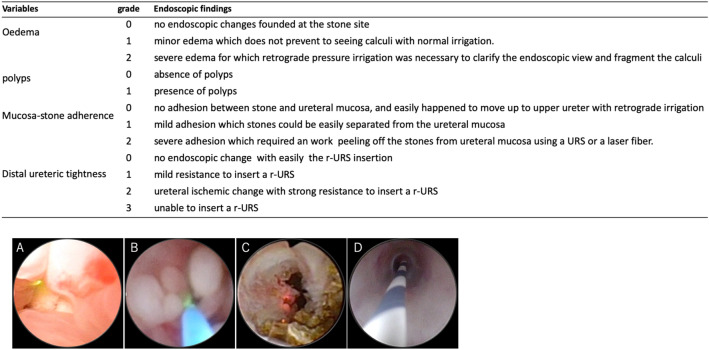
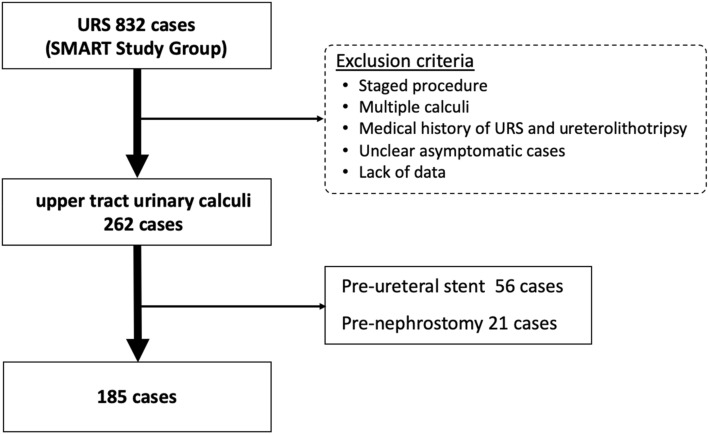
Difficulty in performing ureteroscopic lithotripsy (URSL) depends on endoscopic findings surrounding calculi. In this multicentre prospective cohort study of 185 patients with a single ureteral stone who underwent ureteroscopic lithotripsy registered in the SMART study between January 2014 and February 2017, we established a classification of endoscopic findings and analysed risk factors for ureteral changes. We evaluated endoscopic findings (oedema, polyps, ureteral mucosa-stone adherence, and distal ureteric tightness) based on the SMART classification. Operative time and ureteral injuries were significantly correlated with endoscopic finding grades. Multivariate analyses revealed that mucosa-stone adherence (MSA) was strongly affected by hydronephrosis grade (odds ratio, 12.4; p = 0.022) and the interval before surgery (odds ratio, 1.10; p = 0.012). The cutoff value for MSA was 98 days, with a predictive accuracy of 0.78. Risk factors for distal ureteric tightness were age (odds ratio, 0.96; p = 0.004) and early intervention (odds ratio, 0.90; p = 0.023). The cutoff value was 34 days, with a predictive accuracy of 0.72. In conclusion, appropriate intervention around 34 days (limited to 98 days) after symptom onset is necessary for treating ureteral calculi. Even if intervention passed 98 days post-symptom onset, staged URSL, alternative procedures, and detailed informed consent should be planned in advance, assuming strong MSA.
输尿管镜碎石术 (URSL) 的难度取决于结石周围的内镜发现。在这项纳入了 2014 年 1 月至 2017 年 2 月期间在 SMART 研究中登记的 185 例单发输尿管结石患者的多中心前瞻性队列研究中,我们建立了一种内镜发现分类,并分析了输尿管变化的危险因素。我们根据 SMART 分类评估了内镜发现(水肿、息肉、输尿管黏膜-结石粘连和输尿管下段狭窄)。手术时间和输尿管损伤与内镜发现分级显著相关。多变量分析显示,黏膜-结石粘连(MSA)强烈受到肾积水分级(优势比,12.4;p=0.022)和术前间隔时间(优势比,1.10;p=0.012)的影响。MSA 的截止值为 98 天,预测准确率为 0.78。输尿管下段狭窄的危险因素为年龄(优势比,0.96;p=0.004)和早期干预(优势比,0.90;p=0.023)。截止值为 34 天,预测准确率为 0.72。总之,在症状出现后 34 天内(最长不超过 98 天)进行适当的干预对于治疗输尿管结石是必要的。即使干预超过症状出现后 98 天,如果存在强烈的 MSA,也应提前计划分期 URSL、替代程序和详细的知情同意。