Physical Chemistry of Biosystems, Institute of Physical Chemistry, University of Heidelberg, 69120, Heidelberg, Germany.
Analytical Science Research Laboratories, Kao Corporation, 1334 Minato, Wakayama, Wakayama Prefecture, 640-8580, Japan.
Sci Rep. 2020 Jul 23;10(1):12302. doi: 10.1038/s41598-020-69064-1.
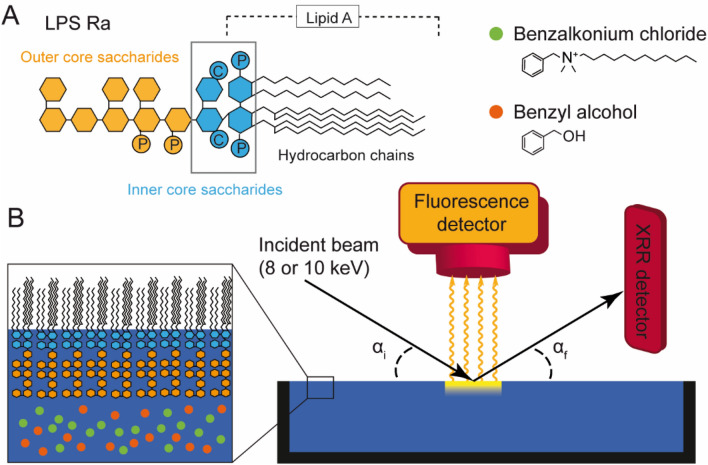
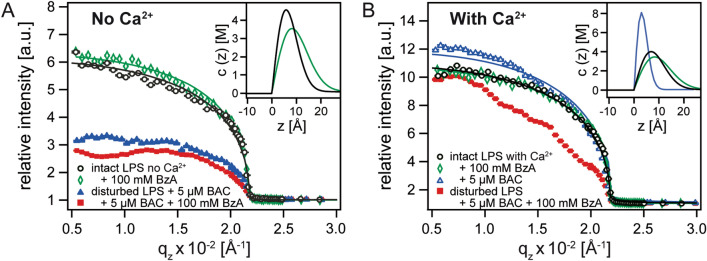
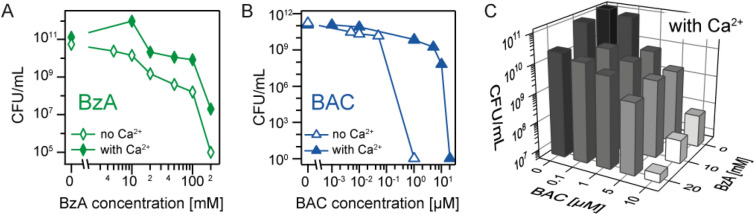
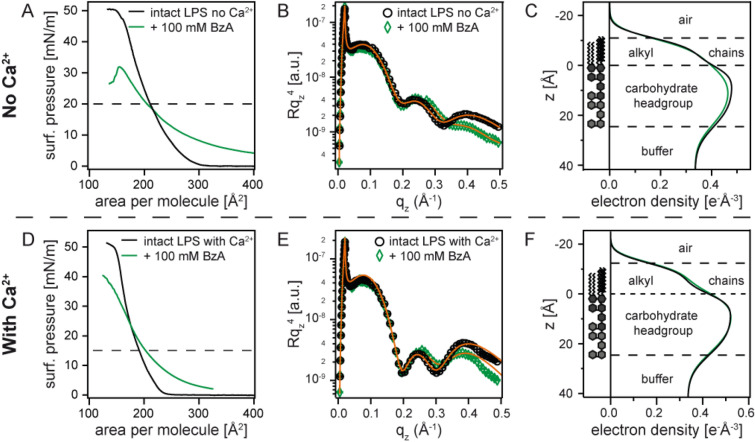
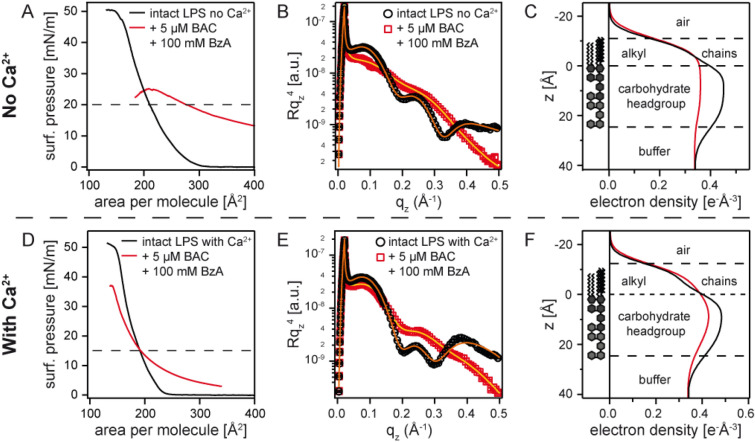
Antimicrobial resistance is a major threat to public health. Although many commercial sanitisers contain a combination of cationic surfactants and aromatic alcohols, the physical mechanisms where these two substances bind to or how they disturb bacterial membranes are still largely unknown. In this study, we designed a well-defined model of Gram-negative bacteria surfaces based on the monolayer of lipopolysaccharides with uniform saccharide head groups. Since commonly used X-ray reflectivity is sensitive to changes in the thickness, roughness and electron density but is not sensitive to elements, we employed grazing incidence X-ray fluorescence. In the absence of Ca, cationic surfactants can penetrate into the membrane core with no extra support by disturbing the layer of K coupled to negatively charged saccharide head group at z = 17 Å from the air/chain interface. On the other hand, Ca confined at z = 19 Å crosslink charged saccharides and prevent the incorporation of cationic surfactants. We found that the addition of nonlethal aromatic alcohols facilitate the incorporation of cationic surfactants by the significant roughening of the chain/saccharide interface. Combination of precise localisation of ions and molecular-level structural analysis quantitatively demonstrated the synegtestic interplay of ingredients to achieve a high antibacterial activity.
抗菌耐药性是公共卫生的主要威胁。尽管许多商业消毒剂都含有阳离子表面活性剂和芳香醇的组合,但这两种物质与细菌结合的物理机制或它们如何干扰细菌膜的机制在很大程度上仍然未知。在这项研究中,我们设计了基于具有均匀糖基头部的脂多糖单层的明确定义的革兰氏阴性细菌表面模型。由于常用的 X 射线反射率对厚度、粗糙度和电子密度的变化敏感,但对元素不敏感,因此我们采用掠入射 X 射线荧光法。在没有 Ca 的情况下,阳离子表面活性剂可以穿透膜核心,无需通过扰乱与空气/链接口处的 z = 17 Å 的带负电荷的糖基头部相连的 K 层来提供额外的支撑。另一方面,Ca 被限制在 z = 19 Å 处交联带电荷的糖,并防止阳离子表面活性剂的掺入。我们发现,添加非致死性芳香醇通过显著粗糙化链/糖界面来促进阳离子表面活性剂的掺入。离子的精确定位和分子水平结构分析的结合定量证明了成分的协同相互作用,以实现高抗菌活性。