Department of Chemistry, Clemson University, Clemson, SC, 29634, USA.
Sci Rep. 2020 Jul 23;10(1):12351. doi: 10.1038/s41598-020-69185-7.
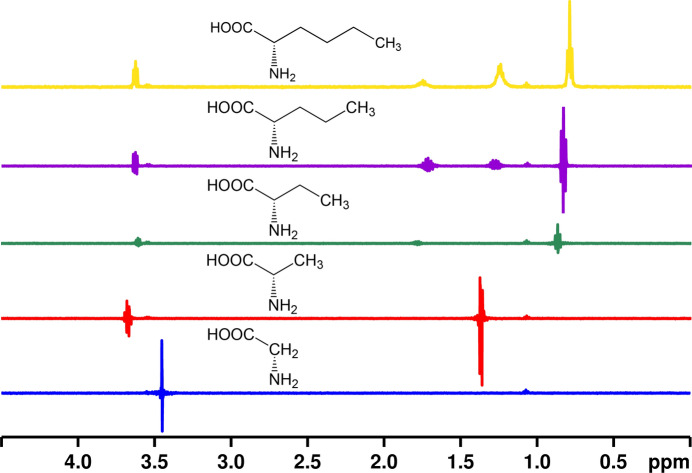
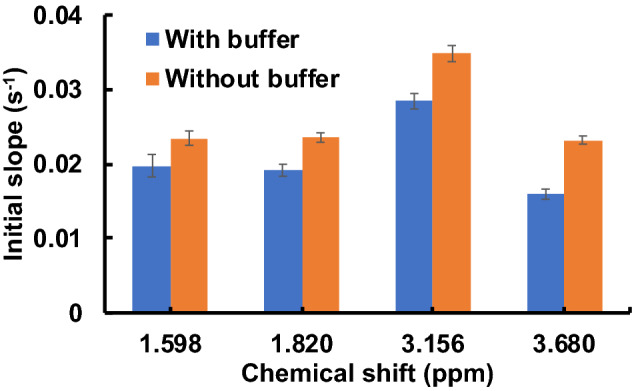
As nanotechnology becomes increasingly used in biomedicine, it is important to have techniques by which to examine the structure and dynamics of biologically-relevant molecules on the surface of engineered nanoparticles. Previous work has shown that Saturation-Transfer Difference (STD)-NMR can be used to explore the interaction between small molecules, including amino acids, and the surface of polystyrene nanoparticles. Here we use STD-NMR to further explore the different driving forces that are responsible for these interactions. Electrostatic effects are probed by using zwitterionic polystyrene beads and performing STD-NMR experiments at high, low, and neutral pH, as well as by varying the salt concentration and observing the effect on the STD buildup curve. The influence of dispersion interactions on ligand-nanoparticle binding is also explored, by establishing a structure-activity relationship for binding using a series of unnatural amino acids with different lengths of hydrophobic side chains. These results will be useful for predicting which residues in a peptide are responsible for binding and for understanding the driving forces for binding between peptides and nanoparticles in future studies.
随着纳米技术在生物医学中的应用越来越广泛,我们需要掌握一些技术,以便在工程纳米粒子的表面上检查与生物相关的分子的结构和动态。先前的工作表明,饱和转移差异(STD)-NMR 可用于探索小分子(包括氨基酸)与聚苯乙烯纳米粒子表面之间的相互作用。在这里,我们使用 STD-NMR 进一步探索了导致这些相互作用的不同驱动力。通过使用两性离子聚苯乙烯珠并在高、低和中性 pH 以及改变盐浓度并观察对 STD 积累曲线的影响来探测静电作用。还通过使用一系列具有不同疏水侧链长度的非天然氨基酸建立结合的结构-活性关系,探索了分散相互作用对配体-纳米粒子结合的影响。这些结果对于预测肽中的哪些残基负责结合以及在未来的研究中理解肽与纳米粒子之间的结合驱动力将非常有用。