Wuhan Center for Disease Control and Prevention, Wuhan, 430024, China.
Wuhan Third Hospital, Tongren Hospital of Wuhan University, Wuhan, 430060, China.
Virol Sin. 2020 Dec;35(6):752-757. doi: 10.1007/s12250-020-00270-x. Epub 2020 Jul 23.
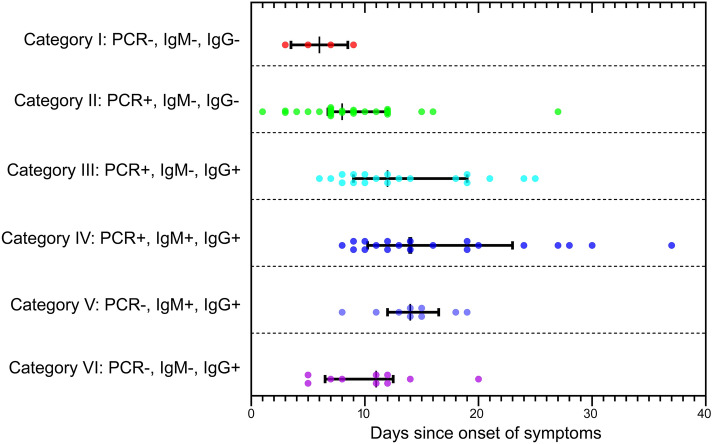
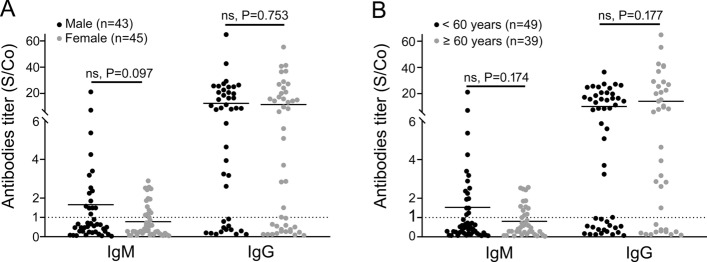
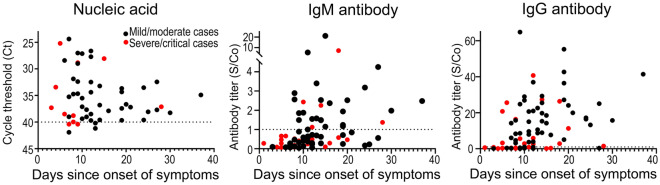
The immense patient number caused by coronavirus disease 2019 (COVID-19) global pandemic brings the urge for more knowledge about its immunological features, including the profile of basic immune parameters. In this study, eighty-eight reported COVID-19 patients in Wuhan were recruited from January to February, 2020, including 32 severe/critical cases and 56 mild/moderate cases. Their mean age was 56.43 years (range 17-83) and gender ratio (male/female) was 43:45. We tested SARS-CoV-2 RNA with commercial kits, investigated the level of serologic IgM and IgG antibodies against severe acute respiratory syndrome coronavirus 2 (SARS-CoV-2) using magnetic particle chemiluminescence immunoassays, and compared the results of serologic tests and nucleic acid test (NAT). Among 88 patients, 95.45% were confirmed as positive by the combination of NAT and antibody test, which was significantly higher (P < 0.001) than by single nucleic acid test (73.86%) or serologic test (65.91%). Then the correlation between temporal profile and the level of antibody response was analyzed. It showed that seroconversion started on day 5 after disease onset and IgG level was rose earlier than IgM. Comparison between patients with different disease severity suggested early seroconversion and high antibody titer were linked with less severe clinical symptoms. These results supported the combination of serologic testing and NAT in routine COVID-19 diagnosis and provided evidence on the temporal profile of antibody response in patients with different disease severity.
2019 年冠状病毒病(COVID-19)全球大流行导致患者数量巨大,这迫切需要更多关于其免疫学特征的知识,包括基本免疫参数的特征。在这项研究中,我们招募了 2020 年 1 月至 2 月期间来自武汉的 88 例确诊 COVID-19 患者,包括 32 例重症/危重症病例和 56 例轻症/普通型病例。他们的平均年龄为 56.43 岁(17-83 岁),性别比(男/女)为 43:45。我们使用商业试剂盒检测 SARS-CoV-2 RNA,使用磁微粒化学发光免疫分析法检测针对严重急性呼吸综合征冠状病毒 2(SARS-CoV-2)的血清 IgM 和 IgG 抗体水平,并比较血清学检测和核酸检测(NAT)的结果。在 88 例患者中,NAT 和抗体联合检测阳性率为 95.45%,明显高于单一核酸检测(73.86%)或血清学检测(65.91%)(P<0.001)。然后分析了抗体反应的时间特征与水平之间的相关性。结果显示,血清学转换始于发病后第 5 天,IgG 水平升高早于 IgM。不同疾病严重程度患者的比较表明,早期血清学转换和高抗体滴度与较轻的临床症状有关。这些结果支持在常规 COVID-19 诊断中联合进行血清学检测和 NAT,并为不同疾病严重程度患者的抗体反应时间特征提供了证据。