Departamento de Inmunología, Instituto Nacional de Cardiología Ignacio Chávez, Ciudad de México, México.
Departamento de Ciencias de La Salud, Universidad Tecnológica de México (UNITEC), Estado de México, Los Reyes, México.
Appl Microbiol Biotechnol. 2023 Apr;107(7-8):2131-2141. doi: 10.1007/s00253-023-12468-6. Epub 2023 Mar 14.
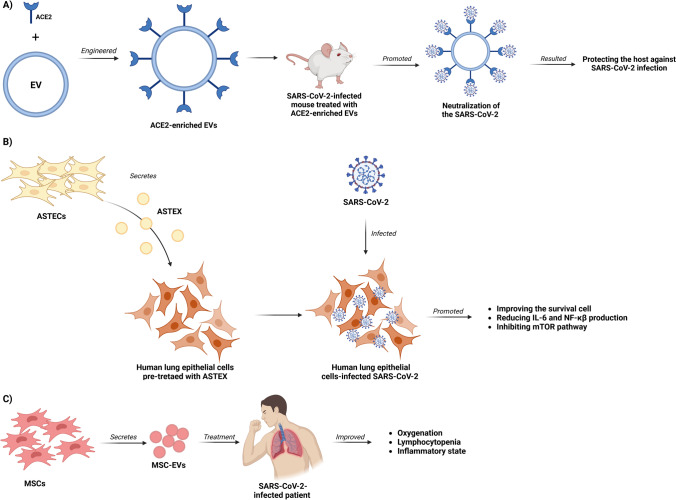
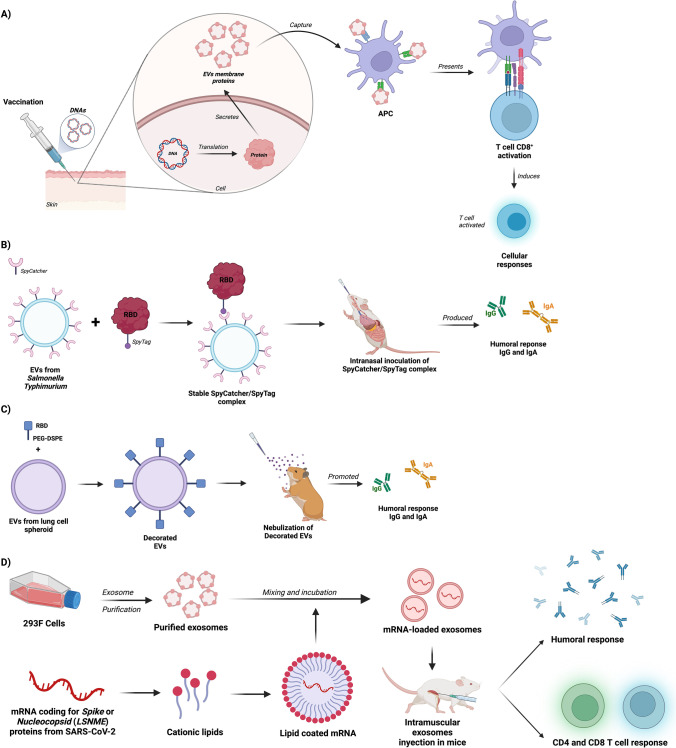
The lethality of the COVID 19 pandemic became the trigger for one of the most meteoric races on record in the search for strategies of disease control. Those include development of rapid and sensitive diagnostic methods, therapies to treat severe cases, and development of anti-SARS-CoV-2 vaccines, the latter responsible for the current relative control of the disease. However, the commercially available vaccines are still far from conferring protection against acquiring the infection, so the development of more efficient vaccines that can cut the transmission of the variants of concerns that currently predominate and those that will emerge is a prevailing need. On the other hand, considering that COVID 19 is here to stay, the development of new diagnosis and treatment strategies is also desirable. In this sense, there has recently been a great interest in taking advantage of the benefits offered by extracellular vesicles (EVs), membrane structures of nanoscale size that carry information between cells participating in this manner in many physiological homeostatic and pathological processes. The interest has been focused on the fact that EVs are relatively easy to obtain and manipulate, allowing the design of natural nanocarriers that deliver molecules of interest, as well as the information about the pathogens, which can be exploited for the aforementioned purposes. Studies have shown that infection with SARS-CoV-2 induces the release of EVs from different sources, including platelets, and that their increase in blood, as well as some of their markers, could be used as a prognosis of disease severity. Likewise, EVs from different sources are being used as the ideal carriers for delivering active molecules and drugs to treat the disease, as well as vaccine antigens. In this review, we describe the progress that has been made in these three years of pandemic regarding the use of EVs for diagnosis, treatment, and vaccination against SARS-CoV-2 infection. KEY POINTS: • Covid-19 still requires more effective and specific treatments and vaccines. • The use of extracellular vesicles is emerging as an option with multiple advantages. • Association of EVs with COVID 19 and engineered EVs for its control are presented.
新型冠状病毒肺炎(COVID-19)疫情的致死性成为人们寻找疾病控制策略的最迅速的竞赛之一的触发因素。这些策略包括开发快速和敏感的诊断方法、治疗严重病例的疗法,以及开发抗严重急性呼吸综合征冠状病毒 2(SARS-CoV-2)疫苗,后者负责目前对该疾病的相对控制。然而,商业上可用的疫苗仍远不能提供预防感染的保护,因此,开发更有效的疫苗,以减少目前占主导地位和即将出现的关注变体的传播,是一个迫切的需求。另一方面,考虑到 COVID-19 将长期存在,开发新的诊断和治疗策略也是可取的。在这方面,最近人们对利用细胞外囊泡(EVs)的优势产生了极大的兴趣,EVs 是纳米级大小的膜结构,通过这种方式在许多生理稳态和病理过程中在细胞之间传递信息。这种兴趣集中在 EVs 相对容易获得和操作的事实,允许设计天然纳米载体,递呈感兴趣的分子,以及关于病原体的信息,这些信息可以用于上述目的。研究表明,SARS-CoV-2 感染会诱导不同来源的 EVs 的释放,包括血小板,并且它们在血液中的增加以及它们的一些标志物可以被用作疾病严重程度的预后。同样,来自不同来源的 EVs 正在被用作递呈活性分子和药物以治疗疾病以及疫苗抗原的理想载体。在这篇综述中,我们描述了在 COVID-19 大流行的这三年中,在使用 EVs 进行 SARS-CoV-2 感染的诊断、治疗和疫苗接种方面取得的进展。
COVID-19 仍需要更有效和更具特异性的治疗方法和疫苗。
细胞外囊泡的使用作为具有多种优势的选择正在出现。
提出了 EVs 与 COVID-19 的关联和用于控制 COVID-19 的工程化 EVs。