University of Maryland School of Public Health, Maryland Institute for Applied Environmental Health, College Park, MD, USA.
Division of Epidemiology and Public Heath, Health Protection and Influenza Research Group, University of Nottingham School of Medicine, Nottingham, UK.
Influenza Other Respir Viruses. 2021 Jan;15(1):154-163. doi: 10.1111/irv.12790. Epub 2020 Jul 23.
It has long been known that nasal inoculation with influenza A virus produces asymptomatic to febrile infections. Uncertainty persists about whether these infections are sufficiently similar to natural infections for studying human-to-human transmission.
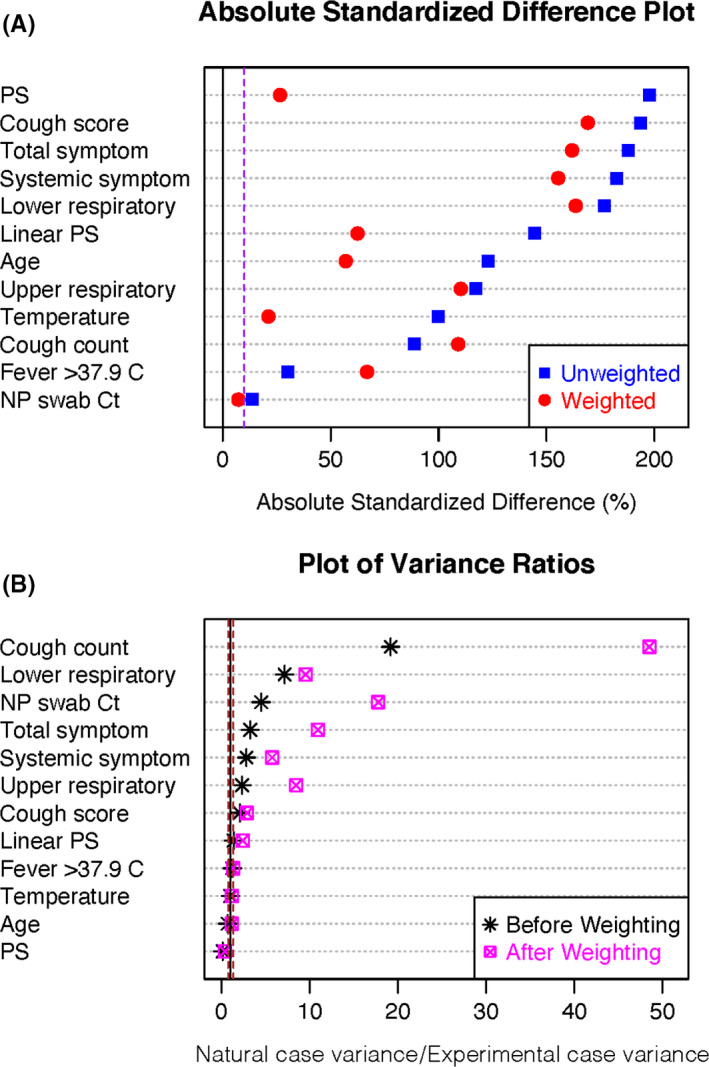
We compared influenza A viral aerosol shedding from volunteers nasally inoculated with A/Wisconsin/2005 (H3N2) and college community adults naturally infected with influenza A/H3N2 (2012-2013), selected for influenza-like illness with objectively measured fever or a positive Quidel QuickVue A&B test. Propensity scores were used to control for differences in symptom presentation observed between experimentally and naturally infected groups.
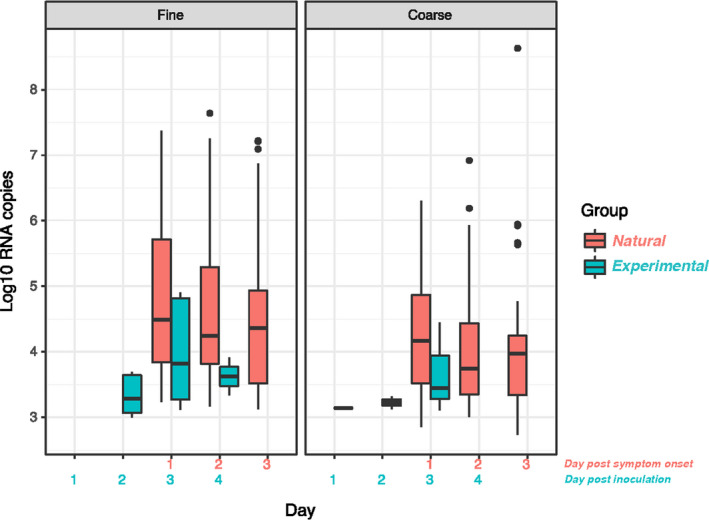
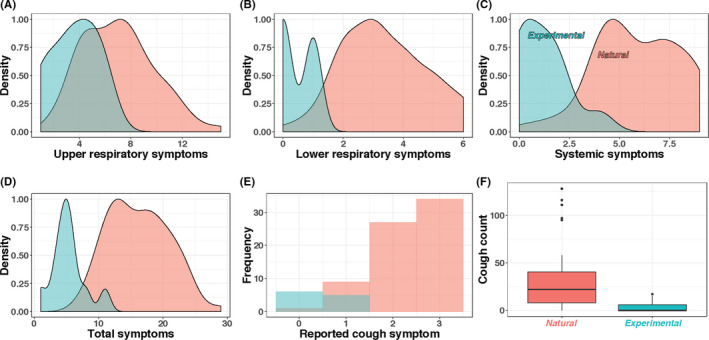
Eleven (28%) experimental and 71 (86%) natural cases shed into fine particle aerosols (P < .001). The geometric mean (geometric standard deviation) for viral positive fine aerosol samples from experimental and natural cases was 5.1E + 3 (4.72) and 3.9E + 4 (15.12) RNA copies/half hour, respectively. The 95th percentile shedding rate was 2.4 log greater for naturally infected cases (1.4E + 07 vs 7.4E + 04). Certain influenza-like illness-related symptoms were associated with viral aerosol shedding. The almost complete lack of symptom severity distributional overlap between groups did not support propensity score-adjusted shedding comparisons.
Due to selection bias, the natural and experimental infections had limited symptom severity distributional overlap precluding valid, propensity score-adjusted comparison. Relative to the symptomatic naturally infected cases, where high aerosol shedders were found, experimental cases did not produce high aerosol shedders. Studying the frequency of aerosol shedding at the highest observed levels in natural infections without selection on symptoms or fever would support helpful comparisons.
长期以来,人们已经知道,鼻腔接种甲型流感病毒会导致无症状至发热感染。但对于这些感染是否与自然感染足够相似,从而能够用于研究人际传播,仍存在不确定性。
我们比较了鼻腔接种 A/Wisconsin/2005(H3N2)的志愿者与自然感染甲型 H3N2(2012-2013 年)的大学生社区成人之间的甲型流感病毒气溶胶脱落情况。选择具有客观测量发热或阳性 Quidel QuickVue A&B 检测结果的流感样疾病患者。使用倾向评分来控制实验组和自然感染组之间观察到的症状表现差异。
11 例(28%)实验组和 71 例(86%)自然感染病例向细颗粒气溶胶中排出病毒(P<0.001)。实验组和自然感染病例的病毒阳性细气溶胶样本的几何平均值(几何标准差)分别为 5.1E+3(4.72)和 3.9E+4(15.12)RNA 拷贝/半小时。自然感染病例的脱落率高 95%位为 2.4 对数级(1.4E+07 与 7.4E+04)。某些流感样疾病相关症状与病毒气溶胶脱落有关。两组之间的症状严重程度分布几乎没有重叠,这并不支持经过倾向评分调整后的脱落比较。
由于选择偏倚,自然感染和实验感染在症状严重程度分布上存在局限性重叠,无法进行有效的、经过倾向评分调整后的比较。与症状明显的自然感染病例相比,实验组未产生高气溶胶脱落者。在没有选择症状或发热的情况下,研究自然感染中最高观察水平的气溶胶脱落频率,将有助于进行有价值的比较。