UCL Research Department of Infection and Population Health, University College London, London, UK.
UCL Research Department of Infection and Population Health, University College London, London, UK; Department of Infectious Disease Epidemiology, London School of Hygiene & Tropical Medicine, London, UK.
Lancet Respir Med. 2014 Jun;2(6):445-54. doi: 10.1016/S2213-2600(14)70034-7. Epub 2014 Mar 17.
Assessment of the effect of influenza on populations, including risk of infection, illness if infected, illness severity, and consultation rates, is essential to inform future control and prevention. We aimed to compare the community burden and severity of seasonal and pandemic influenza across different age groups and study years and gain insight into the extent to which traditional surveillance underestimates this burden.
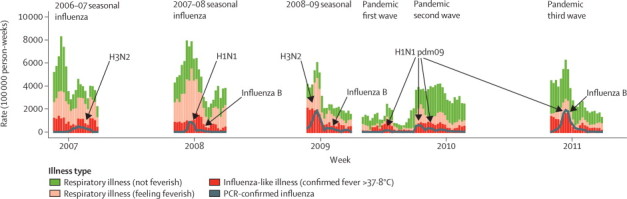
Using preseason and postseason serology, weekly illness reporting, and RT-PCR identification of influenza from nasal swabs, we tracked the course of seasonal and pandemic influenza over five successive cohorts (England 2006-11; 5448 person-seasons' follow-up). We compared burden and severity of seasonal and pandemic strains. We weighted analyses to the age and regional structure of England to give nationally representative estimates. We compared symptom profiles over the first week of illness for different strains of PCR-confirmed influenza and non-influenza viruses using ordinal logistic regression with symptom severity grade as the outcome variable.
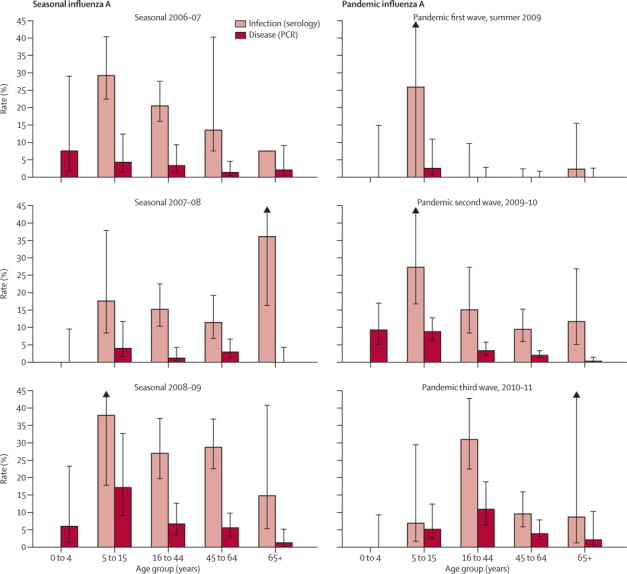
Based on four-fold titre rises in strain-specific serology, on average influenza infected 18% (95% CI 16-22) of unvaccinated people each winter. Of those infected there were 69 respiratory illnesses per 100 person-influenza-seasons compared with 44 per 100 in those not infected with influenza. The age-adjusted attributable rate of illness if infected was 23 illnesses per 100 person-seasons (13-34), suggesting most influenza infections are asymptomatic. 25% (18-35) of all people with serologically confirmed infections had PCR-confirmed disease. 17% (10-26) of people with PCR-confirmed influenza had medically attended illness. These figures did not differ significantly when comparing pandemic with seasonal influenza. Of PCR-confirmed cases, people infected with the 2009 pandemic strain had markedly less severe symptoms than those infected with seasonal H3N2.
Seasonal influenza and the 2009 pandemic strain were characterised by similar high rates of mainly asymptomatic infection with most symptomatic cases self-managing without medical consultation. In the community the 2009 pandemic strain caused milder symptoms than seasonal H3N2.
Medical Research Council and the Wellcome Trust.
评估流感对人群的影响,包括感染风险、感染后的发病情况、疾病严重程度和就诊率,对于指导未来的防控措施至关重要。本研究旨在比较不同年龄组和研究年份季节性流感和大流行流感的疾病负担和严重程度,并深入了解传统监测方法对这一负担的低估程度。
本研究使用 preseason和postseason 血清学检测、每周的疾病报告以及鼻拭子的 RT-PCR 检测,对五个连续队列(英格兰 2006-2011 年;5448 人-季节随访)中季节性和大流行流感的发病情况进行了跟踪。我们比较了季节性和大流行流感毒株的疾病负担和严重程度。我们对分析结果进行了加权处理,使其能够代表英格兰的年龄和地区结构。我们使用有序逻辑回归,以症状严重程度等级为因变量,比较了不同 PCR 确诊的流感和非流感病毒引起的症状在前一周的差异。
基于针对特定毒株的四倍血清学滴度升高,每年冬季约有 18%(95%CI 16-22)的未接种疫苗者感染流感。在感染人群中,每 100 个人-流感季节中发生 69 例呼吸道疾病,而未感染流感的人群中则为 44 例。感染后调整年龄的发病率为 23 例/100 人-季节(13-34),表明大多数流感感染为无症状感染。在所有血清学确诊的感染者中,有 25%(18-35)的人经 PCR 确诊患有疾病。17%(10-26)的 PCR 确诊流感患者因病就诊。在比较大流行流感和季节性流感时,这些数字并没有显著差异。在 PCR 确诊的病例中,感染 2009 年大流行株的患者症状明显较轻,而感染季节性 H3N2 的患者症状则较重。
季节性流感和 2009 年大流行株的特点均为主要为无症状感染,感染率高,大多数有症状的患者无需医疗咨询即可自行管理。在社区中,2009 年大流行株引起的症状较轻,而季节性 H3N2 则较严重。
医学研究理事会和惠康信托基金会。