Goto Taichiro
Lung Cancer and Respiratory Disease Center, Yamanashi Central Hospital, Kofu, Yamanashi 4008506, Japan.
J Pers Med. 2020 Jul 18;10(3):64. doi: 10.3390/jpm10030064.
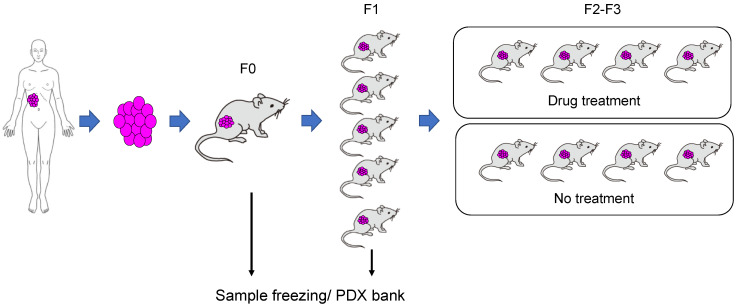
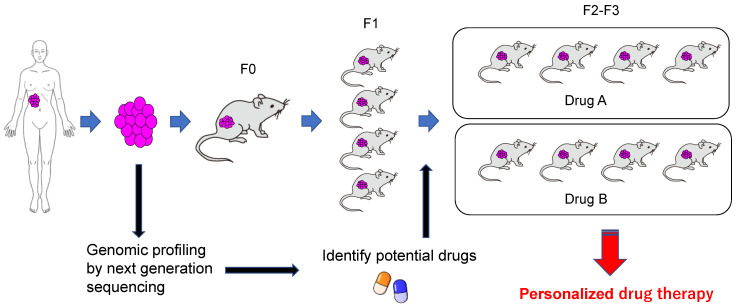
Patient-derived xenografts (PDXs) describe models involving the implantation of patient-derived tumor tissue into immunodeficient mice. Compared with conventional preclinical models involving the implantation of cancer cell lines into mice, PDXs can be characterized by the preservation of tumor heterogeneity, and the tumor microenvironment (including stroma/vasculature) more closely resembles that in patients. Consequently, the use of PDX models has improved the predictability of clinical therapeutic responses to 80% or greater, compared with approximately 5% for existing models. In the future, molecular biological analyses, omics analyses, and other experiments will be conducted using recently prepared PDX models under the strong expectation that the analysis of cancer pathophysiology, stem cells, and novel treatment targets and biomarkers will be improved, thereby promoting drug development. This review outlines the methods for preparing PDX models, advances in cancer research using PDX mice, and perspectives for the establishment of precision cancer medicine within the framework of personalized cancer medicine.
患者来源的异种移植模型(PDXs)是指将患者来源的肿瘤组织植入免疫缺陷小鼠体内的模型。与将癌细胞系植入小鼠体内的传统临床前模型相比,PDXs的特点是能够保留肿瘤异质性,其肿瘤微环境(包括基质/脉管系统)与患者体内的更为相似。因此,与现有模型约5%的临床治疗反应预测率相比,PDX模型的使用已将临床治疗反应的可预测性提高到80%或更高。未来,将使用最近制备的PDX模型进行分子生物学分析、组学分析及其他实验,人们强烈期望借此改善对癌症病理生理学、干细胞以及新型治疗靶点和生物标志物的分析,从而推动药物研发。本综述概述了制备PDX模型的方法、使用PDX小鼠进行癌症研究的进展,以及在个性化癌症医学框架内建立精准癌症医学的前景。