Division of Gynecologic Oncology, Department of Obstetrics and Gynecology University of Minnesota, Minneapolis, MN, USA.
Kelly Gynecologic Oncology Service, Department of Gynecology and Obstetrics, Johns Hopkins School of Medicine, Baltimore, MD, USA.
Gynecol Oncol. 2020 Oct;159(1):17-22. doi: 10.1016/j.ygyno.2020.07.016. Epub 2020 Jul 21.
Human epidermal growth factor receptor 2 (HER2) has emerged as an important prognostic and therapeutic target in advanced stage and recurrent uterine serous carcinoma (USC). The significance of tumoral HER2 expression in early-stage disease has not been established.
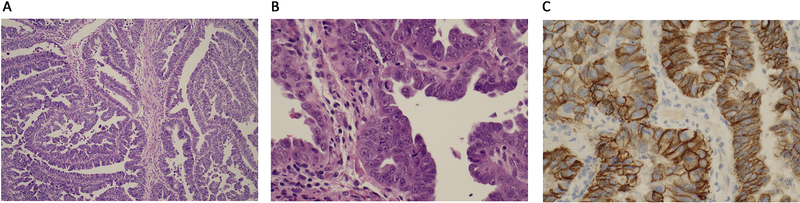
This multi-center cohort study included women with stage I USC treated from 2000 to 2019. Demographic, treatment, recurrence, and survival data were collected. Immunohistochemistry (IHC) was performed for HER2 and scored 0-3+. Equivocal IHC results (2+) were further tested with fluorescence in-situ hybridization (FISH). HER2 positivity was defined as 3+ IHC or FISH positive.
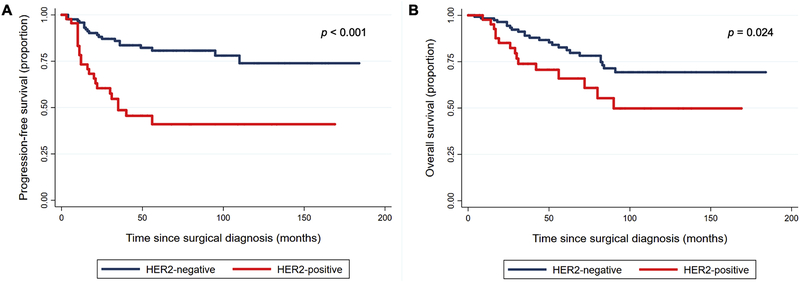
One hundred sixty-nine patients with stage I USC were tested for HER2; 26% were HER2-positive. There were no significant differences in age, race, stage, adjuvant therapy, or follow-up duration between the HER2-positive and negative cohorts. Presence of lymph-vascular space invasion was correlated with HER2-positive tumors (p = .003). After a median follow-up of 50 months, there were 43 (25.4%) recurrences. There were significantly more recurrences in the HER2-positive cohort (50.0% vs 16.8%, p < .001). HER2 positive tumors were associated with worse progression-free (PFS) and overall survival (OS) (p < .001 and p = .024). On multivariate analysis, HER2 positive tumors were associated with inferior PFS (aHR 3.50, 95%CI 1.84-6.67; p < .001) and OS (aHR 2.00, 95%CI 1.04-3.88; p = .039) compared to HER2-negative tumors.
Given its significant association with worse recurrence and survival outcomes, HER2 positivity appears to be a prognostic biomarker in women with stage I uterine serous carcinoma. These data provide support for clinical trials with anti-HER2-directed therapy in early-stage disease.
人表皮生长因子受体 2(HER2)已成为晚期和复发性子宫浆液性癌(USC)的重要预后和治疗靶点。肿瘤 HER2 表达在早期疾病中的意义尚未确定。
本多中心队列研究纳入了 2000 年至 2019 年期间接受治疗的 I 期 USC 女性患者。收集了人口统计学、治疗、复发和生存数据。进行了 HER2 的免疫组织化学(IHC)检测,并评分 0-3+。IHC 结果不确定(2+)的进一步进行荧光原位杂交(FISH)检测。HER2 阳性定义为 3+ IHC 或 FISH 阳性。
169 例 I 期 USC 患者进行了 HER2 检测;26%为 HER2 阳性。HER2 阳性和阴性队列在年龄、种族、分期、辅助治疗和随访时间方面无显著差异。存在淋巴血管空间侵犯与 HER2 阳性肿瘤相关(p=0.003)。中位随访 50 个月后,有 43 例(25.4%)复发。HER2 阳性组的复发率明显更高(50.0% vs 16.8%,p<0.001)。HER2 阳性肿瘤与无进展生存期(PFS)和总生存期(OS)较差相关(p<0.001 和 p=0.024)。多变量分析显示,与 HER2 阴性肿瘤相比,HER2 阳性肿瘤与较差的 PFS(aHR 3.50,95%CI 1.84-6.67;p<0.001)和 OS(aHR 2.00,95%CI 1.04-3.88;p=0.039)相关。
鉴于其与复发和生存结果的显著相关性,HER2 阳性似乎是 I 期子宫浆液性癌患者的预后生物标志物。这些数据为早期疾病中使用抗 HER2 靶向治疗的临床试验提供了支持。