Department of Gynecology, National Cancer Center Hospital, Tokyo, Japan.
Department of Pathology and Clinical Laboratories, National Cancer Center Hospital, Tokyo, Japan.
J Gynecol Oncol. 2018 May;29(3):e34. doi: 10.3802/jgo.2018.29.e34. Epub 2018 Feb 19.
Uterine serous carcinoma (USC) is an aggressive type 2 endometrial cancer. Data on prognostic factors for patients with early-stage USC without adjuvant therapy are limited. This study aims to assess the baseline recurrence risk of early-stage USC patients without adjuvant treatment and to identify prognostic factors and patients who need adjuvant therapy.
Sixty-eight patients with International Federation of Gynecology and Obstetrics (FIGO) stage I-II USC between 1997 and 2016 were included. All the cases did not undergo adjuvant treatment as institutional practice. Clinicopathological features, recurrence patterns, and survival outcomes were analyzed to determine prognostic factors.
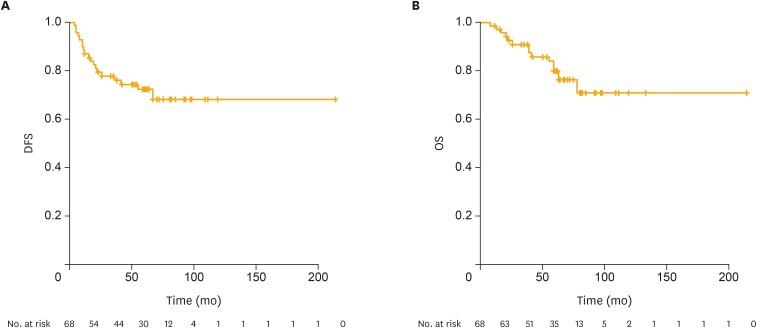
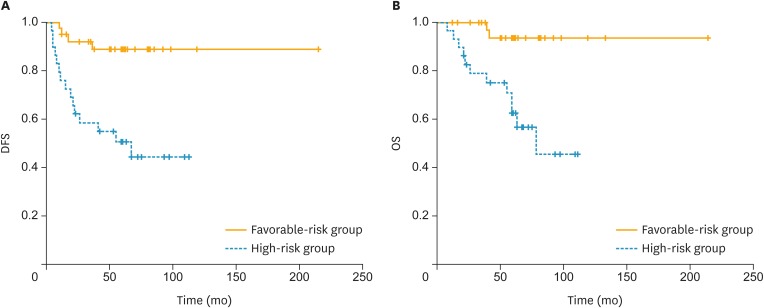
FIGO stages IA, IB, and II were observed in 42, 7, and 19 cases, respectively. Median follow-up time was 60 months. Five-year disease-free survival (DFS) and overall survival (OS) rates for all cases were 73.9% and 78.0%, respectively. On multivariate analysis, cervical stromal involvement and positive pelvic cytology were significant predictors of DFS and OS, and ≥1/2 myometrial invasion was also a significant predictor of OS. Of 68 patients, 38 patients had no cervical stromal invasion or positive pelvic cytology and showed 88.8% 5-year DFS and 93.6% 5-year OS.
Cervical stromal invasion and positive pelvic cytology are prognostic factors for stage I-II USC. Patients with stage IA or IB USC showing negative pelvic cytology may have an extremely favorable prognosis and need not receive any adjuvant therapies.
子宫浆液性癌(USC)是一种侵袭性的 2 型子宫内膜癌。缺乏辅助治疗的早期 USC 患者的预后因素数据有限。本研究旨在评估早期 USC 患者在未接受辅助治疗时的基线复发风险,并确定预后因素和需要辅助治疗的患者。
纳入 1997 年至 2016 年间的 68 例国际妇产科联合会(FIGO)I 期-II 期 USC 患者。所有病例均未按照机构惯例接受辅助治疗。分析临床病理特征、复发模式和生存结局,以确定预后因素。
FIGO 分期为 IA、IB 和 II 期的患者分别为 42、7 和 19 例。中位随访时间为 60 个月。所有病例的 5 年无病生存率(DFS)和总生存率(OS)分别为 73.9%和 78.0%。多因素分析显示,宫颈间质受累和盆腔细胞学阳性是 DFS 和 OS 的显著预测因素,≥1/2 肌层浸润也是 OS 的显著预测因素。在 68 例患者中,38 例无宫颈间质浸润或盆腔细胞学阳性,5 年 DFS 率为 88.8%,5 年 OS 率为 93.6%。
宫颈间质浸润和盆腔细胞学阳性是 I 期-II 期 USC 的预后因素。表现为盆腔细胞学阴性的 IA 期或 IB 期 USC 患者可能具有极好的预后,无需接受任何辅助治疗。