Rudolph Tanja K, Messika-Zeitoun David, Frey Norbert, Thambyrajah Jeetendra, Serra Antonio, Schulz Eberhard, Maly Jiri, Aiello Marco, Lloyd Guy, Bortone Alessandro Santo, Clerici Alberto, Delle-Karth Georg, Rieber Johannes, Indolfi Ciro, Mancone Massimo, Belle Loic, Lauten Alexander, Arnold Martin, Bouma Berto J, Lutz Matthias, Deutsch Cornelia, Kurucova Jana, Thoenes Martin, Bramlage Peter, Steeds Richard P
Department of Cardiology, Heart and Diabetes Center Bad Oeynhausen, Ruhr-University of Bochum, Bad Oeynhausen, Germany
University of Ottawa Heart Institute, Ottawa, Ontario, Canada.
Open Heart. 2020 Jul;7(2). doi: 10.1136/openhrt-2020-001271.
Contemporary data regarding the impact of comorbidities on the clinical presentation and management of patients with severe aortic stenosis (AS) are scarce.
Prospective registry of severe patients with AS across 23 centres in nine European countries.
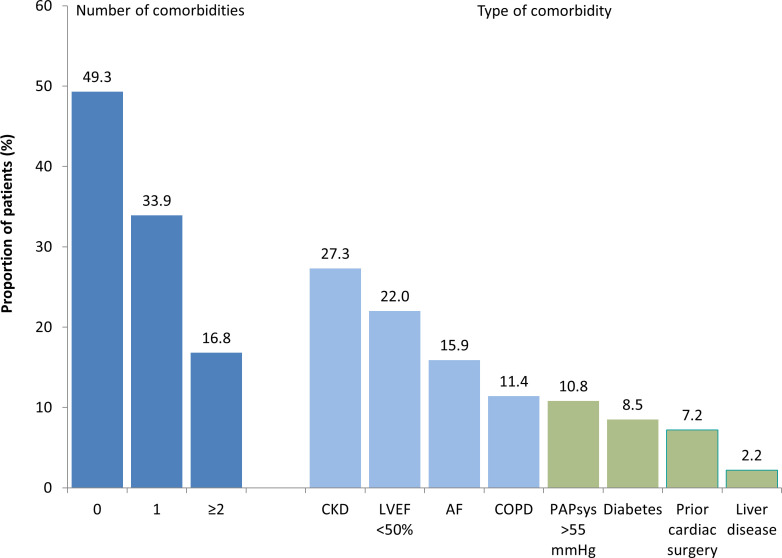
Of the 2171 patients, chronic kidney disease (CKD 27.3%), left ventricular ejection fraction (LVEF) <50% (22.0%), atrial fibrillation (15.9%) and chronic obstructive pulmonary disease (11.4%) were the most prevalent comorbidities (49.3% none, 33.9% one and 16.8% ≥2 of these). The decision to perform aortic valve replacement (AVR) was taken in a comparable proportion (67%, 72% and 69%, in patients with 0, 1 and ≥2 comorbidities; p=0.186). However, the decision for TAVI was more common with more comorbidities (35.4%, 54.0% and 57.0% for no, 1 and ≥2; p<0.001), while the decision for surgical AVR (SAVR) was decreased with increasing comorbidity burden (31.9%, 17.4% and 12.3%; p<0.001). The proportion of patients with planned AVRs that were performed within 3 months was significantly higher in patients with 1 or ≥2 comorbidities than in those without (8.7%, 10.0% and 15.7%; p<0.001). Furthermore, the mean time to AVR was significantly shorter in patients with one (30.5 days) or ≥2 comorbidities (30.8 days) than in those without (35.7 days; p=0.012). Patients with reduced LVEF tended to be offered an AVR more frequently and with a shorter delay while patients with CKD were less frequently treated.
Comorbidities in severe patients with AS affect the presentation and management of patients with severe AS. TAVI was offered more often than SAVR and performed within a shorter time period.
关于合并症对重度主动脉瓣狭窄(AS)患者临床表现及治疗影响的当代数据较少。
对9个欧洲国家23个中心的重度AS患者进行前瞻性登记。
在2171例患者中,慢性肾脏病(CKD,27.3%)、左心室射血分数(LVEF)<50%(22.0%)、心房颤动(15.9%)和慢性阻塞性肺疾病(11.4%)是最常见的合并症(49.3%无合并症,33.9%有一种合并症,16.8%有≥2种合并症)。进行主动脉瓣置换术(AVR)的决策比例相当(无合并症、有一种合并症和有≥2种合并症的患者分别为67%、72%和69%;p = 0.186)。然而,合并症越多,经导管主动脉瓣置入术(TAVI)的决策越常见(无合并症、有一种合并症和有≥2种合并症的患者分别为35.4%、54.0%和57.0%;p<0.001),而外科主动脉瓣置换术(SAVR)的决策则随着合并症负担的增加而减少(分别为31.9%、17.4%和12.3%;p<0.001)。有1种或≥2种合并症的计划进行AVR的患者在3个月内进行手术的比例显著高于无合并症的患者(分别为8.7%、10.0%和15.7%;p<0.001)。此外,有一种合并症(30.5天)或≥种合并症(30.8天)的患者进行AVR的平均时间显著短于无合并症的患者(35.7天;p = 0.012)。LVEF降低的患者更常接受AVR且延迟时间更短,而CKD患者接受治疗的频率较低。
重度AS患者的合并症会影响重度AS患者的临床表现及治疗。TAVI的实施频率高于SAVR,且手术时间更短。