School of Life Sciences and Tsinghua-Peking Center for Life Sciences, Tsinghua University, Beijing, China.
Department of Etiology and Carcinogenesis, National Cancer Center/Cancer Hospital, Chinese Academy of Medical Sciences (CAMS) and Peking Union Medical College (PUMC), Beijing, China.
Nat Commun. 2020 Jul 24;11(1):3715. doi: 10.1038/s41467-020-17492-y.
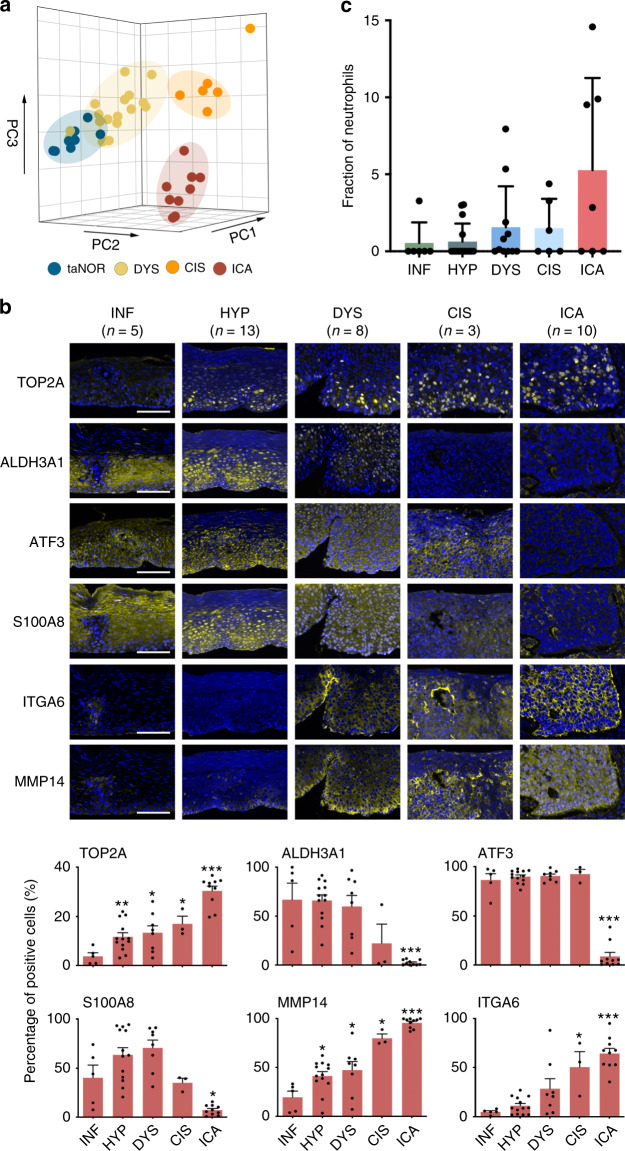
Esophageal squamous cell carcinoma (ESCC) is prevalent in some geographical regions of the world. ESCC development presents a multistep pathogenic process from inflammation to invasive cancer; however, what is critical in these processes and how they evolve is largely unknown, obstructing early diagnosis and effective treatment. Here, we create a mouse model mimicking human ESCC development and construct a single-cell ESCC developmental atlas. We identify a set of key transitional signatures associated with oncogenic evolution of epithelial cells and depict the landmark dynamic tumorigenic trajectories. An early downregulation of CD8 response against the initial tissue damage accompanied by the transition of immune response from type 1 to type 3 results in accumulation and activation of macrophages and neutrophils, which may create a chronic inflammatory environment that promotes carcinogen-transformed epithelial cell survival and proliferation. These findings shed light on how ESCC is initiated and developed.
食管鳞状细胞癌(ESCC)在世界上的一些地区较为常见。ESCC 的发展呈现出从炎症到浸润性癌症的多步骤发病过程;然而,这些过程中的关键因素以及它们的演变方式在很大程度上仍是未知的,这阻碍了早期诊断和有效治疗。在这里,我们创建了一个模拟人类 ESCC 发展的小鼠模型,并构建了一个单细胞 ESCC 发育图谱。我们鉴定了一组与上皮细胞致癌进化相关的关键过渡特征,并描绘了标志性的肿瘤发生轨迹。最初组织损伤引发的 CD8 反应的早期下调,伴随着免疫反应从 1 型向 3 型的转变,导致巨噬细胞和中性粒细胞的积累和激活,这可能会产生一个慢性炎症环境,促进致癌转化的上皮细胞的存活和增殖。这些发现揭示了 ESCC 的发生和发展机制。